RCIS Exam Questions and Answers
If you want to know what RCIS exam questions actually look like — how many there are, which topics get tested hardest, and how to reason through a tricky waveform or calculation — this guide walks you through the real question types with worked examples and rationales, so nothing on test day feels unfamiliar.
- What the RCIS exam actually covers
- How many questions are on the RCIS exam?
- The main topics tested (and their weight)
- Sample hemodynamics questions with rationale
- Reading pressure waveforms under exam conditions
- Sample ECG and rhythm questions with rationale
- Pharmacology, procedures, and equipment questions
- How to study smart for RCIS exam questions
- Key takeaways
What the RCIS exam actually covers
The Registered Cardiovascular Invasive Specialist (RCIS) exam, administered by Cardiovascular Credentialing International (CCI), tests whether you can safely and competently function in an invasive cardiovascular lab. That is a broad mandate, and the questions reflect it. You will be asked about anatomy and physiology, hemodynamics, ECG interpretation, pharmacology, radiation safety, procedural steps, equipment, and patient assessment — all in the context of real cath-lab work.
Because the exam is competency-based, most questions are not simple recall. They hand you a scenario — a pressure tracing, a set of vitals, a rhythm strip, a medication order — and ask what it means or what you should do next. The single most valuable thing you can do in preparation is stop memorizing isolated facts and start practicing the reasoning that connects them. Our hemodynamics study guide, ECG study guide, and cardiac anatomy guide are built around exactly that habit.
This article is educational and is not medical advice. Clinical thresholds and protocols vary by institution and evolve with current guidelines; always follow your local policy and the most recent published standards.
How many questions are on the RCIS exam?
The RCIS exam currently contains a set number of multiple-choice questions delivered in a fixed time window at a Pearson VUE testing center. CCI structures the test with a bank of scored questions plus a smaller number of unscored pilot questions that are being trialed for future exams. You are not told which is which, so you treat every question as if it counts.
The exact count and time limit are published by CCI and can be adjusted, so always confirm the current numbers on the official CCI candidate handbook rather than trusting a figure you read in a forum. As a planning rule of thumb, candidates generally have a little over a minute per question — enough time to read carefully, but not enough to agonize. Pacing matters: flag the ones you are unsure of, answer everything (there is no penalty for guessing on a scored item you cannot deduce), and circle back.
The main topics tested (and their weight)
CCI publishes a content outline with weighted domains, and while the exact percentages shift between exam versions, the relative emphasis is stable. Hemodynamics and physiological monitoring, procedural knowledge, and patient care consistently carry the most weight. Here is a practical breakdown of the topics tested and how heavily they tend to show up.
| Domain | Typical emphasis | What it looks like on the exam |
|---|---|---|
| Hemodynamics & monitoring | High | Pressure waveforms, cardiac output, resistance calculations, shunt runs |
| ECG & arrhythmias | High | Rhythm identification, blocks, ischemia patterns, lethal rhythms |
| Anatomy & physiology | Moderate–High | Coronary anatomy, chambers, valves, conduction pathway |
| Pharmacology | Moderate | Anticoagulants, vasoactive drugs, contrast, emergency meds |
| Procedures & equipment | Moderate | Catheter selection, sheath management, device basics |
| Radiation safety & QA | Lower | ALARA, shielding, dose concepts, sterile technique |
Notice that two clusters — hemodynamics and ECG — dominate. If your study time is limited, front-load those. You can rehearse both with our timed banks for hemodynamics practice questions, ECG practice questions, and rhythm-strip drills.
Sample hemodynamics questions with rationale
Hemodynamics questions reward a working feel for numbers, not just memorized formulas. Expect to calculate cardiac output, cardiac index, and vascular resistance, and to read pressure tracings. Let's work two examples the way you should on test day.
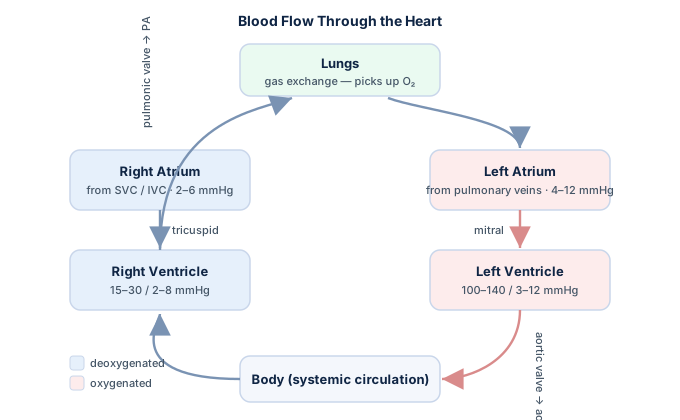
Example 1 — Cardiac index. A patient has a cardiac output of 4.0 L/min and a body surface area of 2.0 m². What is the cardiac index, and is it normal?
Reasoning: Cardiac index equals cardiac output divided by body surface area, so 4.0 ÷ 2.0 = 2.0 L/min/m². The normal range is roughly 2.5–4.0 L/min/m², so 2.0 is low and suggests inadequate perfusion for this patient's size. This is exactly why we index — a raw output of 4.0 might sound fine until you scale it to the body. Review the full logic in our pages on cardiac index and cardiac output.
Example 2 — Systemic vascular resistance. Mean arterial pressure is 90 mmHg, right atrial (central venous) pressure is 6 mmHg, and cardiac output is 5 L/min. What is the SVR in Wood units, and what does an elevated value imply?
Reasoning: SVR (Wood units) = (MAP − RAP) ÷ CO = (90 − 6) ÷ 5 = 16.8 Wood units; multiply by 80 to convert to dynes·s·cm⁻⁵ (about 1,344). A high SVR points toward vasoconstriction — think cardiogenic or hypovolemic shock — while a low SVR suggests a distributive picture such as sepsis. Practice the conversions on our systemic vascular resistance explainer and the hemodynamic calculator.
You will also meet stroke volume, ejection fraction, and the Fick method. Keep our stroke volume and ejection fraction references handy, and rehearse Fick output on the Fick cardiac output calculator.
Reading pressure waveforms under exam conditions
Waveform questions are where strong candidates pull ahead. The exam shows a tracing and asks you to name the chamber, spot an abnormality, or identify a catheter position. The trick is to read the shape and the numbers together.
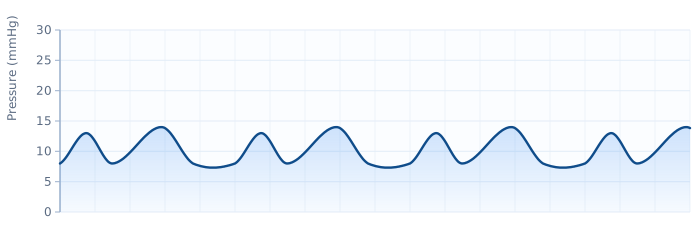
Example — Which chamber is this? You see a tracing with a low mean pressure (around 8–12 mmHg), gentle a and v waves, and no sharp systolic peak. What is it, and how do you know the catheter is positioned correctly?
Reasoning: A rounded, low-pressure tracing with a and v waves and no ventricular-style upstroke is a wedge (PCWP) tracing — the balloon is occluding a pulmonary artery branch so you are reading a pressure that reflects left atrial pressure. Contrast that with a right-ventricular tracing, which has a steep systolic upstroke and a low, near-zero early diastolic pressure. Knowing the normal magnitudes cold — RA single digits, RV around 25/5, PA around 25/10, wedge low — lets you name almost any tracing in seconds. The Swan-Ganz catheter page walks through each position as the catheter advances.
A few high-yield pattern recognitions worth banking: a giant v wave suggests mitral regurgitation; equalization of diastolic pressures with a dip-and-plateau (square-root sign) suggests constriction; and blunted, equalized pressures with pulsus paradoxus point toward tamponade. Our reference on cardiac tamponade hemodynamics and shock hemodynamics collect these into recognizable stories rather than loose facts.
Sample ECG and rhythm questions with rationale
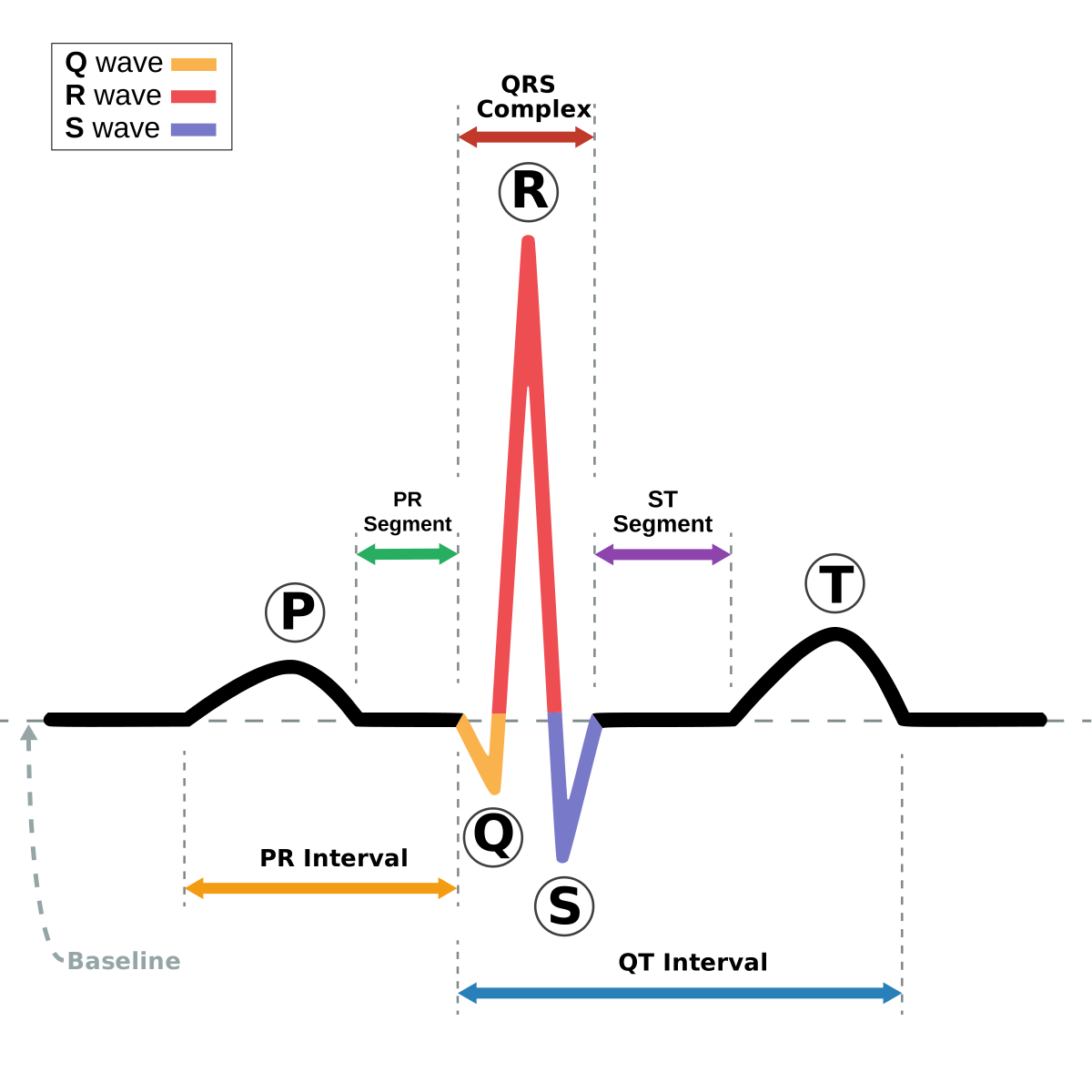
ECG questions on the RCIS exam range from calling a rhythm at a glance to interpreting intervals and ischemia patterns. The reliable approach is a fixed sequence: rate, rhythm (regular?), P waves, PR interval, QRS width, then ST/T changes. Apply the same checklist every time and the answers fall out.
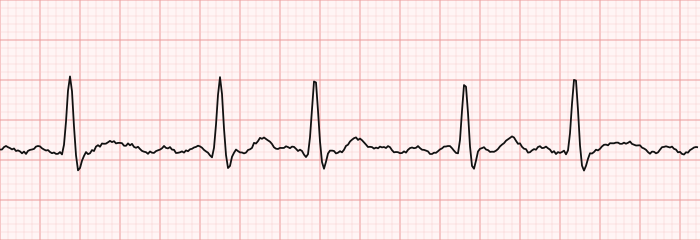
Example — Identify the rhythm. A strip shows an irregularly irregular ventricular rhythm, no discernible P waves, and a fibrillatory baseline. What is it, and what is the chief clinical concern?
Reasoning: Irregularly irregular with absent P waves is the textbook fingerprint of atrial fibrillation. The main concern is loss of atrial kick plus stasis in the left atrial appendage, raising stroke risk; rate control and anticoagulation decisions follow. Compare it side by side with atrial flutter's sawtooth pattern on our atrial fibrillation page.
Example — Interval interpretation. The PR interval is progressively lengthening until a QRS is dropped. Which block is this?
Reasoning: Progressive PR prolongation with an eventual dropped beat is second-degree AV block, Mobitz type I (Wenckebach) — usually benign and nodal. Contrast it with Mobitz II (constant PR, sudden dropped beats) and complete heart block (AV dissociation), which are more ominous and often need pacing. Build fluency with our ECG rhythm interpretation and ECG interpretation basics walkthroughs.
Expect at least one ischemia question. ST elevation in contiguous leads with reciprocal depression signals acute injury; our STEMI ECG interpretation guide maps the territory-to-artery logic that these questions reward. And when a rhythm question hinges on a prolonged QT, verify with the QTc calculator and our QT interval reference.
Pharmacology, procedures, and equipment questions
Beyond numbers and tracings, the exam checks that you understand the drugs and hardware of the cath lab. Pharmacology questions typically test mechanism, indication, and what to watch for. Procedural questions test sequence and safety.
Example — Drug action. A patient with active chest pain and no hypotension is given a sublingual agent that dilates coronary and systemic veins and reduces preload. What is it, and what is the key contraindication to screen for first?
Reasoning: That profile describes nitroglycerin. Before giving it, screen for recent phosphodiesterase-5 inhibitor use (e.g., sildenafil) and for hypotension or suspected right-ventricular infarction, any of which can cause a dangerous pressure drop. Details live on our nitroglycerin page and the broader cath-lab medications overview; heart-failure agents you may also be asked about are covered under heart-failure medications.
Procedural questions often hinge on knowing how an intervention differs from a diagnostic study, or what a support device does. Understand the distinction between diagnostic angiography and intervention on our PCI vs. cardiac catheterization comparison, get the lab overview from what is a cardiac cath lab, and know the counterpulsation principle behind the intra-aortic balloon pump. Anatomy underpins all of it — keep the coronary artery anatomy and cardiac conduction system references close, since a surprising number of procedure questions are really anatomy questions in disguise.
How to study smart for RCIS exam questions
The candidates who pass comfortably tend to share a method, not just more hours. Here is a sequence that works.
- Map the blueprint first. Download CCI's current content outline and note the weighted domains. Spend your time in proportion to the weights, not in proportion to what you already enjoy.
- Learn in patterns, not lists. Instead of memorizing that RA pressure is low, learn the whole pressure story from RA to aorta so any single value has context. The same goes for the rate-rhythm-P-PR-QRS ECG checklist.
- Do timed questions early and often. Reasoning under a clock is a separate skill from knowing the material. Use our topic banks for hemodynamics and ECG to build that stamina.
- Review wrong answers deeply. For every miss, write one sentence explaining the rationale in your own words. That single habit compounds faster than re-reading notes.
- Rehearse the math cold. Cardiac output, index, SVR/PVR, and QTc should be automatic. Drill them with the hemodynamic calculator until the formulas feel like reflexes.
If you are still deciding on the career path around the credential, our overview of the cardiovascular technologist role gives helpful context for why these competencies matter on the job.
Key takeaways
- The RCIS exam is competency-based: most questions present a scenario and ask you to interpret or act, not simply recall a fact.
- Confirm the current question count and time limit on CCI's official candidate handbook, since these can change; plan for roughly a minute or so per item.
- Hemodynamics and ECG carry the most weight. Front-load them, and master the shared logic — "pressure drop over flow" and the rate-rhythm-P-PR-QRS checklist.
- Waveform and calculation questions separate strong candidates. Know normal chamber pressures cold and drill the formulas until they are reflexive.
- Practice under a clock, review every wrong answer with a one-sentence rationale, and study patterns rather than isolated facts.
- This guide is educational only and not medical advice; always defer to current guidelines and your institution's protocols.
Practise hundreds of questions free
Test yourself with free RCIS questions, instant feedback, and explanations.
Start Practising →Frequently asked questions
How many questions are on the RCIS exam?
The RCIS exam includes multiple-choice, multiple-response, hotspot, and drag-and-place items, with scored questions plus a smaller number of unscored pilot questions that do not count toward your result. Because you cannot tell which is which, treat every question seriously. CCI can adjust the exact count and time limit, so always confirm the current numbers in the official CCI candidate handbook before your test date.
What topics are tested on the RCIS exam?
The main domains are hemodynamics and physiological monitoring, ECG and arrhythmia interpretation, cardiac anatomy and physiology, pharmacology, procedures and equipment, and radiation safety. Hemodynamics and ECG typically carry the heaviest weight, so they deserve the largest share of your study time.
Is the RCIS exam hard?
It is challenging but very passable with focused preparation. The difficulty comes from its scenario-based format: you must interpret waveforms, calculate values, and choose the correct next action rather than recite definitions. Candidates who practice timed questions and review their mistakes tend to pass comfortably.
What score do I need to pass the RCIS exam?
CCI uses a scaled scoring system and sets a passing standard through a formal process, so the raw percentage needed is not a simple fixed number. Check CCI's current documentation for the reported scale. Practically, aim to consistently score well above passing on timed practice banks before you sit the real exam.
How long should I study for the RCIS exam?
Most candidates spend several weeks to a few months, depending on their clinical experience. A common effective plan is to map CCI's content blueprint, study in proportion to the domain weights, and do daily timed practice questions in the final few weeks to build speed and stamina.
Are there calculations on the RCIS exam?
Yes. Expect to calculate cardiac output, cardiac index, systemic and pulmonary vascular resistance, stroke volume, and corrected QT. Memorize the formulas and their normal ranges, and drill them until the arithmetic is automatic so you can spend your time reasoning rather than recalling.
What is the best way to prepare for hemodynamics questions?
Learn the pressure story as a whole — normal values from the right atrium to the aorta — so any single number has context, and memorize the universal resistance pattern of pressure drop divided by flow. Then practice reading waveforms and running the calculations under a time limit using topic-specific question banks.
Can I use the RCIS credential examples here as actual test questions?
No. The examples in this guide are original teaching scenarios designed to show the reasoning the exam rewards; they are not reproduced CCI items, and the content is educational rather than medical or exam-preparation advice from CCI itself. Use official CCI resources to confirm exam specifics.
What is the difference between the RCIS and CCT exams?
The RCIS credential focuses on invasive cardiovascular procedures such as cardiac catheterization and hemodynamic monitoring, while the Certified Cardiographic Technician (CCT) credential centers on non-invasive testing like ECG and monitoring. They overlap in ECG knowledge but differ substantially in procedural and hemodynamic depth.
Sources & further reading
- Cardiovascular Credentialing International (CCI)
- American College of Cardiology
- American Heart Association
- MedlinePlus (U.S. National Library of Medicine)
External links are provided for reference; always confirm current details with the official source.