Coronary Artery Anatomy: Arteries, Branches & Dominance
The heart pumps blood to every organ in the body, yet it cannot feed itself from the blood rushing through its chambers. Instead it relies on its own dedicated network of vessels — the coronary arteries — and knowing exactly which one supplies which wall is the backbone of reading any heart attack, angiogram, or ECG.
- Why coronary artery anatomy matters
- The two main coronary arteries and where they begin
- The left coronary system: LAD and circumflex
- The right coronary artery and its branches
- Coronary dominance explained
- Which artery supplies which wall
- Coronary blood flow and venous return
- Common variations and anomalies
- Key takeaways
Why coronary artery anatomy matters
If you can name the coronary arteries and picture where each one runs, an enormous amount of cardiovascular medicine falls into place. A coronary artery anatomy map is not trivia — it is the framework that lets you predict which wall of the heart is at risk when a vessel closes, interpret the ST changes on a 12-lead tracing, and follow a wire through the cath lab.
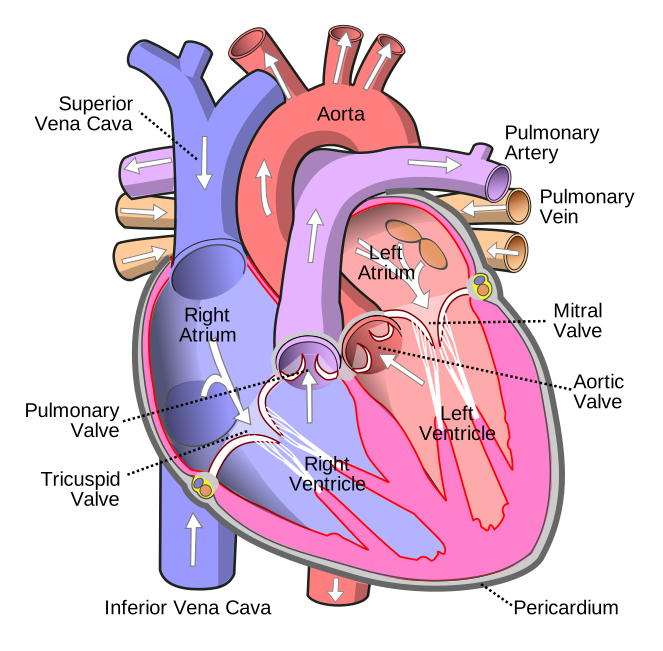
The heart is a muscular pump working nonstop, and muscle that works that hard needs a rich, continuous oxygen supply. The blood inside the four chambers races through too quickly to nourish the wall directly, so the myocardium is fed from the outside in, by arteries that sit on the heart's surface and send branches diving into the muscle. When one of those arteries narrows or clots, everything downstream begins to starve — which is why coronary artery disease and myocardial infarction are best understood through the lens of anatomy.
For anyone preparing for the RCIS or working in a cardiovascular lab, this is foundational. It sits alongside the cardiac conduction system and core hemodynamics principles as knowledge you draw on every single shift. This article is educational and written for students and clinicians — it is not medical advice.
The two main coronary arteries and where they begin
All coronary blood starts in one place: the aortic root, just above the aortic valve. Two small openings there — the coronary ostia — sit inside pockets called the sinuses of Valsalva, and from them the two main coronary arteries arise.
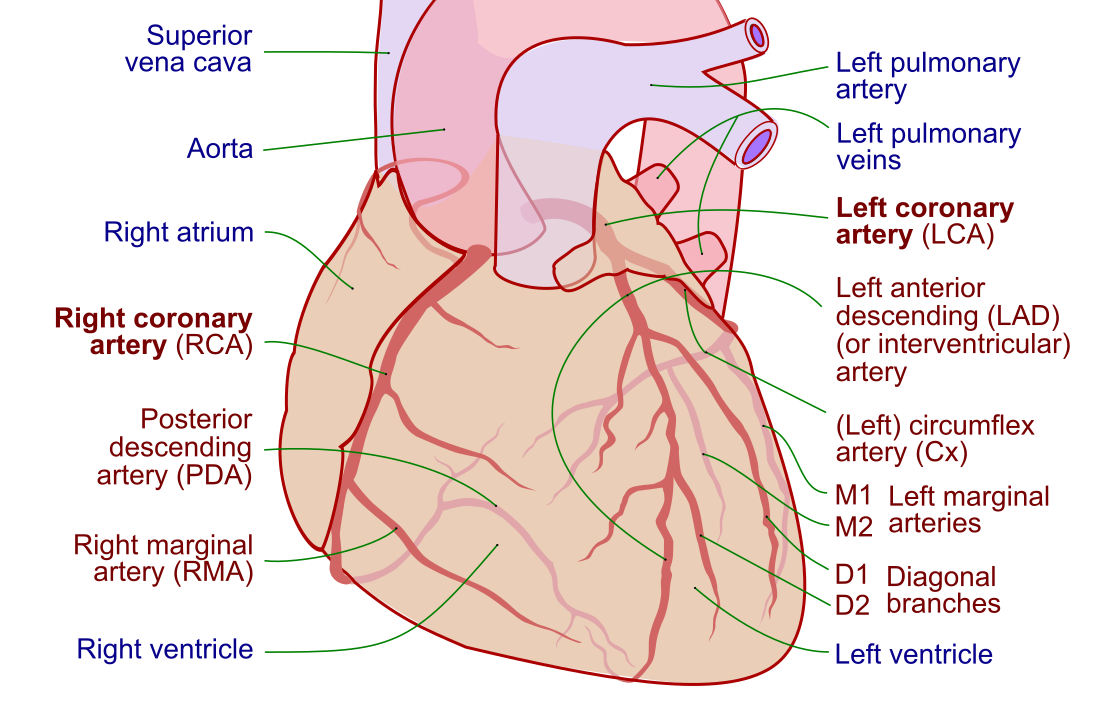
The left main coronary artery (LMCA) comes off the left coronary sinus. It is short but critically important, because within a centimeter or two it divides into the two great vessels of the left side. The right coronary artery (RCA) arises from the right coronary sinus and travels down the right side of the heart. That leaves the two big questions of coronary anatomy: how the left main splits, and how far the RCA reaches around the back.
One elegant detail worth remembering is when the coronaries actually fill. Unlike every other artery in the body, the coronaries receive most of their blood during diastole — the relaxation phase — because during systole the contracting muscle squeezes the intramural vessels shut. This is why a very fast heart rate or a low diastolic blood pressure can quietly starve the myocardium: you are shortening the very window in which the heart feeds itself. It is also why the intra-aortic balloon pump, which inflates in diastole, boosts coronary perfusion.
The left coronary system: LAD and circumflex
The left main is the trunk; the left anterior descending (LAD) and the left circumflex (LCx) are its two great branches. Together they supply the majority of the left ventricle — the chamber that does the heavy lifting of pumping blood to the whole body — which is why the left system dominates so much of clinical concern.
The LAD runs down the front of the heart in the anterior interventricular groove, heading toward the apex. Along the way it gives off septal perforators that dive into the interventricular septum and diagonal branches that fan across the front-left wall. Because the LAD feeds the anterior wall, the septum, and much of the apex, a proximal LAD occlusion can devastate a large slab of pumping muscle. That is the vessel clinicians nickname the widowmaker.
The circumflex curls the other way — around the left side of the heart in the left atrioventricular groove, toward the back. It gives off obtuse marginal (OM) branches that supply the lateral wall of the left ventricle. How far the circumflex reaches around the back depends on coronary dominance, which we come to shortly.
When you put the phrase LAD circumflex RCA together, you have essentially named the three vessels that every angiogram report, every STEMI call, and every RCIS question revolves around. Master these three and their territories and the rest is detail.
| Vessel | Path | Main branches | Supplies |
|---|---|---|---|
| Left main (LMCA) | Left sinus to bifurcation | LAD, circumflex | Feeds the whole left system |
| LAD | Anterior interventricular groove to apex | Septals, diagonals | Anterior wall, septum, apex |
| Circumflex (LCx) | Left AV groove, wraps posteriorly | Obtuse marginals | Lateral wall (± posterior) |
The right coronary artery and its branches
The RCA runs in the right atrioventricular groove, curving between the right atrium and right ventricle toward the back of the heart. Along its course it hands off several important branches, and a couple of them carry outsized clinical weight because of what they feed.
Near its origin the RCA usually gives the conus branch and then the SA nodal artery, which supplies the sinoatrial node — the heart's natural pacemaker — in most people. Further along it gives acute marginal branches to the right ventricle. As it reaches the back of the heart at the crux, in most individuals it gives off the posterior descending artery (PDA) and the AV nodal artery.
Those last two branches explain a clinical pattern worth committing to memory. Because the RCA typically feeds both the SA and AV nodes, an inferior heart attack from an RCA occlusion often comes with bradycardia and AV block. This is a favorite exam link: inferior STEMI plus a slow rhythm or new heart block points you straight back to the right coronary artery. Reviewing the ECG fundamentals alongside this anatomy makes the connection stick.
Coronary dominance explained
Coronary dominance is one of those concepts that sounds complicated and is actually simple once you anchor it to a single question: which artery gives rise to the posterior descending artery (PDA)? The PDA runs down the back of the heart in the posterior interventricular groove and supplies the inferior wall and the back of the septum. Whichever vessel supplies it defines dominance.
- Right dominant — the PDA comes from the RCA. This is by far the most common pattern, seen in roughly 80–85% of people.
- Left dominant — the PDA comes from the circumflex. This occurs in about 8–10% of people and makes the left system responsible for an even larger share of the myocardium.
- Co-dominant (balanced) — the inferior wall is shared, with the PDA fed partly by the RCA and partly by the circumflex. This accounts for the remainder.
Why does it matter beyond terminology? Dominance changes the stakes of a given blockage. In a left-dominant heart, the circumflex feeds the inferior wall and the AV node, so a circumflex lesion there can produce the inferior-infarct-plus-block picture you would normally attribute to the RCA. It also shifts which artery a proceduralist worries about most. Numbers vary between studies and populations, so treat the percentages as approximate rather than absolute.
| Dominance | PDA arises from | Approx. frequency |
|---|---|---|
| Right dominant | Right coronary artery | ~80–85% |
| Left dominant | Circumflex | ~8–10% |
| Co-dominant | Both RCA and circumflex | ~5–10% |
Which artery supplies which wall
The single most useful thing to walk away with is a clean answer to the question: which artery supplies which wall? This mapping is what turns a set of ECG leads into a specific culprit vessel, and it is tested relentlessly. The relationship is not rigid — dominance and individual variation shift the edges — but the core pattern holds for the great majority of hearts.
Here is the workhorse table that ties territory to artery to the ECG leads that face that wall:
| Wall / territory | Usual artery | ECG leads |
|---|---|---|
| Anterior / septal | Left anterior descending (LAD) | V1–V4 |
| Lateral | Circumflex (or diagonal) | I, aVL, V5–V6 |
| Inferior | Right coronary artery (RCA) | II, III, aVF |
| Posterior | RCA or circumflex (PDA) | Reciprocal changes in V1–V3 |
| Right ventricle | Proximal RCA | V4R (right-sided lead) |
Reading these territories on a real tracing is a skill in its own right; our guide to STEMI ECG interpretation walks through how ST elevation in specific leads localizes the culprit artery, and the broader ECG interpretation overview builds the foundation. If you want to test yourself, the RCIS ECG practice questions put this mapping to work.
Coronary blood flow and venous return
Arteries are only half of the story. After the coronary arteries deliver oxygen to the myocardium, deoxygenated blood has to get back out — and it does so through the coronary veins, most of which drain into the coronary sinus, a wide venous channel on the back of the heart that empties into the right atrium.
Understanding flow direction matters clinically. Coronary perfusion depends on the pressure difference across the bed: aortic diastolic pressure pushing blood in, versus the pressure in the heart wall and chambers resisting it. When the left ventricle is stiff, hypertrophied, or under high pressure, the inner layer of muscle — the subendocardium — is the first to suffer, because it is squeezed hardest and sits farthest from the surface vessels. This is why the subendocardium is the most vulnerable zone in ischemia.
These pressure relationships tie coronary anatomy directly into hemodynamics. The same principles that govern cardiac output, systemic vascular resistance, and ejection fraction shape whether the coronaries can keep up with demand. In the cath lab, a Swan-Ganz catheter and careful pressure monitoring help clinicians read that balance in real time, and the hemodynamic calculator can turn measured pressures into the derived numbers you need.
Common variations and anomalies
Textbook anatomy describes the usual case, but human hearts vary, and a few of those variations carry real clinical weight. Most are harmless quirks; a minority can be dangerous.
Dominance, covered above, is the most common variation and is entirely normal. Beyond it, branch patterns differ from person to person — the size and reach of diagonals, marginals, and the exact origin of the SA and AV nodal arteries all shift between individuals. A ramus intermedius, an extra branch coming straight off the left main between the LAD and circumflex, is a frequent and benign finding.
Coronary artery anomalies — where a vessel arises from the wrong sinus or follows an unusual course — are rarer and matter most when an aberrant artery runs between the aorta and pulmonary trunk, where it can be compressed during exertion. Such anomalies are one recognized cause of sudden cardiac death in young athletes, which is why they draw attention out of proportion to how often they occur. Myocardial bridging, where a segment of a coronary artery dips into the muscle and gets squeezed with each beat, is another common variant that is usually benign but occasionally symptomatic.
Finally, the coronary circulation can adapt over time. When a vessel narrows slowly, the heart may grow collateral vessels — natural bypass channels that reroute blood around a blockage. Collaterals help explain why some people tolerate a tight stenosis surprisingly well, while a sudden clot in a previously healthy artery is so devastating: there has been no time to build a detour. Evidence on how best to protect and exploit collateral flow continues to evolve.
Key takeaways
- The heart is fed by two main coronary arteries arising from the aortic root: the left main (which splits into the LAD and circumflex) and the right coronary artery.
- The LAD supplies the anterior wall, septum, and apex; the circumflex supplies the lateral wall; the RCA supplies the inferior wall and usually both the SA and AV nodes.
- Coronary dominance is defined by which artery gives the posterior descending artery: right dominant (~80–85%) is most common, followed by left dominant and co-dominant patterns.
- For which artery supplies which wall: inferior → RCA (leads II, III, aVF), anterior → LAD (V1–V4), lateral → circumflex (I, aVL, V5–V6).
- Coronaries fill mainly in diastole, so tachycardia and low diastolic pressure reduce myocardial perfusion; the subendocardium is the most vulnerable layer.
- Variations like dominance, a ramus intermedius, and myocardial bridging are usually benign; anomalous coronary origins are rare but a recognized cause of sudden death in young athletes.
- This content is educational, not medical advice.
Practise cardiac anatomy
Test coronary arteries, dominance, and conduction questions.
Practise Anatomy →Frequently asked questions
What are the three main coronary arteries?
The three vessels clinicians talk about most are the left anterior descending (LAD), the left circumflex (LCx), and the right coronary artery (RCA). The LAD and circumflex both branch from the short left main coronary artery, while the RCA arises separately from the right coronary sinus. Together these three supply essentially the entire heart muscle.
Which coronary artery is the widowmaker?
The proximal left anterior descending (LAD) artery is called the widowmaker because it supplies a large portion of the left ventricle — the anterior wall, much of the septum, and the apex. A blockage high up in the LAD can knock out so much pumping muscle at once that it causes severe pump failure or sudden death, hence the nickname.
What does coronary dominance mean?
Coronary dominance describes which artery gives rise to the posterior descending artery (PDA), which supplies the inferior wall and back of the septum. If the PDA comes from the right coronary artery, the person is right dominant (about 80–85% of people). If it comes from the circumflex, they are left dominant, and if both contribute, they are co-dominant or balanced.
Which artery supplies which wall of the heart?
In most hearts, the left anterior descending supplies the anterior wall, septum, and apex; the circumflex supplies the lateral wall; and the right coronary artery supplies the inferior wall plus the SA and AV nodes. On the ECG, anterior maps to leads V1–V4, lateral to I, aVL, V5–V6, and inferior to II, III, and aVF.
Why does the right coronary artery cause heart block?
In most people the right coronary artery supplies both the sinoatrial (SA) node and the atrioventricular (AV) node. When the RCA is blocked — the usual cause of an inferior heart attack — those nodes lose blood flow, which can produce slow heart rates (bradycardia) and AV block. This is why an inferior STEMI is classically associated with conduction problems.
When do the coronary arteries fill with blood?
The coronary arteries fill mainly during diastole, the heart's relaxation phase. During systole, the contracting heart muscle squeezes the intramural vessels and briefly limits flow. Because filling depends on diastole, a very fast heart rate shortens the filling window and a low diastolic blood pressure reduces the driving pressure, both of which can starve the heart muscle of oxygen.
What is the difference between the LAD and the circumflex?
Both branch from the left main coronary artery, but they run in opposite directions. The LAD travels down the front of the heart in the anterior interventricular groove toward the apex, supplying the anterior wall and septum. The circumflex curls around the left side in the AV groove toward the back, supplying the lateral wall through its obtuse marginal branches.
Are coronary artery anomalies dangerous?
Most coronary variations, such as dominance patterns or an extra ramus intermedius branch, are entirely benign. A minority of true anomalies — where an artery arises from the wrong sinus and runs between the aorta and pulmonary trunk — can be compressed during exercise and are a recognized cause of sudden cardiac death in young athletes, which is why they receive so much attention.
How does blood leave the heart muscle after the coronary arteries?
After the coronary arteries deliver oxygen to the myocardium, deoxygenated blood is collected by the coronary veins. Most of these drain into the coronary sinus, a large venous channel on the back of the heart that empties into the right atrium. From there the blood rejoins the general venous circulation to be pumped to the lungs for reoxygenation.
Sources & further reading
- Cardiovascular Credentialing International (CCI)
- American College of Cardiology
- American Heart Association
- MedlinePlus (U.S. National Library of Medicine)
External links are provided for reference; always confirm current details with the official source.