How to Pass the RCIS Exam (First Time)
A practical, no-fluff study strategy for the Registered Cardiovascular Invasive Specialist exam — what to study, in what order, and how to practise so it sticks.
How hard is the RCIS exam?
The RCIS exam has a reputation for being challenging but fair. It's hard because it covers a wide range of domains and asks you to apply knowledge — interpreting a waveform, choosing the right drug, or recognising a complication — rather than just recalling facts. The good news: that means it rewards active practice. Candidates who do large volumes of exam-style questions, and understand why each answer is right, consistently do well.
RCIS exam pass rate
Pass rates for credentialing exams vary year to year and are published by the credentialing body, CCI. The RCIS is widely considered a moderately difficult but very passable exam — most well-prepared, clinically experienced candidates pass, while those who rely on cramming or skip the high-yield domains are the ones who tend to struggle. For more detail, see our RCIS pass-rate guide.
Rather than fixating on a published number, focus on the one thing fully in your control: how ready you are. A reliable readiness signal is consistently scoring 80%+ on mixed, full-length practice exams. Use our mock exam to benchmark yourself.
Why candidates fail (and how to avoid it)
- Weak hemodynamics. It is the highest-yield domain and the most common downfall — drill pressures, waveforms, and calculations until they are automatic.
- Memorising answers, not concepts. Shuffle questions and learn why each option is right or wrong.
- No timed practice. Running out of time or fading late is fixable only with full-length mock exams.
- Cramming. Spaced daily practice beats a last-minute marathon for retention.
Know the exam blueprint before you study
Most candidates lose time studying everything at the same intensity. The smarter approach is to study to the blueprint — CCI publishes the content outline and the approximate weighting of each domain, and your study hours should mirror those weights. A domain that carries more of the exam deserves more of your week; a lightly weighted domain deserves a proportionate, not obsessive, effort.
While you should always confirm the current outline on the official CCI website, the invasive-cardiovascular knowledge base has consistently clustered around the areas below. Notice how heavily the hands-on lab domains — hemodynamics, procedures, and pharmacology — dominate.
| Domain | Relative weight | What it rewards |
|---|---|---|
| Hemodynamics & monitoring | High | Reading pressures/waveforms, cardiac output, shunts, gradients |
| Procedures & equipment | High | Access, catheters, sheaths, closure, IABP, imaging adjuncts |
| Pharmacology | Medium–High | Anticoagulants, antiplatelets, vasoactives, reversal agents |
| Anatomy & physiology | Medium | Chambers, valves, coronary anatomy, dominance, conduction |
| ECG & arrhythmias | Medium | Rhythm recognition, ischemia/infarct localization |
| Patient care & safety | Medium | Sterile technique, ALARA radiation safety, the time-out, emergencies |
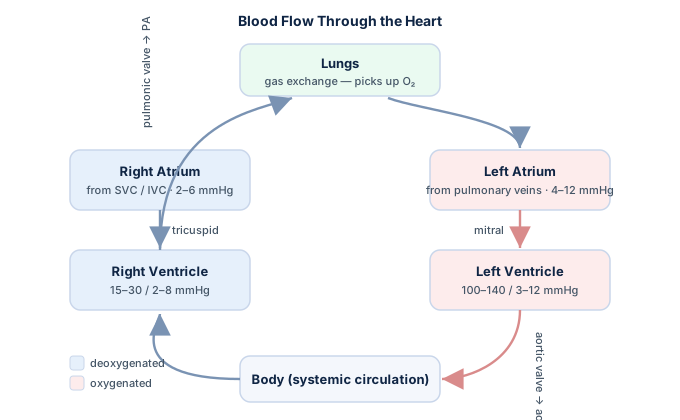
Map your calendar to these weights, then let your practice results re-weight it further: whichever domain you score lowest on gets extra sessions, regardless of its blueprint size. Studying to the blueprint and to your own weak spots is how efficient candidates pass without living in their books.
A 6–8 week study plan
| Week | Focus |
|---|---|
| 1–2 | Anatomy & physiology + start daily MCQs. Build the foundation. |
| 3–4 | Hemodynamics — pressures, waveforms, shunts, valve gradients, cardiac output. Highest yield. |
| 5 | Pharmacology — anticoagulants, antiplatelets, vasoactives, reversal agents. |
| 6 | Procedures, equipment, ECG, radiation safety, and patient care. |
| 7–8 | Full-length mock exams, review weak areas, and consolidate. |
Throughout, do questions every day. Practice testing is one of the most evidence-backed study methods — it beats re-reading notes for long-term recall.
Start your daily practice now
Build the habit today — a few questions a day compounds fast.
Open the Practice Hub →High-yield topics to master
- Normal hemodynamic values — RA, RV, PA, PCWP, LV, aorta. Know them cold. Practise here.
- Waveform recognition — a/c/v waves, large v wave (MR), cannon a waves, square-root sign.
- Cardiac output — Fick and thermodilution principles.
- Shunt detection — oxygen step-ups and what they mean.
- Cath-lab pharmacology — reversal agents (protamine, flumazenil, naloxone), DAPT, anticoagulants. Practise here.
- Coronary anatomy & dominance — which artery supplies what, and angiographic views.
- Safety — ALARA radiation principles and the Universal Protocol time-out.
How to use practice questions effectively
Doing questions is the highest-yield study activity for the RCIS — but only if you do them the right way. Passive question-answering (guess, check, move on) builds a false sense of readiness. Turn every practice block into a learning loop instead:
- Attempt before you peek. Commit to an answer and a reason before revealing the rationale. The act of retrieving strengthens memory far more than recognising the right option.
- Read the explanation for every question — including the ones you got right. A lucky guess and a confident correct answer look identical on your score; the explanation tells you which you had.
- Explain the distractors. For each wrong option, say out loud why it's wrong. RCIS items are single-best-answer, so several options are often partly true — the skill is ranking them.
- Keep an error log. Write down every concept you missed. Review the log weekly; the same themes will keep surfacing, and those are your real weak spots.
- Space it out. Twenty questions a day for three weeks beats 400 in a weekend. Spaced retrieval is one of the most robust findings in learning science.
- Interleave topics. Mix hemodynamics, pharmacology, and ECG in the same session. It feels harder — and that difficulty is exactly what builds durable, test-ready recall.
Test-day strategy and question tactics
Preparation gets you to the testing centre; strategy gets you through the exam without leaving points on the table. A few deliberate habits protect your score when fatigue and nerves set in:
- Read the last line of the stem first. Knowing exactly what's being asked ("most appropriate next step," "most likely cause") keeps long scenarios from misleading you.
- Predict the answer before reading the options. If your prediction is on the list, you can usually pick it quickly and resist well-crafted distractors.
- Eliminate ruthlessly. Cross off options you can disprove. Getting from four to two doubles your odds even when you must guess.
- Don't fight one hard item. Flag it, lock in your best guess, and move on — every question is worth the same, and a fresh look later is often clearer.
- Watch absolute words. "Always" and "never" are frequently wrong in medicine; graded language ("usually," "most") is often safer.
- Trust your first instinct. Only change an answer when you find a concrete reason, not a vague doubt — second-guessing costs more points than it saves.
- Pace yourself. Note the halfway time when you start, and check once at the midpoint. Answer every standard item — there's no penalty for a wrong single-best-answer question, so never leave a blank.
Your final-week checklist
The last week is for consolidation and confidence, not cramming new material. Taper the volume and sharpen what you already know:
- Two full-length, timed mock exams — one early in the week, one two days out — to lock in pacing and stamina.
- Re-drill your error log until the recurring misses feel automatic.
- Recite the normal hemodynamic values daily (RA, RV, PA, PCWP, LV, aorta) — they anchor a huge share of the exam.
- Skim safety and pharmacology reversal agents (protamine, flumazenil, naloxone) — cheap points that are easy to forget.
- Sort out logistics — confirm the test-centre location, required ID, and arrival time.
- Protect your sleep the two nights before. Memory consolidation and recall both depend on it far more than a few extra questions would help.
Walk in having already proven to yourself — on shuffled, full-length mocks — that you can pass. That evidence, not a headline pass rate, is what steadies your nerves on the day.
10 tips to pass first time
- Practise more than you read. Active recall beats passive review.
- Learn from explanations, not just the score — understand every miss.
- Prioritise hemodynamics. It's high-yield and very learnable.
- Memorise normal values until they're automatic.
- Shuffle questions so you learn the concept, not the position.
- Take timed mock exams to build stamina and pacing.
- Track your weak areas and revisit them deliberately.
- Sleep before test day — recall depends on it.
- Read every stem carefully — single-best-answer is about the most correct option.
- Answer everything — never leave a standard item blank.
Free resources and tools to help you pass
You don't need an expensive course to pass the RCIS — you need consistent, targeted practice and the right reference tools. Everything below is free on this site and maps directly onto the study plan above:
- Topic practice banks — drill one domain at a time with instant explanations: hemodynamics, pharmacology, ECG, anatomy, and more from the practice hub.
- Calculation drills — a dedicated calculations bank for Fick output, shunt ratios, valve area, resistances, and QTc, so the math is automatic on exam day.
- Scenario questions — case-style items that mirror the applied reasoning the exam rewards, in the scenarios bank.
- Hemodynamic calculators — check your work and build intuition with the all-in-one hemodynamic calculator and the focused Fick cardiac output and QTc tools.
- Full-length mock exam — mixed-topic, timed, exam-mode practice to build stamina: the RCIS mock exam.
- Guides — background reading in the hemodynamics and ECG guides, plus the exam format guide.
The winning routine is simple: a short domain review, a daily set of questions, an error log you actually revisit, and a mock exam each week of your final stretch. Do that and the exam becomes a formality rather than a gamble.
Frequently asked questions
How long should I study for the RCIS exam?
Typically 6–12 weeks, depending on your clinical experience. Consistent daily practice matters more than total hours crammed.
What's the single best resource?
High-quality practice questions with explanations. Pair them with a domain review and full-length mock exams.
How do I know I'm ready?
When you reliably score 80%+ on shuffled, full-length mocks and can explain the wrong answers.
What is the RCIS exam pass rate?
It varies year to year and is published by CCI. The RCIS is moderately difficult but very passable — most prepared candidates pass. See our pass-rate guide and focus on your own readiness rather than the headline number.
How many questions are on the RCIS exam?
The RCIS is a computer-based, multiple-choice exam covering all the core invasive-cardiovascular domains. For the current question count, time limit, and scoring, see our RCIS exam guide.