RCIS Exam Guide: Format, Content & What to Expect
Everything you need to know to walk into the Registered Cardiovascular Invasive Specialist exam prepared — format, content domains, requirements, and test-day logistics.
RCIS exam format
The RCIS exam is administered by Cardiovascular Credentialing International (CCI). The official RCIS examination page lists traditional multiple-choice, multiple-response, hotspot, and drag-and-place items. Our single-answer practice quizzes do not reproduce every official item format.
A portion of the items on any registry-style exam are typically unscored pretest questions being trialled for future exams; you won't know which ones, so treat every question as if it counts. For the current official question count and time limit, always check CCI directly, as these details can change.
| Attribute | What to expect |
|---|---|
| Delivery | Computer-based at an approved testing centre |
| Question types | Multiple-choice, multiple-response, hotspot, and drag-and-place |
| Scoring | Scaled score; some pretest items unscored |
| Result | Pass / fail, usually reported promptly |
RCIS exam requirements
To sit the exam you must meet one of CCI's eligibility pathways, which combine formal education in cardiovascular technology with documented clinical experience in an invasive setting. The specifics depend on your background — read our RCIS certification guide for the full breakdown of eligibility and how to apply.
At a high level, candidates typically qualify through one of a few routes: graduating from an accredited cardiovascular technology program, completing another allied-health credential plus documented invasive clinical experience, or accumulating substantial on-the-job experience in an invasive cardiovascular setting. Because CCI periodically updates these pathways and the required hours, always verify your specific route against the current official requirements before you apply.
- Accredited-program route — completion of a CAAHEP-accredited cardiovascular technology program in the invasive track.
- Allied-health route — an existing healthcare credential combined with documented invasive cath-lab experience.
- Experience route — a defined amount of clinical experience in an invasive cardiovascular laboratory.
Not sure which fits you? Our RCIS requirements guide and RCIS programs overview walk through each option in plain language.
How to register and apply
Once you've confirmed eligibility, the application itself is straightforward — but it pays to get the paperwork right the first time so nothing delays your test date. The typical sequence looks like this:
- Create your CCI account and select the RCIS examination.
- Choose your eligibility pathway and upload the supporting documentation (transcripts, credential proof, or a verified log of clinical experience).
- Submit the application and fee, then wait for CCI to confirm your eligibility.
- Receive your authorization to test, which opens a window during which you must schedule.
- Book a seat at an approved testing centre (or the approved remote option, where offered) for a date inside that window.
Confirm the current fees, documentation, and scheduling details directly with CCI, since these change from time to time. Give yourself a buffer — apply a few weeks before you actually want to test so a documentation query doesn't push your date back.
Content domains tested
The exam samples across the knowledge required to work safely in the invasive cardiovascular lab. The major domains are:
- Cardiovascular anatomy & physiology — chambers, valves, coronary anatomy, conduction system, dominance.
- Hemodynamics — normal pressures, waveform recognition, shunt detection, valve gradients, and cardiac output (Fick & thermodilution). This is one of the highest-yield areas.
- Procedures & equipment — access techniques, catheters, sheaths, guidewires, IABP, and imaging.
- Pharmacology — anticoagulants, antiplatelets, vasoactive drugs, contrast, sedation, and reversal agents.
- ECG & arrhythmias — rhythm recognition and ischemia/infarct localization.
- Patient care & safety — sterile technique, radiation safety (ALARA), the Universal Protocol time-out, and emergency response.
Practise each domain free
Drill the exact domains above with instant feedback and explanations.
Go to Practice Hub →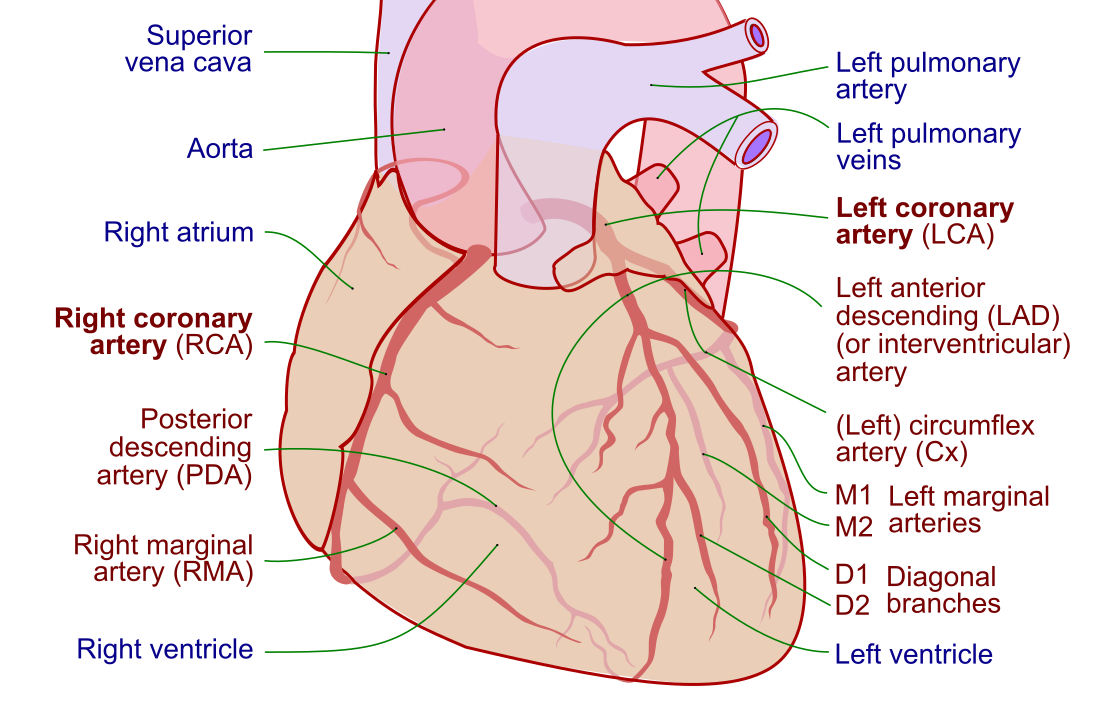
Scoring and results
The RCIS is reported as a pass or fail decision based on a scaled score. Scaling matters: because different exam forms can vary slightly in difficulty, CCI converts your raw number of correct answers to a common scale so that the standard to pass is consistent regardless of which form you happened to sit. You are not competing against other candidates — you're measured against a fixed passing standard.
A few practical implications follow from how the exam is scored:
- Unscored pretest items don't count. A share of questions are being trialled for future exams and carry no weight — but since you can't tell which, treat every item as if it does.
- There's no penalty for guessing on standard single-best-answer items, so never leave one blank. An educated guess can only help.
- You usually receive your result promptly at the testing centre, often with domain-level feedback that highlights where you were strong or weak.
- If you don't pass, that feedback becomes your study map — CCI allows retakes after a waiting period, and most repeat candidates pass once they close their specific gaps.
Always confirm the current passing standard, score-reporting details, and retake policy on the official CCI website, as these can be updated.
What the questions look like
RCIS questions test applied knowledge, not just memorisation. Expect items that give you a scenario — a waveform, a pressure value, a drug situation — and ask for the best interpretation or action. Here's a representative example:
Q. A large v wave on the pulmonary capillary wedge tracing is most characteristic of which condition?
A. Mitral regurgitation — regurgitant flow into the left atrium during systole produces a giant v wave. This is exactly the kind of waveform-to-diagnosis reasoning the exam rewards.
Our hemodynamics practice bank is full of questions in this style, each with a worked explanation.
You'll also meet calculation items — Fick and thermodilution cardiac output, shunt ratios, valve area, vascular resistance, and QTc — where the exam wants you to apply a formula correctly under time pressure. Rehearse those until the arithmetic is second nature using our calculations bank and the built-in hemodynamic calculators. And because much of the lab is visual, expect image-based questions too: pressure tracings, ECG strips, and angiographic views that you must read and interpret.
How to prepare for the RCIS exam
Preparation that works for the RCIS is built on three pillars — a structured domain review, a large volume of exam-style practice questions with explanations, and full-length timed mock exams to build stamina and pacing. The domains aren't equally weighted, so weight your hours toward the high-yield areas (hemodynamics, procedures, and pharmacology) while keeping the others ticking over.
- Review to the blueprint. Spend the most time where the exam does. Confirm the current domain weighting on the CCI outline and mirror it in your schedule.
- Practise daily. Active recall through questions beats re-reading notes — and it's the fastest way to surface your weak spots.
- Learn from every explanation, including the questions you got right, and keep an error log you revisit weekly.
- Finish with mock exams. Two or three shuffled, full-length runs tell you whether your timing and stamina are ready, not just your knowledge.
For a week-by-week schedule, the high-yield topic list, and test-day tactics, follow our companion guide on how to pass the RCIS exam. When you're ready to benchmark, a full mock exam is the single best readiness check.
On test day
- Bring the identification required by the testing centre.
- Arrive early; budget time for check-in and security.
- Read each stem carefully — single-best-answer means more than one option may be partly true.
- Don't dwell: flag tough items, answer everything (no negative marking on standard items), and return if time allows.
- Manage the clock — keep a steady pace so you reach every question.
RCIS vs related cardiovascular credentials
The RCIS sits within a family of CCI credentials, and candidates often ask how it differs from the others. In short, the RCIS is the invasive credential — it's for professionals working in the cardiac catheterization laboratory. The related credentials cover different corners of cardiovascular care:
| Credential | Focus | Typical setting |
|---|---|---|
| RCIS | Invasive cardiovascular procedures | Cardiac cath lab |
| RCES | Cardiac electrophysiology | EP lab (ablations, devices) |
| RCS | Adult echocardiography (non-invasive) | Echo lab |
| RVS | Vascular ultrasound (non-invasive) | Vascular lab |
Many professionals start with the RCIS and later add a second credential — for example moving into electrophysiology with the RCES, or cross-training in non-invasive imaging. If you're weighing your options, our what-is-an-RCIS overview, cardiovascular technologist career guide, and cardiovascular ultrasound technologist guide compare the day-to-day work, training, and pay of each path.
Whichever direction you take, the RCIS is a strong foundation: it certifies the core hemodynamic, procedural, and safety knowledge that underpins nearly every role in the invasive and interventional cardiovascular space.
Frequently asked questions
How many questions are on the RCIS exam?
CCI lists 170 questions, with 150 scored and 20 unscored. Formats include traditional multiple-choice and innovative items. Confirm current examination details with CCI before scheduling.
Is the RCIS exam hard?
It is challenging but very passable with focused preparation. See our guide on how to pass the RCIS exam and the typical pass rate.
What's the best way to prepare?
Mix domain review with high volumes of practice questions. Start free in our practice hub and finish with a full mock exam.
How long is the RCIS exam?
CCI lists a three-hour session: 170 minutes to answer questions and ten minutes for the tutorial and survey. Confirm current arrangements on the official RCIS page before scheduling.
How much does the RCIS exam cost?
Fees are set by CCI and vary with membership status and any retake situation. Check the current fee schedule on the CCI website before applying; see our RCIS cost guide for context.
Can I retake the RCIS exam if I fail?
Yes. CCI permits retakes after a waiting period, and the domain-level feedback from your attempt shows exactly where to focus. Most repeat candidates pass once they close their specific gaps.
Is the RCIS exam multiple choice?
Traditional single-answer multiple-choice is one format, alongside multiple-response, hotspot, and drag-and-place questions. Read the instructions for each item; not every question asks for just one choice.
Simulate the real thing
Take a full-length, mixed-topic mock exam in exam mode.
Start the Mock Exam →