Cardiac Cath Lab Tech: Role, Path & Pay
A cardiac cath lab tech is the hands-on specialist who scrubs, monitors, and troubleshoots alongside the cardiologist while catheters travel through a patient's arteries to the heart — one of the most fast-paced, high-stakes roles in allied cardiology.
- What is a cardiac cath lab tech?
- What does a cardiac cath lab tech do?
- A day in the life of a cath lab tech
- Duties and skills every cath lab tech needs
- Medications and monitoring in the cath lab
- How to become a cardiac cath lab tech
- Cardiac cath lab tech salary and job outlook
- Cath lab tech vs cardiac sonographer: invasive vs non-invasive
- Career growth and specialization
- Key takeaways
What is a cardiac cath lab tech?
A cardiac cath lab tech is the allied-health professional who works shoulder-to-shoulder with an interventional cardiologist inside the cardiac catheterization laboratory. The formal titles vary — invasive cardiovascular technologist, cardiovascular technologist (CVT), or registered cardiovascular invasive specialist (RCIS) — but the everyday shorthand is simply "cath lab tech." If you have ever pictured the team gowned in lead aprons under bright fluoroscopy, threading a thin catheter from a wrist or groin puncture up to the beating heart, the cath lab tech is one of the people who makes that procedure run safely and smoothly.
The role sits at the intersection of anatomy, physics, pharmacology, and split-second teamwork. During a diagnostic angiogram or an emergency stent placement, the tech may be scrubbed at the table handing devices, recording pressures and rhythms at the physiologic monitor, or circulating to draw medications and manage supplies. It is invasive work — real catheters inside real arteries — so the margin for error is thin and the atmosphere can shift from routine to emergent in seconds.
To understand where the tech works, it helps to picture the room itself: a shielded suite built around an X-ray C-arm, a hemodynamic recording system, and a crash cart that is never far away. A good primer on what a cardiac cath lab is paints the full picture of that environment.
This article is educational — written for students, career-changers, and clinicians preparing for credentials such as the RCIS. It is not medical or career-placement advice; scope of practice, licensing, and pay vary by region, employer, and year.
What does a cardiac cath lab tech do?
The short answer to what they do: everything that keeps an invasive cardiac procedure moving except making the physician's clinical decisions. On any given case, a cath lab tech rotates through three well-defined positions, and strong techs are fluent in all of them.
- Scrub role — gowned and gloved at the sterile table, the scrub tech prepares the field, hands the operator guidewires, catheters, balloons, and stents, and manages the flush and contrast lines. This is the position that demands the deepest knowledge of the hardware.
- Monitor role — seated at the physiologic recording system, this tech captures the pressure waveforms, ECG rhythm, and hemodynamic measurements, times events, logs medications, and calls out changes the operator needs to hear.
- Circulate role — moving freely around the room, the circulating tech draws and passes medications, opens sterile supplies, positions equipment, and helps manage the patient and any complications.
Across those roles, the concrete tasks include preparing and positioning the patient, prepping access sites, operating the fluoroscopy and injector equipment, recording and interpreting hemodynamic pressures, watching the monitor for dangerous rhythms, assisting with device deployment, and documenting the entire case. Techs also assist with a widening menu of procedures — right-heart catheterization, coronary angiography, percutaneous coronary intervention (PCI), electrophysiology studies and ablations, pacemaker and defibrillator implants, and structural-heart interventions.
A day in the life of a cath lab tech
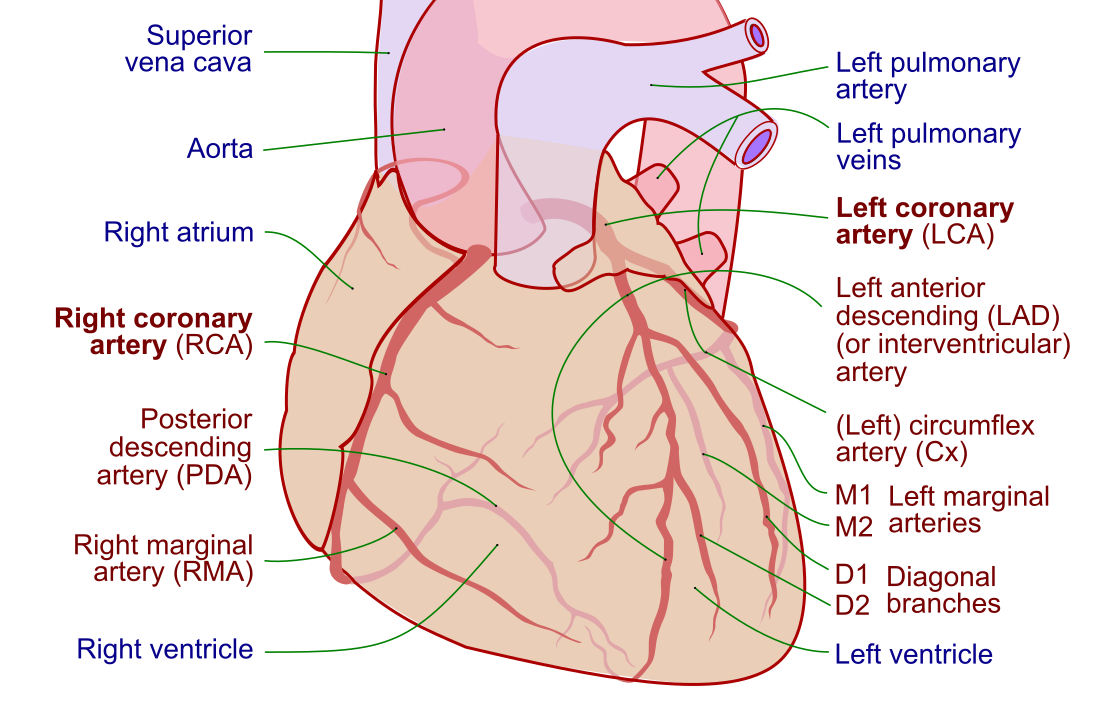
A typical shift is a blend of scheduled cases and unscheduled emergencies. Elective mornings might feature diagnostic angiograms and planned stents; an afternoon can be upended the moment a STEMI activation pages the on-call team.
The rhythm of a routine case looks something like this:
- Pre-procedure — review the patient's history and labs, confirm consent, verify allergies (especially contrast), and set up the room, sterile trays, and hemodynamic system.
- Access and setup — assist with radial or femoral access, connect pressure transducers, zero the lines, and confirm a clean waveform before catheters advance.
- The procedure — hand or record as the operator navigates the coronaries or right heart, inject contrast for imaging, capture pressures and gradients, and stay alert for arrhythmia, hypotension, or a vasovagal reaction.
- Intervention, if needed — support balloon angioplasty and stent deployment, monitor the activated clotting time (ACT), and manage the anticoagulation and antiplatelet workflow.
- Closure and recovery — assist with hemostasis or a closure device, document the case, and hand off to recovery staff with a clear report.
Because cath labs run emergency call, many techs rotate through nights and weekends to be ready for a heart attack at 3 a.m. The STEMI patient who arrives mid-infarction is the reason the field measures itself in "door-to-balloon" minutes — and the tech is part of the clock that saves heart muscle.
Duties and skills every cath lab tech needs
The duties and skills of a cath lab tech reach well beyond "handing instruments." The role blends technical mastery, clinical vigilance, and calm under pressure. Here is what separates a competent tech from an indispensable one.
| Skill domain | Why it matters in the cath lab |
|---|---|
| Coronary and cardiac anatomy | You must recognize each vessel and chamber on fluoroscopy to anticipate the operator's next move. |
| Hemodynamics | Reading pressure waveforms and gradients in real time — the core of the monitor role. |
| ECG and rhythm recognition | Catching lethal arrhythmias the instant they appear on the tracing. |
| Radiation safety | Minimizing dose to patient and team through shielding, ALARA practice, and geometry. |
| Pharmacology | Knowing cath-lab drugs — anticoagulants, antiplatelets, vasoactives — and their timing. |
| Sterile technique | Preventing infection during an invasive vascular procedure. |
| Equipment fluency | Troubleshooting injectors, transducers, and the recording system on the fly. |
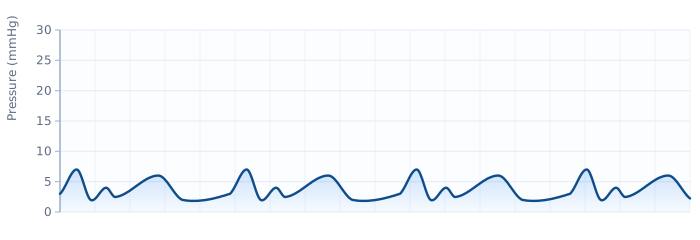
Two of these deserve extra emphasis. First, hemodynamic literacy: a tech must instantly recognize a normal right-atrial tracing versus a giant v-wave, or a damped aortic pressure that signals a problem with the catheter. Building that fluency starts with the fundamentals of pressure, flow, and resistance — the same relationships behind systemic vascular resistance, cardiac output, and cardiac index. Second, ECG vigilance: because catheters irritate the myocardium, brushing up on ECG interpretation and knowing how to respond to SVT or a bradycardic vagal episode is a daily necessity, not a nicety.
Medications and monitoring in the cath lab
Pharmacology is where a cath lab tech's knowledge quietly prevents disaster. The tech who records medications and watches the monitor must understand not just what a drug is, but when it is given, what it does to the numbers on the screen, and what to expect if something goes wrong.
The everyday cath-lab formulary clusters into a few groups:
- Anticoagulants — heparin and bivalirudin keep catheters and the arterial system from clotting; the tech tracks the ACT to confirm adequate anticoagulation before and during intervention.
- Antiplatelet agents — aspirin plus a P2Y12 inhibitor reduce stent thrombosis around PCI.
- Vasoactive and emergency drugs — nitroglycerin for coronary spasm and chest pain, atropine for vagal bradycardia, and pressors for sudden hypotension.
- Contrast media — iodinated dye makes the arteries visible; the tech watches for allergic-type reactions and helps manage contrast volume in patients with kidney disease.
A deeper working knowledge of these agents lives in dedicated references on cath lab medications and, for the patients who arrive in or develop pump failure, heart failure medications. Monitoring ties it together: the tech correlates each drug with the hemodynamic and rhythm response, so a dose of atropine that fails to lift a heart rate, or a pressure that keeps falling despite fluids, becomes an early warning the whole team can act on. When the numbers point toward circulatory collapse, understanding shock hemodynamics helps the team choose the next step.
How to become a cardiac cath lab tech
There is more than one road into the cath lab, but the common milestones are education, supervised clinical training, and credentialing. Here is how to become one.
- Earn the education — most techs complete an associate degree in cardiovascular technology or a related allied-health program. Some enter through nursing, radiologic technology, or surgical technology and cross-train into the invasive setting; others complete a certificate after a prior health-science degree.
- Complete clinical training — accredited programs include supervised hours in a working cath lab, where you learn the scrub, monitor, and circulate roles under experienced staff.
- Earn the credential — the gold-standard credential for invasive work is the RCIS (Registered Cardiovascular Invasive Specialist), awarded by Cardiovascular Credentialing International (CCI) after a national exam. Some techs also hold registered nurse or radiologic-technologist licensure depending on their entry path.
The RCIS exam weighs heavily on the exact knowledge the job demands: cardiac anatomy, hemodynamics, ECG, pharmacology, radiation safety, and procedural technique. Solidifying the fundamentals through structured guides on cardiac anatomy and hemodynamics, then drilling with focused ECG practice questions and hemodynamics practice questions, is the most efficient path to a passing score. For the wider allied-cardiology landscape and other entry points, the overview of how to become a cardiovascular technologist maps the alternatives.
A practical suggestion: shadow a working cath lab before committing. The environment rewards people who stay composed in emergencies, tolerate wearing heavy lead for long stretches, and enjoy fast, procedural teamwork. If that sounds energizing rather than exhausting, the invasive path may be a strong fit.
Cardiac cath lab tech salary and job outlook
Compensation is one of the most-searched questions about this career, and the pay is competitive for the training required. In the United States, cardiovascular technologists and cath lab techs generally earn a median in the broad range of roughly $60,000 to $95,000 per year, with experienced, RCIS-credentialed invasive techs in busy interventional programs, high-cost regions, or travel roles earning toward — and sometimes above — the top of that band. Emergency call pay and shift differentials meaningfully raise total earnings for techs who cover nights and weekends.
Several factors move the number:
- Credentials — holding the RCIS tends to lift pay and widen job options.
- Setting — high-volume interventional and structural-heart labs typically pay above lower-acuity sites.
- Call burden — STEMI call and off-hours coverage add call pay and differentials.
- Geography and experience — metropolitan, high-cost areas and senior techs command more, though the premium often tracks local expenses.
The outlook is favorable. Employment for cardiovascular technologists is projected to grow faster than the average for all occupations over the coming decade, driven by an aging population, rising cardiovascular disease burden, and the expanding volume of catheter-based and structural procedures. Because these figures shift year to year, treat any single number as a snapshot rather than a promise; a fuller, more current picture lives in the deeper look at cardiovascular technologist salary and the field's job outlook.
Cath lab tech vs cardiac sonographer: invasive vs non-invasive
Prospective techs often weigh the invasive cath lab against the non-invasive imaging side of cardiology, so a direct comparison helps. Both careers demand deep cardiac knowledge, but the day-to-day experience could hardly be more different.
| Feature | Cardiac cath lab tech (invasive) | Cardiac sonographer (non-invasive) |
|---|---|---|
| Primary tools | Catheters, guidewires, X-ray fluoroscopy | Ultrasound transducer |
| Radiation | Ionizing radiation (lead protection required) | None |
| Invasiveness | Invasive (arterial/venous access) | Non-invasive (skin contact only) |
| Pace | Fast, procedural, often emergent | Deliberate, image-quality focused |
| Call burden | Frequent emergency STEMI call | Usually limited or none |
| Core credential | RCIS | RCS or RDCS |
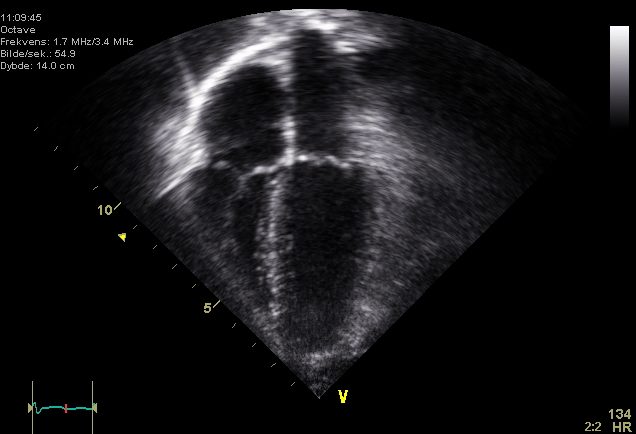
The two disciplines are complementary rather than competing. An echocardiogram can estimate a valve gradient or pump function from the outside, while the cath lab measures pressures and cardiac output directly from within. Patients frequently move between both worlds when findings disagree or an intervention is planned. Anyone drawn to the imaging side can explore the role of the cardiovascular ultrasound technologist, while those set on the procedural side will find the invasive path detailed throughout this guide.
Career growth and specialization
The cath lab is rarely a dead-end job; it is a launchpad. Once a tech is solid across the scrub, monitor, and circulate roles, several avenues open up.
- Electrophysiology (EP) — moving into the EP lab to support ablations for atrial fibrillation and device implants demands mastery of the cardiac conduction system and complex mapping systems.
- Structural heart — labs performing valve repair and replacement (such as TAVR) need techs comfortable with advanced imaging fusion and larger delivery systems.
- Lead and supervisory roles — experienced techs step into charge, education, or lab-management positions.
- Industry and applications — device and imaging companies hire seasoned techs as clinical specialists and trainers.
Underlying every one of these tracks is the same non-negotiable foundation: a firm grasp of coronary anatomy, the physiology of coronary artery disease and myocardial infarction, and the hemodynamic reasoning that turns raw pressures into clinical meaning. Techs who keep sharpening those fundamentals — and who add credentials as they specialize — position themselves for the most interesting and best-paid corners of invasive cardiology.
To keep skills current, many techs return regularly to core references and question banks. Working through rhythm interpretation and ECG strip practice keeps rhythm recognition razor-sharp long after the RCIS exam is behind them.
Key takeaways
- A cardiac cath lab tech — an invasive cardiovascular technologist, often credentialed as an RCIS — works directly with the interventional cardiologist during catheter-based heart procedures.
- What they do: rotate through the scrub, monitor, and circulate roles, handling devices, recording hemodynamics and rhythm, and managing medications and complications.
- Duties and skills span coronary anatomy, hemodynamics, ECG vigilance, radiation safety, cath-lab pharmacology, and sterile technique.
- How to become one: complete an accredited cardiovascular technology program with clinical hours, then earn the RCIS credential from CCI.
- Salary in the US typically runs roughly $60,000–$95,000, rising with the RCIS, interventional volume, call burden, and region; job growth outpaces the average occupation.
- The invasive cath lab contrasts with non-invasive imaging: catheters and fluoroscopy versus radiation-free ultrasound — complementary sides of cardiology.
- This overview is educational and not medical or career-placement advice; verify current pay, scope, and program requirements locally.
Study for the RCIS exam free
Drill cath-lab anatomy, hemodynamics, ECG, and pharmacology with instant feedback.
Start Free Practice →Frequently asked questions
What is a cardiac cath lab tech?
A cardiac cath lab tech is an allied-health professional who assists during invasive cardiac procedures in the catheterization laboratory. Working alongside the interventional cardiologist, the tech rotates through scrubbing at the sterile table, monitoring pressure waveforms and heart rhythm, and circulating to manage medications and supplies. The most common credential for the role is the RCIS (Registered Cardiovascular Invasive Specialist).
What does a cardiac cath lab tech do all day?
A tech prepares patients and the room, assists with vascular access, hands devices during angiograms and stent procedures, records hemodynamic pressures and ECG rhythm, tracks anticoagulation with the ACT, and watches for complications such as arrhythmias or hypotension. Days mix scheduled diagnostic and elective cases with emergency STEMI activations that can happen any hour.
What skills does a cardiac cath lab tech need?
Core skills include coronary and cardiac anatomy, hemodynamic waveform interpretation, ECG and arrhythmia recognition, radiation safety, cath-lab pharmacology, sterile technique, and equipment troubleshooting. Just as important are calm under pressure, sharp situational awareness, and smooth teamwork, because a routine case can turn emergent in seconds.
How do you become a cardiac cath lab tech?
Most people complete an accredited associate degree or certificate in cardiovascular technology that includes supervised clinical hours in a cath lab, then earn the RCIS credential from Cardiovascular Credentialing International (CCI) by passing a national exam. Some enter from nursing or radiologic technology and cross-train into the invasive setting. Requirements vary by state and employer, so verify locally.
What is the RCIS credential?
RCIS stands for Registered Cardiovascular Invasive Specialist, the gold-standard credential for invasive cath-lab work, awarded by CCI after a national exam. The test covers cardiac anatomy, hemodynamics, ECG, pharmacology, radiation safety, and procedural technique. Holding the RCIS generally improves hiring prospects and pay in the cath lab.
How much does a cardiac cath lab tech make?
In the United States, cardiovascular technologists and cath lab techs generally earn a median in the broad range of about $60,000 to $95,000 per year. RCIS credentialing, high interventional volume, emergency call pay, shift differentials, seniority, and high-cost regions push earnings toward the top of that range. Published figures are broad and change yearly, so treat any single number as a snapshot.
Is being a cardiac cath lab tech dangerous?
The main occupational exposure is ionizing radiation from fluoroscopy, which is managed with lead aprons, thyroid shields, leaded glasses, protective barriers, dosimeters, and ALARA (as-low-as-reasonably-achievable) technique. Long shifts wearing heavy lead also carry ergonomic strain. With disciplined safety practice, the field is considered a safe, well-regulated allied-health career.
What is the difference between a cath lab tech and a cardiac sonographer?
A cath lab tech works in the invasive setting, using catheters and X-ray fluoroscopy and measuring pressures directly inside the heart. A cardiac sonographer works non-invasively, using radiation-free ultrasound to image the heart from the skin and estimate function and pressures. Their core credentials differ too — RCIS for invasive work versus RCS or RDCS for echocardiography — and the two roles are complementary.
Can a cath lab tech advance their career?
Yes. Experienced techs commonly specialize in electrophysiology or structural-heart procedures, move into charge, educator, or lab-management roles, or join device and imaging companies as clinical specialists. Adding credentials and deepening expertise in anatomy, hemodynamics, and rhythm opens the most advanced and best-compensated positions in invasive cardiology.
Sources & further reading
- Cardiovascular Credentialing International (CCI)
- American College of Cardiology
- American Heart Association
- MedlinePlus (U.S. National Library of Medicine)
External links are provided for reference; always confirm current details with the official source.