Cardiovascular Technologist Job Outlook
The cardiovascular technologist job outlook is strong and getting stronger — driven by an aging population, a heavy burden of heart disease, and a wave of retirements thinning the workforce. This guide breaks down the demand growth, where the jobs actually are, what the BLS projections mean, and how to stay competitive.
The outlook in one snapshot
If you are weighing a career as a cardiovascular technologist — or already training for one — the headline is encouraging. Demand for people who can run diagnostic and interventional cardiac procedures is projected to keep climbing over the coming decade, and the reasons behind that growth are structural rather than temporary. Heart disease is not going away, the population that suffers from it is getting older and larger, and the specialized skills needed to diagnose and treat it cannot be automated away.
The U.S. Bureau of Labor Statistics (BLS) tracks this field under the occupation “diagnostic medical sonographers and cardiovascular technologists and technicians.” Its long-range projections have consistently shown growth that runs faster than the average for all occupations. Exact percentages shift each time the BLS updates its Occupational Outlook Handbook, so treat any single figure as a moving target and always confirm the current number at the source. The direction, however, has been remarkably stable: up.
Below we unpack what drives that demand, where the openings cluster geographically and by setting, how much the BLS numbers can — and cannot — tell you, and the concrete moves that keep you at the front of the hiring line.
What a cardiovascular technologist actually does
Before you can judge an outlook, it helps to be precise about the job, because “cardiovascular technologist” is really an umbrella over several distinct roles. What ties them together is that they operate the equipment and assist the physicians who diagnose and treat diseases of the heart and blood vessels.
- Invasive (cath lab) technologists work alongside cardiologists during procedures such as coronary angiography, stenting, and structural interventions. If you want the full picture, our overview of the invasive cardiovascular technologist role and of what happens in a cardiac cath lab go deeper. These are the technologists most likely to sit for the RCIS credential.
- Noninvasive (echo) technologists, often called cardiac sonographers, perform echocardiograms to image the heart’s chambers, valves, and pumping function.
- Electrophysiology and device technologists assist with ablations and pacemaker and defibrillator work.
- Vascular technologists focus on the arteries and veins outside the heart.
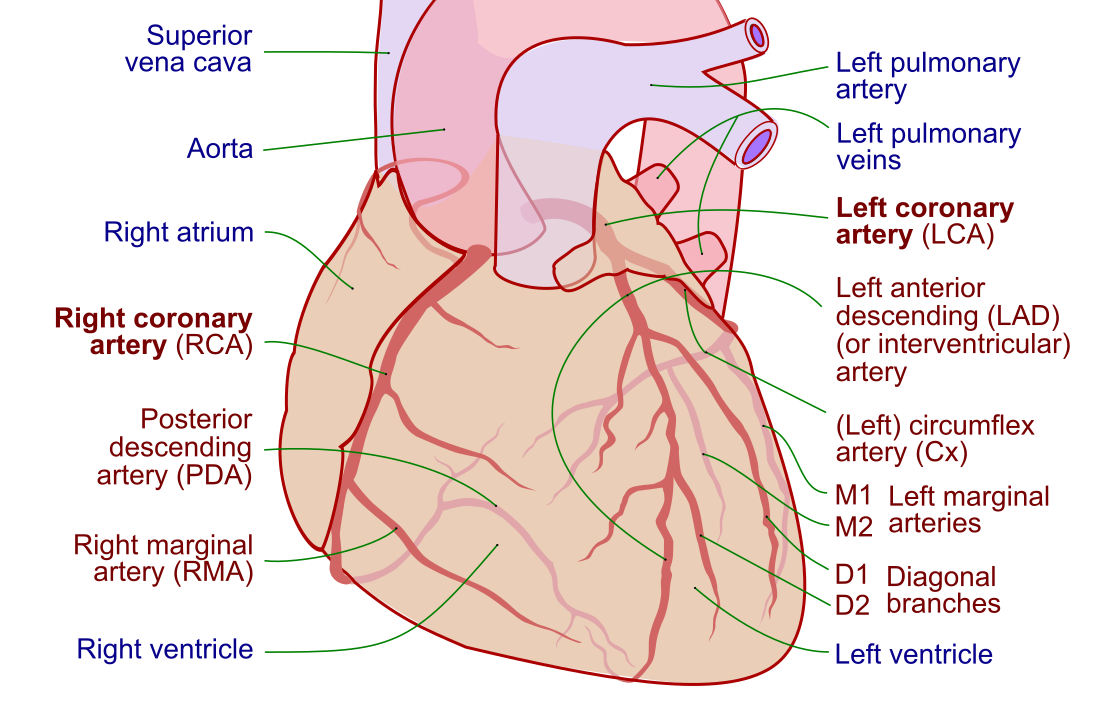
Why does this matter for the outlook? Because demand is not uniform across these tracks. The interventional and structural side is expanding fastest as more conditions once treated with open surgery move into the cath lab. A strong grounding in coronary artery anatomy, hemodynamics, and ECG interpretation is what lets a technologist move between these tracks — and mobility is exactly what keeps you employable.
Why demand keeps growing
The strength of this outlook is not a fluke of one good year. It rests on several forces that reinforce one another, and understanding them helps you predict where the field is headed even as specific numbers change.
An aging population. The single biggest driver is demographics. As the large baby-boomer generation ages, the number of people living with heart disease rises sharply. Age is the dominant risk factor for coronary artery disease, valve disease, and arrhythmias such as atrial fibrillation — and every one of those conditions generates cardiovascular testing and procedures.
A heavy, persistent disease burden. Cardiovascular disease remains the leading cause of death in the United States and worldwide. Rising rates of obesity, diabetes, and hypertension keep the pipeline of patients full, and earlier, more aggressive diagnosis means more echocardiograms, stress tests, and catheterizations per patient.
A shift toward minimally invasive care. Procedures that once required open-heart surgery are increasingly done through catheters. Transcatheter valve replacement, complex percutaneous coronary intervention, and catheter ablation for arrhythmias have all expanded the cath lab’s workload — and every one of those cases needs skilled technologists.
Workforce turnover. A large share of projected openings comes not from brand-new positions but from replacement needs: experienced technologists retiring or moving into education, industry, or management. This “replacement demand” is easy to overlook but is a real, ongoing source of jobs.
Where the jobs are
A national outlook only takes you so far; the practical question is where the openings sit — by setting, by region, and by specialty. Location shapes both your odds of landing a role and what you’ll be paid for it.
By work setting. Hospitals employ the largest share of cardiovascular technologists, and that is where most cath-lab and inpatient echo work lives. But a growing slice of jobs sits in outpatient environments:
| Setting | Typical work | Outlook notes |
|---|---|---|
| Hospitals | Cath lab, EP lab, inpatient echo, stress testing | Largest employer; core of interventional demand |
| Cardiology group practices | Office echo, stress tests, device checks | Growing as care shifts outpatient |
| Outpatient imaging / ASCs | Diagnostic imaging, elective procedures | Expanding fast; often daytime hours |
| Academic / research centers | Complex structural cases, teaching | Access to cutting-edge procedures |
By geography. Demand tends to concentrate where the population is older and where large hospital systems operate — but so does the supply of trained technologists. The most favorable markets for job seekers are often not the biggest cities but mid-sized metros and rural regions, where recruiting is harder and employers may offer relocation help, sign-on bonuses, or higher pay to fill seats. If you are geographically flexible, that flexibility is real leverage. For a closer look at how location and setting move pay, see our breakdown of cardiovascular technologist salary.
By specialty. Within the field, the invasive and electrophysiology tracks and advanced echocardiography (including transesophageal and structural imaging) tend to be the hardest roles to fill — which translates directly into stronger bargaining power and pay for technologists who hold those skills.
Reading the BLS numbers correctly
The BLS Occupational Outlook Handbook is the most authoritative free source for this field, and it is worth learning to read it well rather than repeating a single stat you saw somewhere. A few habits will keep you accurate.
Find the right occupation. Cardiovascular technologists are grouped with diagnostic medical sonographers, so the headline growth figure covers a blended category. That blend can be higher or lower than the outlook for the cath-lab track specifically, so read the detail, not just the top line.
Separate the three numbers. The handbook reports distinct data points that people often confuse:
| BLS metric | What it means |
|---|---|
| Percent growth | Projected change in total jobs over ten years — the “faster than average” headline |
| Numeric change | How many new positions that percent represents |
| Annual openings | Average yearly openings, including replacement of workers who leave — usually the most useful figure for a job seeker |
| Median pay | Midpoint wage; half earn more, half less |
Treat projections as estimates, not promises. BLS figures are modeled forecasts. They are revised on a roughly two-year cycle and can shift with the economy, technology, and healthcare policy. The evidence base here is genuinely evolving, so hedge accordingly: use the numbers to gauge direction and relative strength, not to predict your exact salary or the number of jobs in your zip code. Always verify the current figures directly at bls.gov before citing them.
Credentials that move the needle
A strong outlook rewards candidates who can prove competence, and in this field that proof is a professional credential. Certification is frequently a hiring requirement, a pay differentiator, and in some states a practical necessity.
The most relevant credentials depend on your track:
- RCIS (Registered Cardiovascular Invasive Specialist), from Cardiovascular Credentialing International, is the standard for the cath lab. It is the credential this site is built to help you earn — start with our hemodynamics guide and a round of hemodynamics practice questions.
- RCES (Registered Cardiac Electrophysiology Specialist) targets the EP lab.
- RCS / RDCS certifications cover adult echocardiography for the noninvasive track.
- RVT / RVS credentials cover the vascular track.
Employers increasingly favor graduates of programs accredited by CAAHEP, and many will hire you “registry-eligible” on the condition that you pass your boards within a set window. Earning the credential early — and adding a second one — is one of the clearest ways to convert a good outlook into a good offer. Our guide to cardiovascular technologist schooling and the path to becoming a cardiovascular technologist lay out the steps.
How to stay competitive
A rising tide lifts the field, but individual careers still rise and fall on skill and adaptability. Here is how to make sure the strong outlook works for you, not just the profession in aggregate.
- Cross-train across modalities. The technologists in highest demand can move between the cath lab, the EP lab, and echo. Each added competency — reading a wedge tracing, recognizing a dangerous rhythm on the monitor, assisting a structural case — widens the set of shifts you can cover and the jobs you qualify for. Build the foundation with ECG interpretation and rhythm recognition.
- Master the fundamentals cold. Physiology does not go out of date. Deep comfort with cardiac output, ejection fraction, and systemic vascular resistance makes you faster and safer in the room — and it shows.
- Recognize emergencies instantly. Employers value technologists who can spot a STEMI or a run of ventricular tachycardia and react. Drill these until they are reflexive.
- Keep certifications current. Maintain your registry, log continuing education, and add a second credential when you can. Registry lapses are an avoidable way to fall behind.
- Stay flexible on location and schedule. Willingness to relocate, take call, or work a hard-to-staff shift is genuine leverage in negotiation.
- Follow the technology. Structural heart, intravascular imaging, and physiologic assessment are growth areas. Learning the newest procedures early makes you the person a lab wants to keep.
Honest headwinds to weigh
No outlook is all upside, and a fair assessment names the friction too. None of these erase the strong demand, but they shape day-to-day reality and are worth going in with eyes open.
The work is demanding. Cath-lab technologists stand for long stretches in lead aprons, take call, and manage the physical toll of radiation-protective gear and overnight cases. Burnout is real, and schedules can be unpredictable.
Credentialing takes time and money. Accredited programs, clinical hours, and board exams represent a genuine up-front investment before the strong outlook pays off.
Geography can bind you. The best-paying, easiest-to-land roles are not always where you want to live. Saturated urban markets can be competitive even when the national picture is rosy.
Technology keeps moving. The same innovation that drives demand also means continuous learning is non-negotiable. Skills that were cutting-edge a decade ago become table stakes, and standing still is a slow way to fall behind.
Weighed against strong, structural demand and meaningful, well-compensated work, most people in the field find these trade-offs worth it — but they are real, and you should factor them into your plan rather than discover them later.
Key takeaways
- The cardiovascular technologist job outlook is strong, with BLS projecting faster-than-average growth driven by an aging population and a heavy burden of heart disease.
- Growth has two engines: new positions and replacement demand as experienced technologists retire — which is why annual openings often exceed the raw growth rate.
- Jobs cluster in hospitals but are expanding into outpatient practices and imaging centers; mid-sized and rural markets can offer the best odds and incentives.
- Read BLS numbers carefully: separate percent growth, numeric change, and annual openings, and treat projections as evolving estimates — always verify at bls.gov.
- The interventional, EP, and advanced-echo tracks are hardest to fill, giving credentialed technologists in those areas the most leverage.
- To stay competitive, cross-train across modalities, master hemodynamics and ECG cold, keep certifications current, and stay flexible on location and technology.
- Weigh real headwinds — physical demands, call, up-front training cost, and constant learning — against the field’s strong, durable demand.
- This article is educational career guidance, not employment, financial, or medical advice; confirm current figures with primary sources before making decisions.
Frequently asked questions
What is the job outlook for cardiovascular technologists?
The outlook is strong. The U.S. Bureau of Labor Statistics projects faster-than-average employment growth for the category that includes cardiovascular technologists, driven by an aging population, a high burden of heart disease, and a shift of procedures into the cath lab. Many openings also come from replacing technologists who retire or leave the field. Because BLS revises its projections periodically, check bls.gov for the current figure.
Are cardiovascular technologists in demand?
Yes. Demand is fueled by demographics and disease burden: as more people live longer with coronary artery disease, valve disease, and arrhythmias, the need for diagnostic and interventional cardiac procedures rises. The interventional, electrophysiology, and advanced echocardiography tracks are especially hard to staff, so credentialed technologists in those areas are particularly sought after.
Why is demand for cardiovascular technologists growing?
Several forces stack together: the baby-boomer generation is aging into peak heart-disease years, cardiovascular disease remains the leading cause of death, and many treatments have shifted from open surgery to minimally invasive catheter-based procedures that require skilled technologists. On top of that, a wave of retirements creates ongoing replacement demand for new workers.
Where are the most cardiovascular technologist jobs?
Hospitals employ the largest share, particularly for cath-lab and inpatient work, but jobs are expanding in cardiology group practices and outpatient imaging centers. Geographically, mid-sized metros and rural regions often have the strongest hiring because they are harder to staff, sometimes offering sign-on bonuses or relocation help to attract technologists.
What does the BLS say about cardiovascular technologist growth?
The BLS groups cardiovascular technologists with diagnostic medical sonographers and projects faster-than-average growth for the combined category over its ten-year outlook window. Its Occupational Outlook Handbook reports percent growth, numeric change, average annual openings, and median pay. The exact numbers change with each revision, so treat them as directional estimates and verify the latest data at bls.gov.
How can I stay competitive as a cardiovascular technologist?
Cross-train across modalities so you can work in the cath lab, EP lab, and echo; master core physiology like hemodynamics and ECG interpretation; keep your certifications current and add a second credential; recognize emergencies such as STEMI and ventricular tachycardia instantly; and stay flexible on location, call, and new technology. Each of these turns a strong field-wide outlook into a strong personal one.
Do you need certification to be a cardiovascular technologist?
In most cases, yes — certification is a common hiring requirement and a pay differentiator. Cath-lab technologists typically pursue the RCIS credential; the EP track uses RCES; noninvasive echo uses RCS or RDCS; and vascular work uses RVT or RVS. Many employers hire graduates as registry-eligible on the condition that they pass their boards within a set time frame.
Is being a cardiovascular technologist a good career?
For many people, yes. It offers strong, structurally driven demand, meaningful hands-on work in cardiac care, and solid pay, especially in high-skill niches. The trade-offs include physical demands, on-call schedules, radiation-safety gear in the cath lab, and the up-front cost of accredited training and board exams. Weighing those honestly against the strong outlook helps you decide if the fit is right.
Will automation replace cardiovascular technologists?
It is unlikely to replace them in the foreseeable future. The role blends hands-on procedural skill, real-time judgment during live cases, and patient interaction that current technology cannot reproduce. Automation and AI are more likely to assist — for example in image analysis — than to eliminate the job, which reinforces the value of technologists who keep their skills current.
Sources & further reading
- Cardiovascular Credentialing International (CCI)
- American College of Cardiology
- American Heart Association
- MedlinePlus (U.S. National Library of Medicine)
External links are provided for reference; always confirm current details with the official source.