The Cardiac Conduction System: Pathway & Order
Every heartbeat begins as a whisper of electricity in a cluster of cells no larger than a grain of rice — and the cardiac conduction system is the wiring that turns that spark into a coordinated, life-sustaining squeeze of the heart.
- What Is the Cardiac Conduction System?
- The SA Node: The Heart's Natural Pacemaker
- The Conduction Pathway: Order From SA to Purkinje
- The AV Node: The Critical Delay
- The His-Purkinje System: The Ventricular Fast Lane
- Intrinsic Rates: The Built-In Backup Pacemakers
- How Conduction Maps Onto the ECG
- When Conduction Goes Wrong
- Autonomic Control: Speeding and Slowing the Heart
- Why This Matters for the Cath Lab and the RCIS Exam
- Key Takeaways
What Is the Cardiac Conduction System?
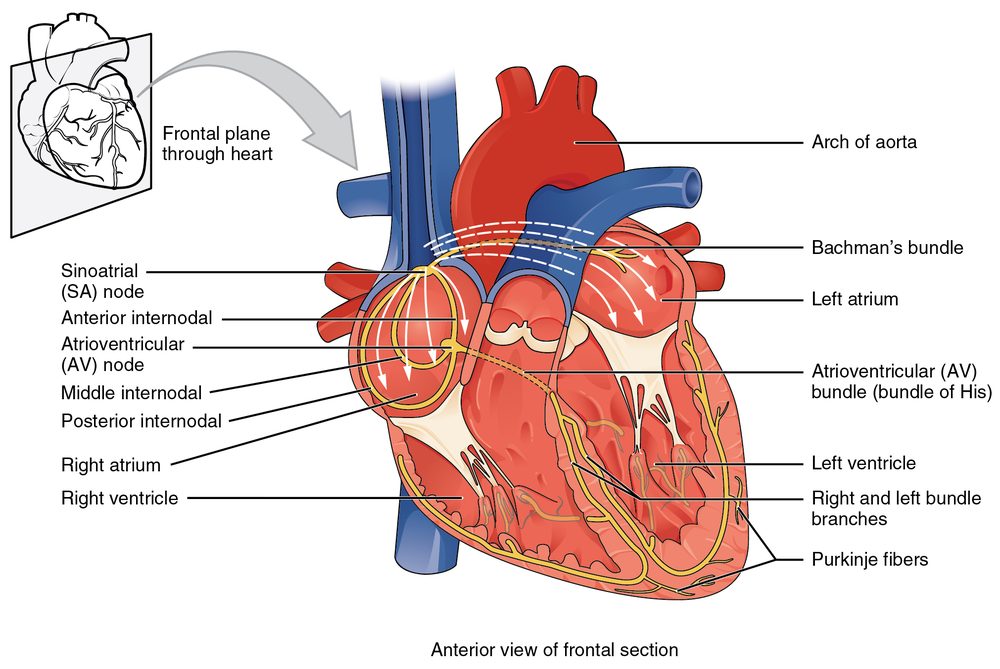
The cardiac conduction system is the heart's built-in electrical network — a set of specialized cells that generate an impulse and then relay it, in a precise sequence, so the chambers contract in the right order and at the right moment. Ordinary cardiac muscle can conduct electricity, but this dedicated system does the job faster, more reliably, and with the timing that makes the heart an efficient pump rather than a bag of quivering muscle.
What sets these cells apart is automaticity: the ability to depolarize on their own, without any signal from the brain or nerves. The heart transplanted into a new chest still beats, because its pacemaker cells keep their own time. The nervous system and circulating hormones modulate the rate — speeding it up during exercise, slowing it at rest — but they do not start the beat. That independence is the single most important idea in this whole topic.
For anyone preparing for the RCIS exam, this system is the foundation beneath almost everything else — every rhythm you read, every block you recognize, and every arrhythmia you treat is a story about this wiring working, failing, or being bypassed. This article is educational content for exam preparation and general learning; it is not medical advice, and clinical decisions always belong to a qualified care team following current guidelines. To see how these electrical events sit inside the pump itself, it helps to keep the broader cardiac anatomy guide in mind as you read.
The SA Node: The Heart's Natural Pacemaker
The journey of every normal heartbeat starts in the sinoatrial (SA) node, a small crescent of specialized cells tucked into the wall of the right atrium near where the superior vena cava enters. The SA node is the heart's dominant pacemaker for one simple reason: it depolarizes faster than anything else in the system, so it fires first and sets the pace before any slower site gets the chance.
SA node cells do not sit still electrically. They have an unstable resting membrane potential that slowly drifts upward — a gradual leak of ions called the funny current — until it reaches threshold and fires. Then the cycle repeats. That automatic drift is what makes the node self-starting, and it is the target of the autonomic nervous system: sympathetic stimulation steepens the drift and speeds the rate, while vagal (parasympathetic) tone flattens it and slows the heart.
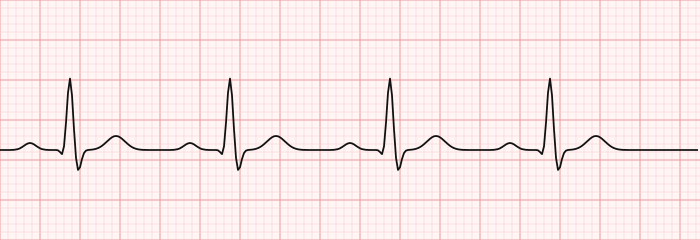
Because the SA node lives in the right atrium, its impulse spreads across both atria first, triggering atrial contraction. On the ECG this is the P wave. When the SA node is in charge and everything downstream behaves, the result is normal sinus rhythm — the reference rhythm against which every other tracing is judged.
The Conduction Pathway: Order From SA to Purkinje
The single most tested fact in this topic is the pathway order — the exact sequence the impulse follows from birth to the last contracting muscle fiber. Memorize it once and much of ECG interpretation falls into place. The impulse travels:
- SA node — the impulse originates in the right atrium.
- Atrial muscle / internodal pathways — the wave spreads across both atria (Bachmann's bundle carries it to the left atrium), producing the P wave and atrial contraction.
- AV node — the impulse reaches the atrioventricular node at the base of the right atrium and slows dramatically.
- Bundle of His — the signal enters the only normal electrical bridge between atria and ventricles.
- Right and left bundle branches — the His bundle splits, sending fibers down each side of the interventricular septum.
- Purkinje fibers — a fine mesh that fans the impulse across the ventricular walls, depolarizing the muscle from the inside out and bottom up.
That last stretch — bundle of His to Purkinje network — is the fast lane. It fires the ventricular muscle almost simultaneously so both ventricles contract as a coordinated unit, which is exactly what an efficient ejection requires. When this highway is intact, the QRS complex on the ECG is narrow. When part of it is blocked, the impulse has to crawl through ordinary muscle instead, and the QRS widens.
Because this sequence maps so directly onto the waves of a tracing, it pays to pair it with focused ECG practice. Working through the RCIS ECG guide and a set of practice ECG strips lets you watch the same pathway play out on dozens of real rhythms.
The AV Node: The Critical Delay
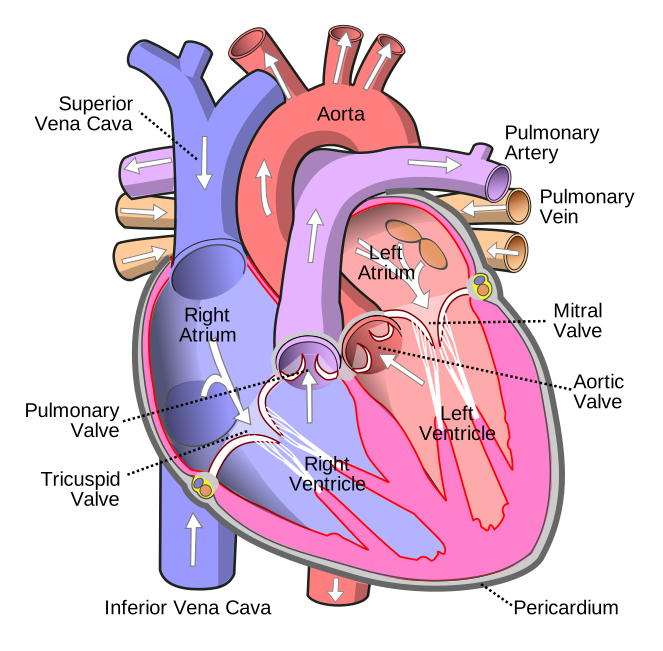
If the SA node is the spark, the atrioventricular (AV) node is the gatekeeper. Sitting near the base of the right atrium in a region called Koch's triangle, just above the ventricles, it is the sole normal electrical connection between the top and bottom of the heart — everywhere else, a fibrous skeleton insulates the atria from the ventricles.
The AV node does something that sounds like a flaw but is actually the point: it slows the impulse down. This deliberate delay — roughly a tenth of a second — is what lets the atria finish contracting and topping off the ventricles with blood before the ventricles squeeze. Without that pause, atrial and ventricular contraction would overlap and pumping efficiency would collapse. On the ECG, the AV delay shows up as the flat PR segment and contributes to the PR interval.
The AV node has a second, protective job. Its slow conduction acts as a filter that limits how many impulses reach the ventricles when the atria go haywire. In atrial fibrillation or atrial flutter, the atria fire hundreds of times a minute; the AV node blocks most of those signals so the ventricles are not driven to a lethal rate. That gatekeeping is also why the AV node is a target in certain arrhythmia treatments.
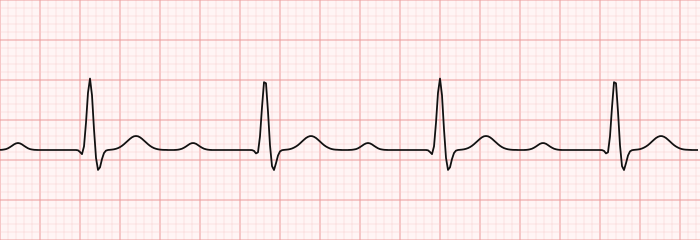
When AV conduction fails outright, the result is heart block, and knowing this anatomy is what lets you tell a benign PR prolongation from a dangerous complete block. The interplay of timing and pressure here also ties directly into filling and output, explored in the hemodynamics guide.
The His-Purkinje System: The Ventricular Fast Lane
Once the impulse clears the AV node, it enters the bundle of His, a short trunk of fast-conducting fibers that dives into the interventricular septum. There it divides into the right bundle branch, which serves the right ventricle, and the left bundle branch, which quickly splits into anterior and posterior fascicles to serve the larger left ventricle.
These branches feed into the Purkinje fibers — a branching web woven through the inner walls of both ventricles. The Purkinje network is the fastest-conducting tissue in the entire heart, and its speed is the whole design: it delivers the impulse to widely separated regions of ventricular muscle almost at the same instant. The ventricles therefore depolarize as a coordinated whole rather than as a slow wave creeping cell to cell, and that synchrony is what produces a strong, efficient contraction.
On the ECG, this rapid, organized ventricular depolarization is the QRS complex. When the His-Purkinje system is healthy, the QRS is narrow — typically under 0.12 seconds — because the whole ventricle lights up quickly. Damage to one branch (a bundle branch block) forces the impulse to travel the long way through ordinary muscle, delaying part of the ventricle and widening the QRS. Damage or irritation here can also spawn dangerous fast rhythms such as ventricular tachycardia.
Intrinsic Rates: The Built-In Backup Pacemakers
Here is where the system's elegance really shows. Every level of the conduction pathway can generate its own impulse if the site above it fails — a cascade of backup pacemakers each running at a slower intrinsic rate. This redundancy means the heart rarely stops just because one pacemaker quits; a lower site simply takes over, buying time.
The rates form a descending ladder, and the RCIS exam expects you to know them:
| Pacemaker site | Intrinsic rate (bpm) | When it takes over |
|---|---|---|
| SA node | 60–100 | Normal, dominant pacemaker |
| AV node / junction | 40–60 | SA node fails or is blocked (junctional rhythm) |
| Ventricles (His-Purkinje / myocardium) | 20–40 | Both SA and AV pacemakers fail (ventricular escape) |
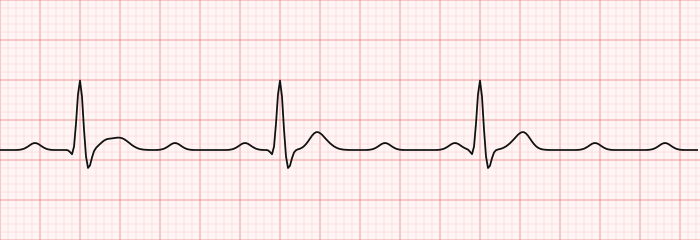
The pattern is intuitive once you see it: the higher the pacemaker sits, the faster it fires, and the faster site always suppresses the slower ones. So the SA node normally silences the junction and ventricles simply by beating them to the punch. If the SA node slows or stops, the junctional pacemaker escapes at 40–60 bpm. If the junction also fails or the impulse cannot cross a complete block, a ventricular escape rhythm at 20–40 bpm becomes the last line of defense.
How Conduction Maps Onto the ECG
The ECG is nothing more than a graph of the conduction system in action. Each wave corresponds to a specific step in the pathway, so once you know the anatomy you can practically narrate a tracing.
| ECG feature | Conduction event |
|---|---|
| P wave | Atrial depolarization (SA node fires, atria activate) |
| PR interval | Time from atrial activation through the AV node delay |
| QRS complex | Ventricular depolarization via the His-Purkinje network |
| T wave | Ventricular repolarization (recovery) |
Read that table as a timeline. The P wave is the SA node's signal sweeping across the atria. The flat PR segment is the AV node holding the impulse back so the ventricles can fill. The narrow QRS is the His-Purkinje system firing the ventricles almost at once. The T wave is the ventricles resetting for the next beat. A prolonged PR points to the AV node; a wide QRS points to the bundle branches or ventricular muscle; a missing or abnormal P wave points to a problem at or above the atria.
This is why the conduction system is the master key to rhythm interpretation. If you can locate where a tracing deviates from the normal pathway, you can usually name the arrhythmia. Building that reflex is the aim of dedicated study in ECG interpretation and structured ECG rhythm interpretation, and it is worth reinforcing with a bank of RCIS ECG practice questions until the mapping becomes automatic.
When Conduction Goes Wrong
Almost every arrhythmia is a failure or hijacking of the normal pathway, and grouping them by where the trouble sits makes them far easier to learn.
- Pacemaker problems (SA node): if the SA node fires too slowly you get sinus bradycardia; too fast, sinus tachycardia; erratically, sick sinus syndrome. These are disorders of the impulse's origin.
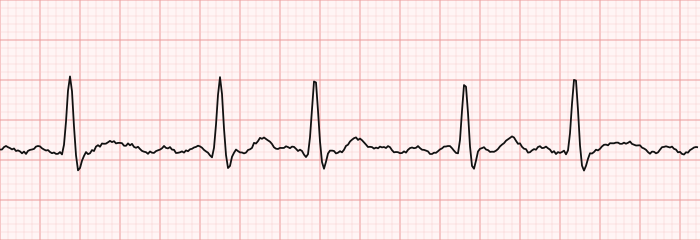
- Conduction blocks (AV node and below): when impulses are delayed or dropped between atria and ventricles, the result is first-, second-, or third-degree AV block. Bundle branch blocks are the same idea one level lower, in the ventricular wiring.
- Reentry and abnormal circuits: some rhythms arise when an impulse loops around a circuit instead of dying out, re-exciting tissue over and over. This mechanism drives many forms of supraventricular tachycardia and atrial flutter.
- Ectopic and ventricular rhythms: an irritable focus below the AV node can seize control, producing the wide, fast complexes of ventricular tachycardia or the chaotic, unsurvivable-without-treatment pattern of ventricular fibrillation.
Modern therapy often works directly on this wiring. Catheter ablation destroys a reentrant circuit or ectopic focus, while a pacemaker supplies impulses when the natural pacemakers fail. Guideline-directed management of these rhythms continues to evolve — particularly around when to ablate versus medicate and the growing role of conduction-system pacing — so specifics should always be checked against the latest society recommendations rather than treated as fixed.
Autonomic Control: Speeding and Slowing the Heart
The conduction system starts the beat on its own, but it does not set the rate in a vacuum. The autonomic nervous system constantly tunes it to match the body's needs, acting mainly on the SA and AV nodes.
The sympathetic branch — the fight-or-flight system — releases norepinephrine, which steepens the SA node's spontaneous drift so it reaches threshold sooner. The heart speeds up, the AV node conducts faster, and contraction strengthens. This is what happens when you exercise, feel afraid, or receive a stimulant. The parasympathetic branch, carried by the vagus nerve, does the opposite: it releases acetylcholine, flattens the drift, and slows both SA firing and AV conduction. Resting vagal tone is why a calm, fit person can sit at a heart rate in the 50s.
This balance explains a great deal of normal physiology — the gentle rise and fall of heart rate with breathing (sinus arrhythmia), the surge with a startle, the slowing during a deep breath or a vasovagal faint. It also underlies a bedside maneuver: vagal stimulation (like a carotid massage or Valsalva) can slow AV conduction enough to break certain reentrant tachycardias. The nodes are exquisitely sensitive to this input precisely because their pacemaker cells depend on that slow ionic drift the autonomic transmitters modulate.
Why This Matters for the Cath Lab and the RCIS Exam
For the registered cardiovascular invasive specialist, the conduction system is not abstract theory — it is a live variable in the room. Catheters advanced through the right heart can brush the AV node or bundle of His and provoke transient block or ectopy. Electrophysiology studies map this exact wiring to locate arrhythmia sources. Ablations deliberately interrupt it. Pacemaker leads are positioned to substitute for it, and increasingly to recruit it directly through conduction-system pacing.
Because of that, the RCIS blueprint leans on this material heavily. Expect questions on the pathway order, the intrinsic rates of each backup pacemaker, the role of the AV node delay, and how each conduction event maps onto the ECG. These are not isolated facts — they connect to hemodynamics (timing drives filling and output), to anatomy (where the wiring runs), and to rhythm recognition (where a tracing goes wrong). Consolidating them with a focused set of hemodynamics practice questions alongside your rhythm drills ties the electrical and mechanical sides of the heart together.
One last framing worth carrying into the exam: the heart's conduction system is a masterclass in engineering redundancy. A dominant fast pacemaker, a deliberate delay to coordinate filling, a fast network to fire the ventricles as one, and a chain of slower backups if any part fails. Understand that design, and the individual rhythms stop being a list to memorize and become variations on a system you actually understand.
Key Takeaways
- The cardiac conduction system is the heart's own electrical wiring; its cells have automaticity and generate the heartbeat without any input from the brain.
- The pathway order is SA node → atrial pathways → AV node → bundle of His → right and left bundle branches → Purkinje fibers.
- The SA node is the dominant pacemaker (60–100 bpm) because it fires fastest and suppresses slower sites.
- The AV node deliberately delays the impulse so the atria can fill the ventricles, and it filters fast atrial rhythms to protect the ventricles.
- The His-Purkinje network is the fastest-conducting tissue, firing both ventricles nearly simultaneously and producing a narrow QRS.
- Intrinsic rates form a backup ladder: SA 60–100, AV/junction 40–60, ventricle 20–40 bpm.
- On the ECG, the P wave, PR interval, QRS, and T wave map directly onto atrial activation, AV delay, ventricular depolarization, and recovery.
- The autonomic nervous system tunes rate via the SA and AV nodes but does not start the beat.
- This is educational content for RCIS preparation and general learning, not medical advice.
Practise anatomy & ECG
Test the conduction system, rhythms, and anatomy with explanations.
Practise Now →Frequently asked questions
What is the correct order of the cardiac conduction system?
The impulse travels in this order: SA (sinoatrial) node, then across the atria through the internodal and atrial pathways, to the AV (atrioventricular) node, then the bundle of His, then the right and left bundle branches, and finally the Purkinje fibers that spread the signal through the ventricular muscle. A common mnemonic is that the impulse goes from the top of the right atrium down to the tips of the ventricles.
What is the difference between the SA node and the AV node?
The SA node is the heart's natural pacemaker; it sits in the right atrium, fires fastest (60–100 bpm), and starts each normal beat. The AV node sits lower, between the atria and ventricles, and its job is to deliberately slow the impulse so the atria can finish filling the ventricles before they contract. The SA node initiates; the AV node delays and filters.
Why does the AV node delay the impulse?
The roughly 0.1-second AV node delay gives the atria time to contract and top off the ventricles with blood before the ventricles squeeze. Without this pause, atrial and ventricular contraction would overlap and the heart would pump much less efficiently. The delay also protects the ventricles by limiting how many impulses get through during very fast atrial rhythms like atrial fibrillation.
What are the intrinsic rates of the cardiac pacemakers?
The SA node fires at 60–100 beats per minute, the AV node or junctional tissue fires at 40–60 bpm, and the ventricular (His-Purkinje or myocardial) pacemakers fire at 20–40 bpm. The higher the site, the faster it fires. If a higher pacemaker fails, a lower one takes over at its slower intrinsic rate as a backup.
Which part of the heart is the natural pacemaker?
The sinoatrial (SA) node, located in the wall of the right atrium near the superior vena cava, is the heart's natural pacemaker. It is dominant because its cells depolarize spontaneously faster than any other conduction tissue, so it fires first and sets the rhythm before slower pacemakers can activate.
What happens if the SA node stops working?
If the SA node slows or fails, a lower pacemaker takes over automatically. Usually the AV node or junctional tissue escapes at 40–60 bpm; if that also fails or the impulse cannot cross a block, a ventricular escape rhythm at 20–40 bpm becomes the last line of defense. This redundancy is why the heart rarely stops just because one pacemaker quits, though a very slow escape rhythm can still be dangerous.
How does the conduction system relate to the ECG?
Each ECG wave reflects a conduction event: the P wave is atrial depolarization from the SA node, the PR interval covers the AV node delay, the QRS complex is ventricular depolarization through the His-Purkinje system, and the T wave is ventricular recovery. Because of this direct mapping, an abnormal wave usually points to a specific spot in the conduction pathway.
Why is the QRS complex narrow in a normal heart?
The QRS is narrow (typically under 0.12 seconds) because the His-Purkinje network conducts the impulse extremely fast, activating both ventricles almost simultaneously. When part of that fast network is blocked, such as in a bundle branch block, the impulse has to travel slowly through ordinary muscle instead, which delays part of the ventricle and widens the QRS.
Does the nervous system control the heartbeat?
The nervous system tunes the heart rate but does not start the heartbeat. The conduction system generates the beat on its own through automaticity. The sympathetic nervous system speeds the rate and the parasympathetic (vagus) nerve slows it, both acting mainly on the SA and AV nodes. This is why a transplanted heart, with its nerves cut, still beats on its own.
Sources & further reading
- Cardiovascular Credentialing International (CCI)
- American College of Cardiology
- American Heart Association
- MedlinePlus (U.S. National Library of Medicine)
External links are provided for reference; always confirm current details with the official source.