Heart Block: First, Second & Third Degree (AV Block)
Heart block — specifically atrioventricular (AV) block — represents a spectrum of conduction delays and failures along the electrical pathway connecting the atria to the ventricles. Ranging from benign, asymptomatic PR prolongation (first-degree) to life-threatening complete electrical dissociation (third-degree), mastering the recognition, anatomical localization, ischemic correlations, and pacing indications of AV blocks is a cornerstone of clinical practice and the RCIS examination.
- What Is Heart Block (Atrioventricular Block)?
- Systematic 3-Step ECG Analysis Method
- First-Degree AV Block
- Second-Degree AV Block: Mobitz Type I (Wenckebach)
- Second-Degree AV Block: Mobitz Type II
- The 2:1 AV Block Diagnostic Challenge
- Third-Degree (Complete) AV Block
- Etiologies and Ischemic Correlations (Inferior vs Anterior MI)
- Emergency Management and Pacemaker Indications
- RCIS Exam & Cath Lab Hemodynamic Pearls
- Key Takeaways for Exam Success
What Is Heart Block (Atrioventricular Block)?
Atrioventricular (AV) block is an impairment, delay, or complete interruption of electrical impulse transmission from the atria to the ventricles. Under normal physiological conditions, an electrical impulse generated by the sinoatrial (SA) node traverses the atrial myocardium, enters the compact atrioventricular (AV) node located within the triangle of Koch in the right atrium, travels down the Bundle of His, and bifurcates into the right and left bundle branches to trigger coordinated ventricular systole.
When disease, ischemia, drugs, or excessive autonomic tone alters the conduction properties of this pathway, AV block occurs. Clinically and electrocardiographically, heart block is classified into three progressive degrees based on the severity of the conduction disturbance:
- First-Degree AV Block: A uniform conduction delay where every atrial impulse reaches the ventricles, but the transit time through the AV node is prolonged (PR interval >0.20 seconds).
- Second-Degree AV Block: Intermittent conduction failure where some atrial impulses reach the ventricles while others are blocked. Subdivided into Mobitz Type I (Wenckebach) and Mobitz Type II.
- Third-Degree (Complete) AV Block: Total conduction failure where no atrial impulses reach the ventricles, resulting in independent atrial and ventricular pacemaking (AV dissociation).
Anatomical localization is the single most critical factor determining clinical prognosis and treatment. Blocks occurring within the AV node (nodal) are typically stable, responsive to autonomic changes, and reversible. Blocks occurring below the AV node (infranodal / His-Purkinje) are unstable, resistant to atropine, prone to sudden asystolic pauses, and almost universally mandate permanent pacemaker implantation.
Systematic 3-Step ECG Analysis Method
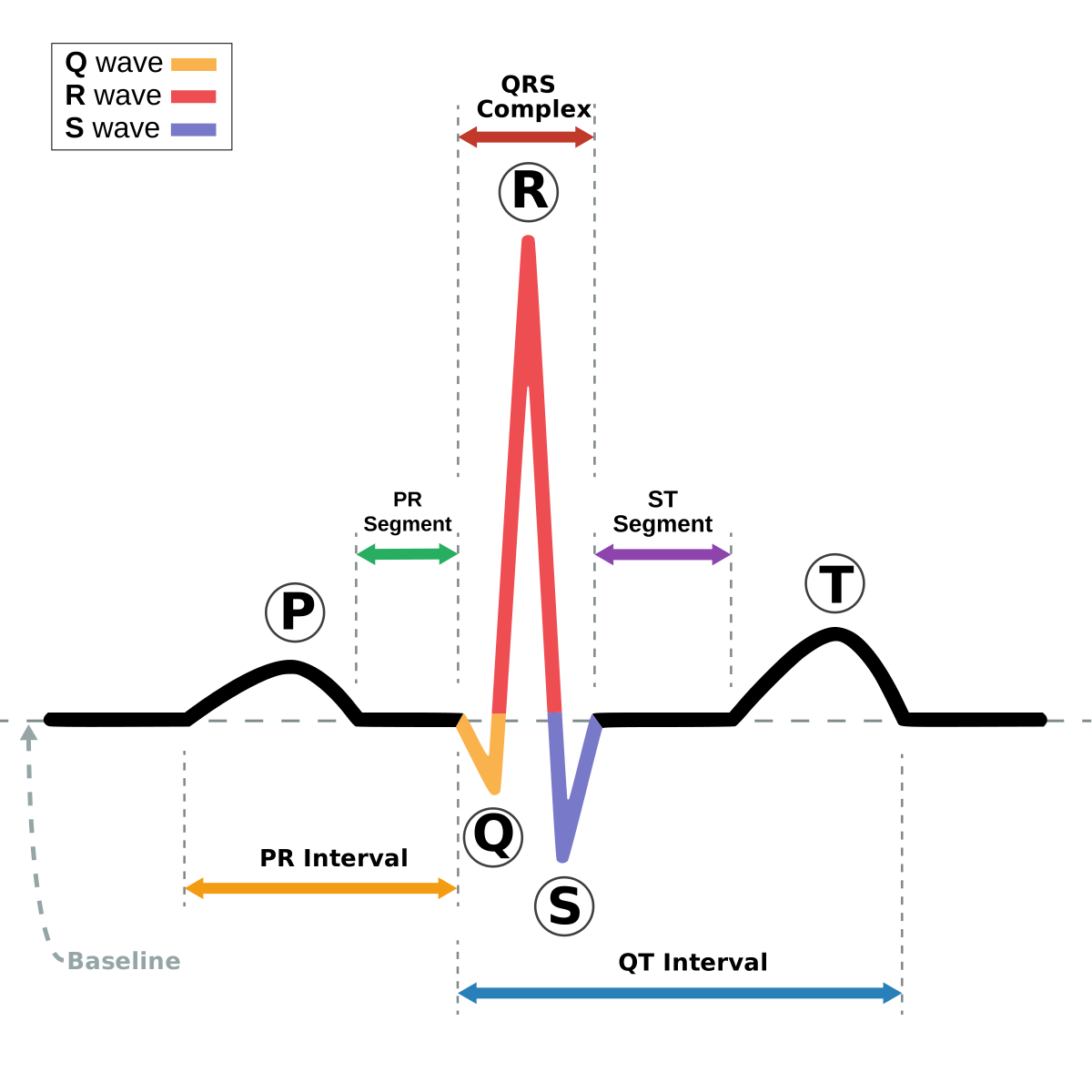
Accurately diagnosing heart blocks on a rhythm strip or 12-lead ECG requires a methodical, step-by-step approach rather than quick pattern matching:
- Step 1: Map and Measure the P Waves (Atrial Rhythm): Use calipers to march out all P waves across the strip. Determine the atrial rate and check if the P–P intervals are regular. In complete heart block, P waves will march through with relentless regularity, even when buried inside QRS complexes or T waves.
- Step 2: Measure the PR Interval and Note Its Pattern: Measure from the beginning of the P wave to the beginning of the QRS complex.
- Is the PR interval fixed and normal (<0.20 s)?
- Is it fixed but prolonged (>0.20 s)? → First-degree AV block.
- Does the PR interval progressively lengthen from beat to beat until a QRS is dropped? → Second-degree Mobitz I (Wenckebach).
- Is the PR interval constant on conducted beats with sudden, unannounced dropped QRS complexes? → Second-degree Mobitz II.
- Step 3: Evaluate the P-to-QRS Relationship and QRS Width:
- Is there a 1:1 relationship between every P wave and QRS?
- Are there more P waves than QRS complexes (e.g., 2:1, 3:1, or variable conduction)?
- Are the P waves and QRS complexes completely dissociated with differing rates? → Third-degree AV block.
- Is the QRS narrow (<0.12 s, suggesting a nodal block with junctional escape) or wide (≥0.12 s, suggesting infranodal block or ventricular escape)?
First-Degree AV Block
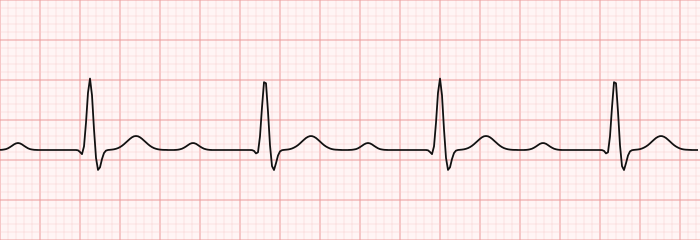
First-degree AV block is characterized by a consistently prolonged PR interval (>0.20 seconds, or 200 ms / 5 small squares on standard ECG paper) with a 1:1 relationship between P waves and QRS complexes. Every atrial impulse conducts to the ventricles; conduction is simply delayed, typically within the AV node itself.
Etiologies & Clinical Management:
- High Vagal Tone: Highly trained endurance athletes and healthy young adults frequently exhibit physiological first-degree block during rest or sleep.
- Pharmacological Agents: Negative dromotropic medications including beta-blockers, non-dihydropyridine calcium channel blockers (diltiazem, verapamil), and digoxin.
- Ischemia / Structural: Inferior myocardial ischemia, early degenerative conduction disease, and acute inflammatory conditions (Lyme carditis, acute rheumatic fever).
- Management: Asymptomatic first-degree block requires no treatment other than monitoring and potential medication titration. In rare instances of extreme PR prolongation (>0.30–0.35 seconds), late atrial contraction occurs during early ventricular diastole (coinciding with the preceding T wave), leading to reduced ventricular filling, elevated wedge pressure, and 'pseudo-pacemaker syndrome' which may warrant dual-chamber pacing.
Second-Degree AV Block: Mobitz Type I (Wenckebach)
Second-degree Mobitz Type I (Wenckebach) AV block is characterized by progressive prolongation of the PR interval over successive beats until a single atrial impulse fails to conduct to the ventricles (dropped QRS complex), after which the cycle resets.
Classic Electrocardiographic Features:
- Progressive PR prolongation: The PR interval of the beat immediately following the dropped beat is the shortest in the cycle, and the PR interval preceding the pause is the longest.
- Group beating: QRS complexes appear in distinct clusters (e.g., 3:2 or 4:3 conduction ratios).
- Progressive shortening of R–R intervals: Because the increment of PR prolongation decreases with each cycle, the R–R intervals actually shorten leading up to the dropped beat.
- The pause containing the dropped P wave is less than twice the preceding R–R interval.
- The QRS complex is typically narrow (<0.12 s) because the block resides within the compact AV node.
Clinical Significance: Mobitz I is generally benign and hemodynamically well-tolerated. It is commonly observed in athletes, during high vagal states, and in the setting of acute inferior myocardial infarction. It rarely progresses to complete heart block. If symptomatic bradycardia occurs, it typically responds briskly to intravenous atropine.
Second-Degree AV Block: Mobitz Type II
Second-degree Mobitz Type II AV block is characterized by sudden, unexpected non-conducted P waves occurring in the setting of constant, unchanging PR intervals on all conducted beats. There is no warning or progressive PR lengthening prior to the dropped QRS complex.
| Diagnostic Feature | Mobitz Type I (Wenckebach) | Mobitz Type II |
|---|---|---|
| Anatomical Site of Block | AV Node (intranodal) | His-Purkinje System (infranodal / subnodal) |
| PR Interval Behavior | Progressively lengthens before dropped beat | Strictly constant on all conducted beats |
| QRS Complex Width | Usually Narrow (<0.12 s) | Usually Wide (≥0.12 s) with bundle branch block |
| Conduction Ratio | Often variable (3:2, 4:3) with group beating | Often fixed (2:1, 3:1) or unpredictable |
| Response to Atropine | Improves conduction (nodal enhancement) | May worsen block (increases atrial rate against a refractory His bundle) |
| Clinical Prognosis | Benign, rarely progresses to CHB | Ominous, high risk of sudden progression to asystole or complete block |
| Pacing Indication | Rare (only if symptomatic) | Mandatory Class I indication for permanent pacemaker |
Etiologies & Clinical Danger: Mobitz II is caused by structural disease or necrosis within the infranodal conduction system (Bundle of His or bundle branches). Common causes include anterior myocardial infarction (extensive septal necrosis) and chronic idiopathic conduction system sclerosis (Lev's disease or Lenègre's disease). Because it reflects advanced structural disease, Mobitz II carries a severe risk of abrupt progression to third-degree heart block or ventricular asystole. Permanent pacemaker implantation is indicated even in asymptomatic patients.
The 2:1 AV Block Diagnostic Challenge
A special and common clinical dilemma occurs when an ECG displays a 2:1 AV block — every other P wave conducts to a QRS complex. Because there are never two consecutive conducted beats in a row, one cannot observe whether the PR interval progressively lengthens (Mobitz I) or remains constant (Mobitz II).
To differentiate whether a 2:1 block is nodal (Mobitz I) or infranodal (Mobitz II), clinicians apply several clinical clues:
- QRS Duration: If the QRS is narrow (<0.12 s), the block is nodal (Mobitz I) in ~80% of cases. If the QRS is wide (≥0.12 s with bundle branch block), the block is infranodal (Mobitz II) in ~80% of cases.
- Response to Atropine or Exercise: Atropine or exercise increases SA node firing and enhances AV nodal conduction. In nodal block (Mobitz I), conduction improves (e.g., 2:1 converts to 3:2 Wenckebach or 1:1 conduction). In infranodal block (Mobitz II), faster sinus rates overwhelm the diseased His-Purkinje system, worsening the block (e.g., 2:1 block degenerates to 3:1 or complete block).
- Response to Carotid Sinus Massage: Carotid sinus pressure increases vagal tone, slowing AV nodal conduction. In nodal block, the conduction ratio worsens; in infranodal block, the slower atrial rate actually allows the His-Purkinje system more time to recover, occasionally improving conduction to 1:1.
- Co-existing Rhythms: Long rhythm strips that capture transitions into 3:2 Wenckebach or periods of fixed PR intervals provide the definitive answer.
Third-Degree (Complete) AV Block
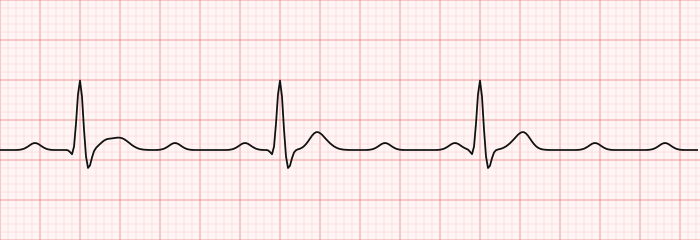
Third-degree AV block represents total failure of conduction between the atria and the ventricles. No atrial impulses reach the ventricular myocardium. As a result, the atria and ventricles are driven by completely independent electrical pacemakers — the classic definition of complete AV dissociation.
Electrocardiographic Hallmarks:
- Regular P–P Intervals: The SA node fires normally, producing uniform P waves at a rate of 60–100 bpm that march out with consistent calipers across the entire tracing.
- Regular R–R Intervals: The ventricles are sustained by an independent subsidiary escape pacemaker firing at a slow, regular rate.
- Atrial Rate > Ventricular Rate: The P wave frequency is distinctly higher than the QRS frequency.
- Variable PR Intervals: Because the two pacemakers operate without communication, the distance between P waves and QRS complexes changes randomly on every beat. P waves may appear before, during, or after the QRS, or fuse into the ST segment and T wave.
Escape Pacemaker Characteristics:
| Escape Pacemaker | Anatomical Location | Intrinsic Rate | QRS Morphology | Stability & Reliability |
|---|---|---|---|---|
| Junctional Escape | AV junction / Bundle of His | 40–60 bpm | Narrow (<0.12 s) | Relatively stable, responds to catecholamines/atropine. Seen in nodal block / inferior MI. |
| Ventricular Escape | Purkinje fibers / Ventricular myocardium | 20–40 bpm | Wide (≥0.12 s), bizarre | Highly unstable, prone to sudden asystole or degenerating into ventricular fibrillation. Seen in anterior MI. |
Etiologies and Ischemic Correlations (Inferior vs Anterior MI)
Understanding the coronary arterial blood supply to the cardiac conduction system is essential for anticipating heart block during acute coronary syndromes in the cardiac cath lab:
- Sinoatrial (SA) Node: Supplied by the SA nodal branch arising from the Right Coronary Artery (RCA) in 60% of individuals, and from the Left Circumflex (LCx) in 40%.
- Atrioventricular (AV) Node: Supplied by the AV nodal branch arising from the dominant coronary artery — the RCA in 85–90% of individuals (right-dominant), and the LCx in 10–15% (left-dominant).
- Bundle of His and Bundle Branches: The penetrating Bundle of His is supplied by the AV nodal artery and septal perforating branches of the Left Anterior Descending (LAD) artery. The right bundle and left anterior fascicle are supplied primarily by the LAD septal branches, while the left posterior fascicle has dual supply from the LAD and posterior descending artery (PDA).
| Feature | AV Block in Acute Inferior MI | AV Block in Acute Anterior MI |
|---|---|---|
| Culprit Artery | Right Coronary Artery (RCA) → AV nodal branch | Left Anterior Descending (LAD) → Septal perforators |
| Mechanism | Ischemia/edema of AV node + Bezold-Jarisch vagal reflex | Extensive myocardial necrosis of bundle branches (infranodal) |
| Onset & Evolution | Progressive: 1st deg → Mobitz I → Complete block | Sudden, catastrophic: Mobitz II or sudden CHB |
| Escape Rhythm | Junctional escape (40–60 bpm, narrow QRS) | Ventricular escape (<30 bpm, wide QRS, unstable) |
| Response to Atropine | Usually favorable (reverses vagal tone) | Poor / unresponsive (block is infranodal tissue) |
| Clinical Prognosis | Usually transient (resolves in 3–7 days post-PCI); low mortality | Permanent, associated with massive pump failure / cardiogenic shock; high mortality (~50–80%) |
| Pacing Requirement | Temporary pacing if hypotensive; PPM rarely needed | Urgent temporary transvenous pacing; PPM usually indicated |
Emergency Management and Pacemaker Indications
Management of heart block follows the ACLS Bradycardia Algorithm, tailored to hemodynamic stability and the level of conduction disease:
1. Acute Symptomatic Bradycardia Protocol:
- First-Line Drug: Atropine 1.0 mg IV push, repeated every 3–5 minutes up to a maximum dose of 3.0 mg. Atropine acts by blocking parasympathetic vagal input to the SA and AV nodes.
Atropine Caution: Atropine is effective only for sinus bradycardia and nodal (Mobitz I) blocks. In Mobitz II and infranodal complete heart block with wide QRS, atropine is typically ineffective and may paradoxically accelerate the sinus rate, worsening the conduction ratio. Do not delay pacing for atropine in wide-complex CHB.
- Second-Line Infusions: If atropine is ineffective or pacing is being prepared:
- Dopamine IV infusion: 5 to 20 mcg/kg/min (inotropic and chronotropic support).
- Epinephrine IV infusion: 2 to 10 mcg/min titrated to patient response.
- Transcutaneous Pacing (TCP): Non-invasive external pacing applied via multifunction defibrillator pads (anterior-posterior placement preferred). Set rate to 60–80 bpm and increase current (milliamperes, mA) until both electrical capture (wide QRS and broad T wave following every spike) and mechanical capture (confirmed palpable femoral or right radial pulse) are established.
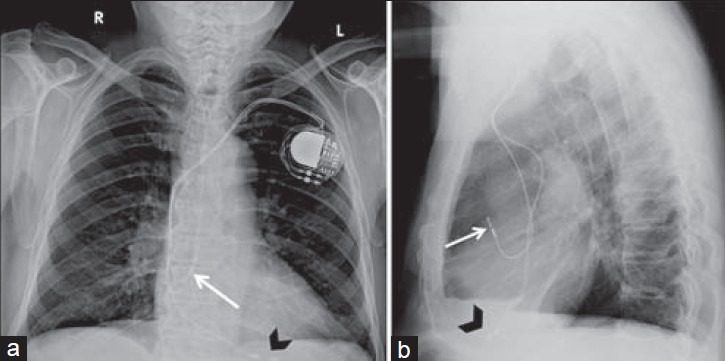
- Temporary Transvenous Pacing (TVP): Insertion of a bipolar pacing catheter through the internal jugular, subclavian, or femoral vein under fluoroscopic or ECG guidance into the apex of the right ventricle for reliable pacing support prior to definitive device implantation.
ACC/AHA Class I Indications for Permanent Pacemaker Implantation:
- Third-degree (complete) AV block at any anatomical level associated with persistent bradycardia or symptoms.
- Second-degree Mobitz Type II AV block with a wide QRS complex or documented infranodal conduction delay, regardless of symptoms.
- Second-degree Mobitz Type I (Wenckebach) or First-degree AV block with documented symptoms attributable to bradycardia.
- High-grade AV block (two or more consecutive non-conducted P waves with slow escape rate).
- Alternating bundle branch block (bifascicular block progressing to trifascicular disease).
RCIS Exam & Cath Lab Hemodynamic Pearls
For cardiovascular invasive specialists operating in the cath and EP environments, heart blocks present unique procedural and diagnostic challenges:
- Cannon 'a' Waves on Pressure Tracings: In complete heart block, when the atria contract synchronously against closed atrioventricular (tricuspid/mitral) valves during ventricular systole, massive retrograde pressure spikes called Cannon 'a' waves are recorded on Right Atrial (RA) and Pulmonary Capillary Wedge Pressure (PCWP) waveforms, accompanied by visible giant venous pulsations in the patient's internal jugular vein.
- Femoral Arterial Line Pulsus Alternans / Variation: Due to AV dissociation and fluctuating diastolic filling times, beat-to-beat stroke volume varies widely, creating dramatic fluctuations in invasive systolic arterial pressure.
- Right Heart Catheterization Risk in Left Bundle Branch Block (LBBB): In patients with pre-existing LBBB undergoing right heart catheterization with a Swan-Ganz catheter, mechanical irritation of the right bundle branch as the catheter traverses the right ventricular outflow tract can induce transient Right Bundle Branch Block (RBBB). In a patient with pre-existing LBBB, this produces complete bilateral bundle branch block and acute asystole. A temporary pacing catheter or transcutaneous pacer pads must be immediately available in the room.
- Temporary Pacing Threshold Testing:
- Pacing (Stimulation) Threshold: The minimum electrical energy (measured in mA or Volts) required to consistently capture the myocardium. Normal acute transvenous threshold is <0.5–1.0 mA. The generator output is set to 2 to 3 times the threshold for safety.
- Sensing Threshold: The minimum intrinsic cardiac signal amplitude (measured in millivolts, mV) detected by the pulse generator. Normal R-wave amplitude is >5–10 mV. Set sensitivity to half the measured intrinsic signal.
Key Takeaways for Exam Success
- First-degree AV block: PR >0.20 s, 100% conducted, normal QRS; usually benign.
- Mobitz I (Wenckebach): Progressive PR lengthening followed by dropped QRS; nodal site, narrow QRS, usually benign, responsive to atropine.
- Mobitz II: Constant PR interval with sudden unheralded dropped QRS; infranodal site, wide QRS, dangerous, Class I indication for permanent pacemaker.
- 2:1 AV block: Differentiate using QRS width and response to atropine (improves nodal/Mobitz I; worsens infranodal/Mobitz II).
- Third-degree (Complete) AV block: Total AV dissociation, atrial rate > ventricular rate, variable PR interval, escape rhythm sustains ventricles.
- Inferior MI causes nodal block (RCA ischemia, transient, responsive to atropine); Anterior MI causes infranodal block (LAD necrosis, permanent, high mortality).
- Atropine is first-line for symptomatic nodal bradycardia (1.0 mg IV push up to 3.0 mg); contraindicated as monotherapy in wide-complex infranodal CHB.
- Always have temporary pacing ready when passing a pulmonary artery catheter in a patient with baseline LBBB.
Practise heart-block recognition
Identify AV blocks on real ECG strips with instant feedback.
Practise ECG Strips →Frequently asked questions
What is the main difference between Mobitz I (Wenckebach) and Mobitz II heart block?
Mobitz I is a nodal block characterized by progressive PR interval lengthening before a dropped beat, usually with a narrow QRS and benign prognosis. Mobitz II is an infranodal block characterized by a constant PR interval with sudden dropped beats, usually with a wide QRS and high risk of sudden progression to complete heart block, requiring a permanent pacemaker.
Why is Mobitz II considered more dangerous than Mobitz I?
Mobitz II occurs in the His-Purkinje system below the AV node and reflects structural damage to the bundle branches. It has a high likelihood of abruptly degenerating into complete heart block or ventricular asystole without warning, which can cause syncope, cardiac arrest, or sudden death.
What is complete (third-degree) heart block on an ECG?
Complete heart block is the total failure of electrical conduction between atria and ventricles. The ECG displays complete AV dissociation: regular P-P intervals (atrial rate 60–100 bpm) and regular R-R intervals (escape rhythm 20–50 bpm) with variable, random PR relationships, and the atrial rate is always faster than the ventricular rate.
How does an inferior MI cause heart block differently from an anterior MI?
Inferior MI involves the RCA, which supplies the AV node, causing nodal block (often Mobitz I or CHB with narrow junctional escape) from edema and vagal reflex that is usually transient (resolves in days) and responsive to atropine. Anterior MI involves the LAD, causing septal necrosis and infranodal block (Mobitz II or wide ventricular escape) that is permanent and carries high mortality.
What are Cannon 'a' waves and when do they occur?
Cannon 'a' waves are large retrograde pressure spikes seen on right atrial (RA) and pulmonary capillary wedge pressure (PCWP) waveforms. They occur during complete heart block (AV dissociation) when the atria contract while the tricuspid and mitral valves are closed during ventricular systole.
Why is right heart catheterization risky in a patient with pre-existing Left Bundle Branch Block (LBBB)?
During pulmonary artery catheter insertion, mechanical contact against the right ventricular septum can induce transient Right Bundle Branch Block (RBBB). In a patient with baseline LBBB, blocking the remaining right bundle causes complete bilateral bundle branch block and acute ventricular asystole.
What is the initial medication and dose for acute symptomatic bradycardia in heart block?
According to ACLS guidelines, Atropine 1.0 mg IV push is the first-line medication, repeated every 3–5 minutes up to a maximum dose of 3.0 mg. It is effective for sinus bradycardia and nodal (Mobitz I) blocks, but ineffective for wide-complex infranodal blocks.
How do you determine the difference between Mobitz I and Mobitz II in a 2:1 AV block?
In a 2:1 block, check QRS width (narrow suggests Mobitz I, wide suggests Mobitz II). Administering atropine or exercise accelerates the sinus rate, which improves nodal conduction (Mobitz I) but worsens infranodal conduction (Mobitz II). Long rhythm strips capturing 3:2 cycles or constant PR intervals also clarify the diagnosis.
What are the Class I indications for a permanent pacemaker in AV block?
Class I indications include: (1) Third-degree (complete) AV block with persistent bradycardia or symptoms, (2) Second-degree Mobitz II AV block with wide QRS or infranodal delay regardless of symptoms, (3) Symptomatic second-degree Mobitz I or first-degree block, and (4) High-grade AV block.
Sources & further reading
- Cardiovascular Credentialing International (CCI)
- American College of Cardiology
- American Heart Association
- MedlinePlus (U.S. National Library of Medicine)
External links are provided for reference; always confirm current details with the official source.