Free RCIS Practice Test: Start with a Topic or Mixed Quiz
Choose your first question set here: a topic quiz for focused practice, or a mixed mock exam for broader review. No account or payment is required. After your attempt, use the results-to-study-plan guide to decide what to review next. These independent practice questions are not CCI examination items.
What a Free RCIS Practice Test Gives You
The Registered Cardiovascular Invasive Specialist (RCIS) credential, offered through Cardiovascular Credentialing International (CCI), tests a wide, procedure-focused body of knowledge — anatomy and physiology, hemodynamics, electrocardiography, pharmacology, procedural technique, and patient care in the cardiac catheterization lab. Reading about those topics builds recognition. Answering questions builds recall, and recall under time pressure is what the actual exam measures.
A good free RCIS practice test closes that gap. Instead of passively rereading notes, you retrieve facts, commit to an answer, and get immediate feedback on what you missed. That single change in study method — active retrieval instead of passive review — is one of the best-supported findings in learning science, and it is exactly what a question bank forces you to do.
On this site the practice question sets are organized by topic so you can target a weak area or run a mixed set. You will find dedicated banks for the core exam content, cardiac anatomy, hemodynamics, pharmacology, ECG rhythms, PCI, and radiation safety, plus image-based questions that show you an actual ECG strip or pressure waveform and ask you to interpret it.
This article and the practice questions are educational, written for RCIS exam preparation. They are not medical advice, and clinical decisions always belong to the treating team following current guidelines.
Online Practice Questions With No Signup
One of the most common frustrations in exam prep is hitting a paywall or a signup form before you can answer a single question. That is not how this works. Every practice bank here runs entirely in your browser as free online practice questions — no signup, no email, no credit card, and nothing to install. Open the page and start answering.
Because the whole thing runs client-side, a few useful features come along for free:
- Instant feedback mode: answer a question and immediately see whether you were right, with an explanation before you move on.
- Exam simulation mode: answer a whole set first, then review your score and every explanation at the end, the way a real testing session feels.
- Progress that sticks: your streaks, history, and bookmarked questions are saved locally in your own browser, so you can leave and pick up where you stopped without ever creating an account.
- Bookmark and review: flag the questions that trip you up and revisit just those later in a focused review set.
The tradeoff of a no-account design is that progress lives in the browser you used. Clearing your site data or switching devices starts you fresh — a fair price for never handing over your email. If you want to compare methods, the practice sets let you switch between instant and exam modes on the fly and filter by difficulty.
How to Use the Practice Test Effectively
Having free questions is only half the equation; how to use them determines whether your score actually moves. The single biggest mistake candidates make is treating a question bank as a scoreboard — answering the easy ones, feeling good, and skipping the topics that hurt. The questions that make you uncomfortable are the ones raising your real exam score.
A simple, repeatable routine works well:
- Take a baseline. Run a mixed set in exam mode without notes. Do not stop to look anything up. The goal is an honest starting point, not a good feeling.
- Read every explanation — especially on the ones you got right. A lucky guess is a gap in disguise. If you were not sure why the right answer was right, treat it as a miss.
- Sort your misses by topic. Three wrong hemodynamics questions and one wrong pharmacology question tell you exactly where to spend the next study block.
- Study the weak topic, then re-test it in isolation. Use a single-topic set — for example, the hemodynamics practice set or the ECG practice set — until you can clear it clean.
- Space it out. Come back to the same topic two or three days later. If you still remember it, it is learned; if not, it was never solid.
Aim for a mix: roughly two-thirds of your time on the topics you are weakest in, one-third keeping strong topics warm. And time yourself. The RCIS exam is timed, and pacing is a skill you can only build by practicing under the clock.
Topics Covered on the RCIS Exam
To study efficiently you need to know the topics covered on the exam and roughly how they are weighted. CCI publishes a detailed content outline, and the exact percentages are refined over time, so always confirm the current breakdown on the official CCI outline before you build a final plan. That said, the domains below have consistently formed the backbone of the RCIS blueprint, and they map directly to the practice banks on this site.
| Content area | What it covers | Practice here |
|---|---|---|
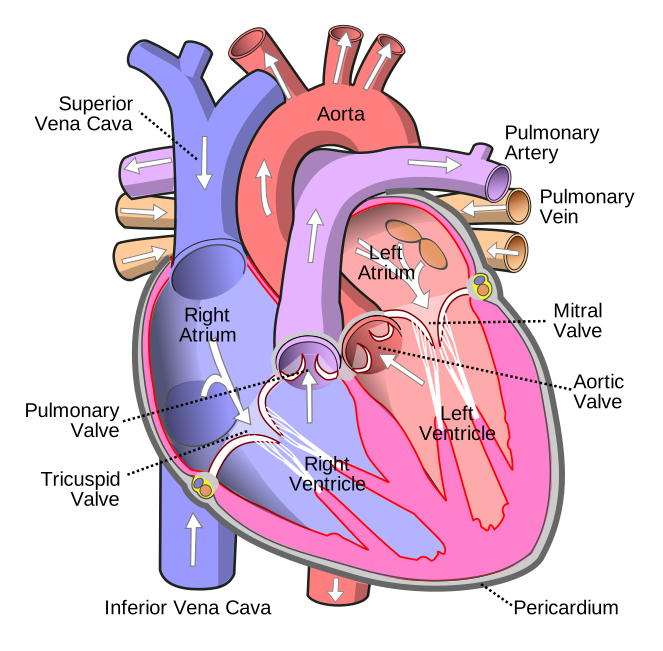
| Anatomy & physiology | Chambers, valves, coronary supply, conduction, circulation | Anatomy bank |
| Hemodynamics | Pressures, waveforms, cardiac output, gradients, shunts | Hemodynamics bank |
| Electrocardiography | Rhythm recognition, intervals, ischemia, blocks | ECG & ECG-strip banks |
| Pharmacology | Anticoagulants, vasoactive drugs, contrast, sedation | Pharmacology bank |
| Procedures & technique | Diagnostic cath, PCI, access, equipment | PCI bank |
| Patient care & safety | Monitoring, complications, radiation safety, infection control | Radiation-safety bank |
Two areas reliably carry the most weight and reward the most study: hemodynamics and electrocardiography. Our full hemodynamics guide, ECG guide, and cardiac anatomy guide teach the underlying concepts in depth, and each links out to the questions that drill them. The sections that follow zoom in on the two highest-yield domains.
ECG and Rhythm Questions
Rhythm recognition is one of the most heavily tested — and most trainable — parts of the RCIS exam. Many questions hand you a strip and ask a single thing: what is this rhythm, and what does it mean for the patient? The reliable path to answering fast is a fixed reading sequence: check rate, decide regular versus irregular, look for a P wave before every QRS, measure the intervals, and judge QRS width. Our step-by-step approach to ECG interpretation and the rhythm interpretation decision tree lay that sequence out in full.
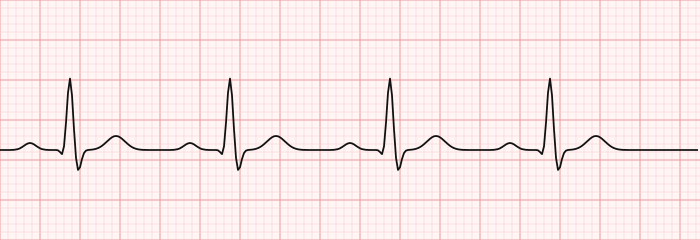
Start by anchoring yourself to normal sinus rhythm, shown above — regular, an upright P wave leading each narrow QRS, rate 60 to 100. Every abnormal rhythm is a deviation from that template. From there, the high-yield strips to know cold include:
- Atrial fibrillation: irregularly irregular, no organized P waves, wavy baseline.
- Supraventricular tachycardia: fast, regular, narrow QRS, P waves often buried.
- Ventricular tachycardia: fast, wide, regular — a must-not-miss.
- Heart block: from a fixed long PR to complete AV dissociation.
- ST-elevation MI: the lead pattern localizes the culprit artery, covered in our STEMI interpretation guide.
For the RCIS specifically, rhythms matter as live monitoring, not trivia — a catheter brushing the ventricle can trigger ectopy, and contrast in the right coronary can slow the rate. Drill the image questions in the ECG strip identification set until naming a rhythm is reflexive, then keep the timing rules sharp with the QTc calculator when a question asks about a prolonged QT.
Hemodynamics and Waveform Questions
If ECG is the most trainable domain, hemodynamics is the one that separates strong candidates from the pack — and it is where cath-lab practice actually lives. Expect questions on normal pressures in each chamber, how to identify a waveform, how to calculate cardiac output, and how to spot the fingerprints of specific pathologies. The physics reduces to one relationship worth memorizing: pressure gradient equals flow times resistance, which is the backbone of both cardiac output and systemic vascular resistance calculations.
Know the normal pressures cold; a large share of hemodynamics questions are just deviations from this table.
| Site | Normal pressure (mmHg) |
|---|---|
| Right atrium (mean) | 2–6 |
| Right ventricle | ~25 / 0–5 |
| Pulmonary artery | ~25 / 8–12 |
| Pulmonary capillary wedge (mean) | 6–12 |
| Left ventricle | ~120 / 0–10 |
| Aorta | ~120 / 80 |
Beyond the numbers, the exam loves pattern-recognition on waveforms: a giant v wave in the wedge tracing pointing to mitral regurgitation, a dip-and-plateau (square-root sign) in constriction, or equalization of diastolic pressures in cardiac tamponade. It also tests the calculated values — cardiac index, stroke volume, ejection fraction, and valve area — and the tools of the trade like the Swan-Ganz catheter and the intra-aortic balloon pump. When shock appears in a vignette, the shock hemodynamics profile — how CVP, wedge, output, and resistance shift by shock type — is the key to the right answer.
Drill it all in the hemodynamics question set, and lean on the in-depth hemodynamics guide whenever an explanation raises a concept you want to see fully worked out.
Building a Study Plan Around Practice Tests
Practice tests are the engine of a good study plan, not a supplement to it. The most effective structure is a loop: diagnose a weakness with questions, close it with focused reading, then re-test to confirm the gap is actually closed. Repeat across every domain until your practice scores are consistently comfortable.
A workable four-week skeleton, adjusted to your own timeline and starting point:
- Week 1 — baseline and anatomy. Take a full mixed exam-mode set to find your weak domains. Firm up the fundamentals with the cardiac anatomy guide and the coronary artery anatomy and conduction system articles.
- Week 2 — hemodynamics and ECG. The two highest-yield domains get the most time. Alternate reading a guide section with a matching question set every day.
- Week 3 — pharmacology and procedures. Work through cath lab medications, heart failure medications, and the difference between PCI and diagnostic catheterization.
- Week 4 — full-length simulation and weak-spot cleanup. Run timed full sets, then hammer only the bookmarked misses.
Whatever your timeline, protect two habits: test under the clock so pacing becomes automatic, and revisit missed questions on a spaced schedule rather than cramming them once. If you are still deciding whether the credential fits your career, our overview of cardiovascular technologist roles and what happens in a cardiac cath lab gives useful context for the questions you will face.
Common Mistakes to Avoid
Even diligent candidates lose points to a handful of predictable habits. Naming them makes them easy to avoid.
- Studying only what you already know. It feels productive and changes nothing. Spend your time where you are missing questions.
- Skipping the explanations. The explanation is where the learning happens. If you only check the score, you are using a question bank as a game, not a study tool.
- Never practicing under time. Untimed practice hides pacing problems until exam day, when it is too late to fix them.
- Memorizing facts without the why. The RCIS exam leans heavily on applied, scenario-style questions. Rote numbers crumble under a clinical vignette; understanding the mechanism survives it.
- Confusing look-alikes. SVT versus VT, atrial flutter versus fibrillation, tamponade versus constriction — build the specific discriminators for each pair instead of a vague sense of the difference.
- Cramming instead of spacing. A single long session before the exam is far weaker than the same hours spread across days.
Key Takeaways
- Practice, don't just read: active retrieval with a free RCIS practice test builds durable recall far better than rereading notes.
- Free and no barrier: the online practice questions here run in your browser with no signup, no email, and nothing to install — with instant-feedback and exam-simulation modes.
- Use them right: take an honest baseline, read every explanation, sort misses by topic, re-test in isolation, and space your review across days.
- Know the blueprint: the topics covered span anatomy, hemodynamics, ECG, pharmacology, procedures, and patient care — confirm current weighting on the official CCI content outline.
- Prioritize high-yield domains: hemodynamics and electrocardiography reward the most study; memorize normal pressures and a systematic rhythm-reading sequence.
- Test under the clock: pacing is a skill you build only by practicing timed, so simulate exam conditions before the real thing.
- These questions and guides are educational RCIS-prep resources, not medical advice; always defer to current guidelines and the treating team for clinical decisions.
Start your free practice test
Test yourself with free RCIS questions, instant feedback, and explanations.
Start Now →Frequently asked questions
Is this RCIS practice test really free?
Yes. Every practice question set on this site is completely free to use. There is no paywall, no trial period, and no charge at any point — you can open a bank and start answering questions immediately.
Do I need to sign up or create an account?
No. The practice tests require no signup, no email, and no account. Everything runs in your browser, and your progress, streaks, and bookmarks are saved locally on your own device. The tradeoff is that clearing your browser data or switching devices starts you fresh, since nothing is stored on a server.
What topics are covered on the RCIS exam?
The RCIS exam covers cardiovascular anatomy and physiology, hemodynamics, electrocardiography, pharmacology, procedural and catheterization technique, and patient care and safety including radiation protection. Cardiovascular Credentialing International (CCI) publishes the detailed content outline with current weightings, which is worth checking directly as it is periodically updated.
How many practice questions should I do before the exam?
There is no magic number, but consistent daily practice matters more than a single large total. A useful benchmark is being able to score comfortably across every topic domain in mixed, timed sets — not just your favorites. Keep practicing until your weak-topic scores are as solid as your strong ones.
How should I use a practice test to actually improve my score?
Take an honest baseline in exam mode without notes, read the explanation for every question (including ones you got right), sort your misses by topic, study each weak area, and then re-test that topic in isolation. Revisit missed questions a few days later rather than cramming them once, and always practice under a timer.
Which RCIS topics are the highest yield?
Hemodynamics and electrocardiography consistently carry heavy weight and reward focused study. For hemodynamics, memorize the normal chamber pressures and learn to read the classic waveform patterns. For ECG, drill a fixed reading sequence until rhythm recognition is reflexive. Anatomy underpins both, so keep it solid.
Are the practice questions written for the current RCIS exam?
The questions are original and grounded in standard cardiovascular references and current clinical guidance. Because credentialing outlines and guidelines are updated over time, always confirm the latest content outline and any evolving clinical recommendations with official CCI materials before your exam. These resources are educational and not a substitute for the official blueprint.
Can I practice specific topics instead of a full mixed test?
Yes. The banks are organized by topic — anatomy, hemodynamics, ECG and ECG strips, pharmacology, PCI, and radiation safety — so you can target a single weak area or run a mixed set that mimics the real exam. Single-topic drilling is the most efficient way to close a specific gap.
Does the practice test simulate real exam conditions?
It can. In exam-simulation mode you answer a full set first and review your score and all explanations at the end, the way a real testing session feels, and you can time yourself to practice pacing. Instant-feedback mode is better for learning a new topic, while exam mode is better for gauging readiness.
Sources & further reading
- Cardiovascular Credentialing International (CCI)
- American College of Cardiology
- American Heart Association
- MedlinePlus (U.S. National Library of Medicine)
External links are provided for reference; always confirm current details with the official source.