RCIS Practice Test: Turn Results into a Study Plan
Already tried a practice set? This guide explains how to turn missed questions into a targeted study plan. For a first attempt, use the free test starting guide; to choose a topic immediately, open the interactive practice hub. Practice scores here are learning feedback, not a prediction of your CCI result.
- Why a Practice Test Beats Re-Reading Notes
- What the RCIS Exam Actually Covers
- Practice by Topic Before You Practice Full-Length
- High-Yield Hemodynamics You Will See Tested
- ECG and Rhythm Recognition Under Time Pressure
- Anatomy, Physiology, and Cath-Lab Pharmacology
- Building Up to a Full Mock Exam
- A Realistic Study Strategy and Timeline
- Key Takeaways
Why a Practice Test Beats Re-Reading Notes
Most candidates preparing for the Registered Cardiovascular Invasive Specialist (RCIS) credential spend their study hours the same way they did in school — highlighting, re-reading, watching lectures. It feels productive, but the cognitive-science evidence is blunt: passive review builds familiarity, not recall. You recognize a fact when you see it again, then blank on it when a question forces you to produce it cold. A well-built RCIS practice test attacks that gap directly by making you retrieve the answer under exam-like conditions.
Two learning principles do the heavy lifting here. The first is retrieval practice — every time you drag an answer out of memory, that memory gets stronger and more durable. The second is spaced repetition — revisiting a topic after a delay, just as you start to forget it, locks it in far better than cramming the same material back-to-back. Practice questions are the natural vehicle for both, which is why candidates who drill practice exam questions consistently outperform those who only read, even when total study time is equal.
There is a third, quieter benefit: calibration. Practicing tells you what you actually know versus what you only think you know. That distinction is where exam points are won and lost. The rest of this guide shows how to build a plan around it — working by topic first, then progressing to full-length mock exam simulations as test day approaches.
This article is educational and written for RCIS exam preparation. It is not medical advice; clinical decisions belong to the treating team following current guidelines.
What the RCIS Exam Actually Covers
Use the official CCI RCIS examination matrix to plan coverage. Its task-based domains differ from our topic-bank labels: bank sizes and informal labels such as high weight do not establish official exam percentages.
CCI describes traditional multiple-choice, multiple-response, hotspot, and drag-and-place items. Our single-answer practice quizzes, including image questions, do not reproduce every official interaction type.
Compare your errors with the official task list, choose relevant topic banks, and record which concepts need another explanation or worked example before your next attempt.
Practice by Topic Before You Practice Full-Length
Jumping straight into a 150-question mixed mock exam is a common early mistake. When you miss a question, you rarely know whether the problem was the hemodynamics, the ECG reading, or a careless slip — the signal gets lost. Early in preparation, drill by topic instead. Isolating one domain at a time makes each miss diagnostic: you can see exactly which concept is shaky and fix it before it compounds.
A practical topic rotation looks like this:
- Start with your weakest high-weight domain. For most candidates that is either hemodynamics or ECG. Work a focused set, review every miss, then rework the same set until you are consistently above 85 percent.
- Alternate domains day to day. Do not spend a whole week on one topic — spacing beats blocking. Hemodynamics Monday, ECG Tuesday, anatomy Wednesday, back to hemodynamics Thursday.
- Keep an error log. Every wrong answer goes on a running list with a one-line note on why you missed it. That log becomes your personalized final-week review.
You can build this rotation with the free topic sets on this site. The hemodynamics practice questions hammer pressures and calculations, the ECG practice questions cover intervals and rhythms, and the ECG strip identification set trains the fast visual pattern-matching the exam demands. Rotate through them, log your misses, and watch the error list shrink.
High-Yield Hemodynamics You Will See Tested
Hemodynamics is where careful candidates pull ahead, because the material is logical rather than memorized. If you understand that pressure, flow, and resistance interlock, you can reconstruct most answers even under pressure. Start with the normal values — they anchor every waveform and calculation question.
| Parameter | Normal range |
|---|---|
| Right atrium (RA / CVP) | 2–6 mmHg |
| Right ventricle (RV) | ~25/4 mmHg |
| Pulmonary artery (PA) | ~25/10 mmHg |
| PCWP (wedge) | 6–12 mmHg |
| Cardiac output | 4–8 L/min |
| Cardiac index | 2.5–4.0 L/min/m² |
| SVR | 800–1200 dynes·sec·cm⁻⁵ |
Beyond the numbers, the exam loves relationships and the reasoning that connects them. Know how cardiac output is the product of stroke volume and heart rate, why it gets indexed to body surface area as the cardiac index, and how systemic vascular resistance reflects the afterload the left ventricle ejects against. Expect Fick and thermodilution output questions, valve-area calculations tied to the aortic valve area, and the classic four-number pattern that decodes each type of shock state.
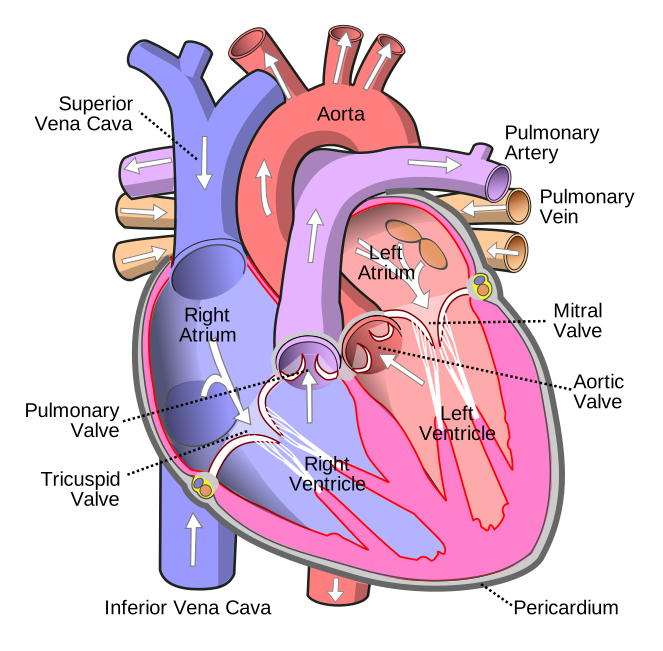
Two catheter-based topics reliably appear: the Swan-Ganz (pulmonary artery) catheter, whose waveform sequence RA → RV → PA → wedge is a favorite question, and the hemodynamics of cardiac tamponade, with its equalization of diastolic pressures. Practice these with the site's hemodynamic calculator and Fick cardiac output tool so the math becomes reflex rather than a stumbling block on test day.
ECG and Rhythm Recognition Under Time Pressure
The second pillar is rhythm and 12-lead reading, and here the exam rewards speed as much as accuracy. You will not have time to reason each strip from scratch, so the goal of practice is to build instant pattern recognition — see the tracing, name it, move on. Anchor everything to a systematic read: rate, rhythm, axis, intervals, morphology. Our step-by-step walkthroughs on ECG interpretation and ECG rhythm interpretation lay out that sequence in detail.
These are the strips and concepts worth drilling until they are automatic:
- Atrial fibrillation — irregularly irregular, no organized P waves. Compare with atrial flutter's sawtooth. See atrial fibrillation.
- SVT vs. VT — narrow-complex regular tachycardia versus wide-complex. Know the clues that favor a ventricular origin. See SVT and ventricular tachycardia.
- AV blocks — first-degree, the two second-degree types, and complete heart block with AV dissociation.
- STEMI localization — ST elevation grouped by lead territory. See STEMI ECG interpretation.
- QT and QTc — measurement, correction, and the danger of prolongation. See the QT interval and the QTc calculator.
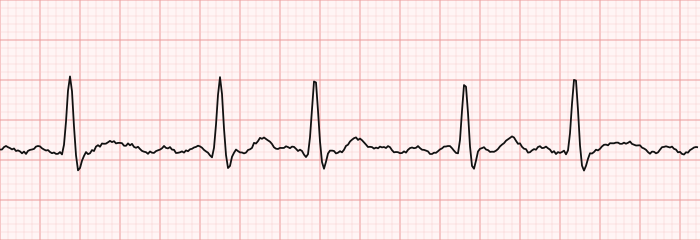
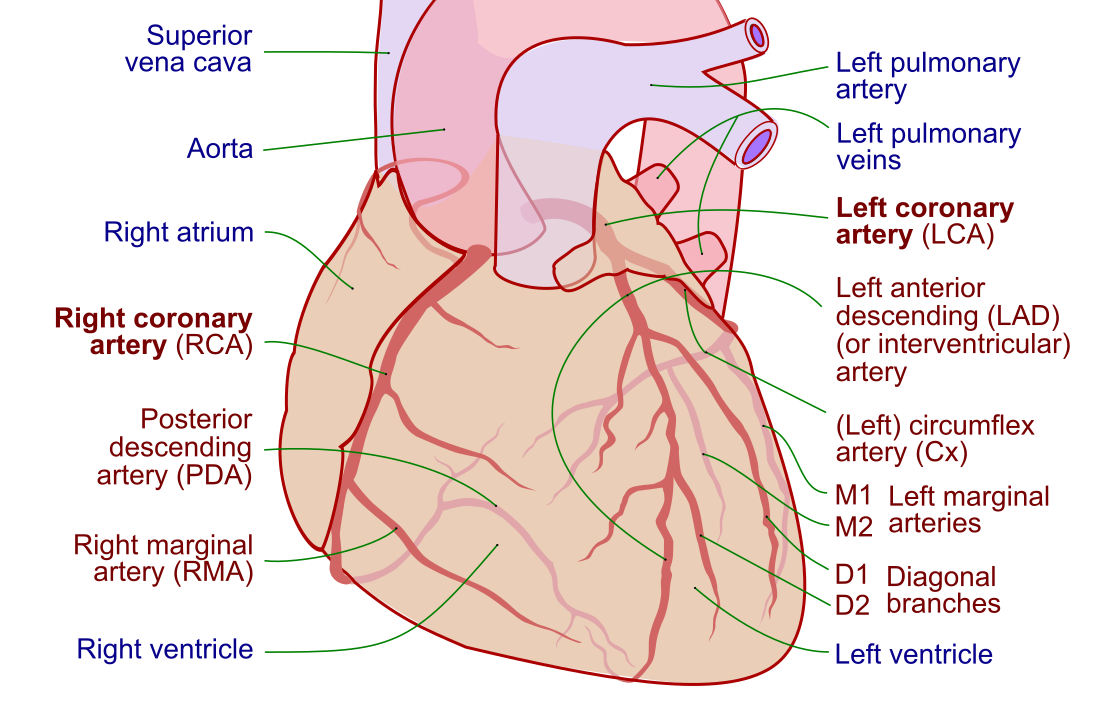
Localizing ischemia connects ECG back to anatomy, which is why understanding the coronary blood supply pays double. A quick review of coronary artery anatomy makes STEMI territory questions far easier, because you can reason from the blocked vessel to the affected leads instead of memorizing pairings.
Anatomy, Physiology, and Cath-Lab Pharmacology
Anatomy questions are among the most learnable on the exam because the answers do not change. Master the coronary tree, the conduction pathway, and the direction of blood flow, and a whole band of questions becomes free points. Know that the left main divides into the LAD and circumflex, that the right coronary artery usually supplies the inferior wall and, in most people, the AV node, and how the cardiac conduction system carries the impulse from SA node to Purkinje fibers.
Pharmacology tends to trip people because the drug list feels endless, but the exam concentrates on a manageable core: the medications you actually push in the lab. Focus your energy on anticoagulants and antiplatelets, vasoactive agents, and the drugs used for chest pain and arrhythmia. The cath-lab medications overview and the article on nitroglycerin cover the high-frequency agents, and the heart failure medication classes round out the pharmacology questions that cross over from the wards. Current guideline-directed therapy for heart failure — the four foundational drug classes — is evolving, so anchor to the most recent guidance rather than older mnemonics where the evidence has moved.
Finally, understand the setting itself. Knowing what happens in a cardiac cath lab and the difference explored in PCI versus diagnostic catheterization frames dozens of procedure and equipment questions that otherwise feel like rote memorization.
Building Up to a Full Mock Exam
Once your topic scores are consistently strong, shift from isolated drilling to full-length mock exam simulation. The purpose changes at this stage. Topic practice builds knowledge; a mock exam builds stamina, pacing, and composure. These are separate skills, and plenty of well-prepared candidates underperform simply because they never practiced sitting a long, mixed test under time pressure.
Run your mocks the way the real exam runs:
- One long block, no pausing. Do not stop to look up an answer mid-exam. Flag it, move on, review afterward. The real test does not pause for you.
- Watch your pace. Track roughly how long you have per question and stay on rhythm. Mixed sets teach you to context-switch between a hemodynamics calculation and a rhythm strip without losing momentum.
- Simulate the environment. Quiet room, no notes, no phone. You are training the conditions, not just the content.
- Review every question — even the ones you got right. A right answer for the wrong reason is a future miss waiting to happen.
A useful rhythm in the final four to six weeks is one full mock per week, with the days between spent working the error log from that mock plus targeted topic sets. Your practice score should climb and, just as importantly, stabilize — a reliable margin above the passing line matters more than one lucky peak. If a domain keeps dragging the score down, drop back to focused practice on just that area before your next full simulation.
A Realistic Study Strategy and Timeline
A good study strategy is less about heroic hours and more about consistent, spaced, active practice. Below is a flexible eight-week structure you can compress or stretch to fit your timeline. The through-line never changes: read a concept, test it immediately, log what you miss, and revisit it after a delay.
| Phase | Focus | Main activity |
|---|---|---|
| Weeks 1–2 | Foundations | Read the guides; topic practice on hemodynamics & ECG |
| Weeks 3–4 | Breadth | Rotate all domains; build the error log |
| Weeks 5–6 | Integration | Weekly mock exam + targeted repair of weak areas |
| Weeks 7–8 | Polish | Final mocks; review error log; light, confident coasting |
Two habits separate candidates who pass comfortably from those who scrape by or fail. The first is the error log — treat it as the single most valuable document in your prep, because it is a map of exactly where your points are leaking. The second is honest calibration: if your mock scores are not comfortably above passing with a week to go, extend your timeline rather than gambling on test day. There is no prize for taking the exam early and failing.
Do not overlook the career context either. Understanding the day-to-day of the cardiovascular technologist role reinforces why the material matters and helps clinical questions stick — when you can picture the procedure, the fact behind it is easier to remember. Motivation and retention are more connected than most study plans admit.
Key Takeaways
- Test yourself, don't just re-read. Retrieval practice and spaced repetition build durable recall; passive review only builds false familiarity.
- Weight your time by the blueprint. Hemodynamics and ECG carry the most questions — give them the most calendar.
- Practice by topic first. Isolating domains makes each miss diagnostic; save full mocks for when your topic scores are strong.
- Keep an error log. Your list of misses is the most valuable document in your prep and your ideal final-week review.
- Master the high-yield facts. Normal pressures, the Fick relationship, core rhythm strips, coronary anatomy, and cath-lab drugs recur constantly.
- Simulate the real exam. Full-length, timed, no-pause mocks train the pacing and stamina that raw knowledge alone cannot.
- Calibrate honestly. Extend your timeline if scores lag — a reliable margin above passing beats one lucky peak.
- Remember it's educational, not clinical advice. Study to pass and to serve patients well, always under current guidelines and your care team's protocols.
Ready to practise?
Test yourself with free RCIS questions, instant feedback, and explanations.
Start a Free Practice Test →Frequently asked questions
How many questions are on the RCIS exam and how long is it?
CCI lists 170 items: 150 scored and 20 unscored. The three-hour session includes 170 minutes for questions and ten minutes for the tutorial and survey. Formats include multiple-choice, multiple-response, hotspot, and drag-and-place. Confirm current details on the official RCIS page linked above.
Are free RCIS practice tests good enough to pass?
Free practice questions are extremely valuable when used correctly — as a diagnostic tool that surfaces your weak topics so you can close them. The free topic sets on this site cover the high-weight domains of hemodynamics, ECG, and anatomy. What matters more than the source is the method: retrieve the answer under exam-like conditions, review every miss, log the reason, and revisit after a delay. That approach passes exams regardless of whether the questions were free or paid.
What is the best order to study RCIS topics?
Start with your weakest high-weight domain, which for most candidates is hemodynamics or ECG, since those carry the most exam questions. Work each topic in isolation until you consistently score above about 85 percent, then rotate across domains day to day rather than blocking a whole week on one area. Spacing your practice across topics improves retention more than studying one subject exhaustively before moving on.
When should I switch from topic practice to full mock exams?
Switch once your individual topic scores are reliably strong — generally consistently above 85 percent on fresh sets. Before that point, a mixed full-length exam mostly tells you that you are weak somewhere without pinpointing where. Once your knowledge base is solid, weekly full mocks in the final four to six weeks build the pacing, stamina, and composure that topic drilling cannot.
What hemodynamic values do I absolutely need to memorize?
Commit the normal chamber and vessel pressures to memory: right atrium 2–6 mmHg, PCWP 6–12 mmHg, cardiac output 4–8 L/min, cardiac index 2.5–4.0 L/min/m², and SVR roughly 800–1200 dynes·sec·cm⁻⁵. Then learn the relationships — cardiac output equals stroke volume times heart rate, the Fick principle, and the Swan-Ganz waveform sequence of RA to RV to PA to wedge. Values anchor the recall; relationships let you reason through the harder questions.
Which ECG rhythms are most commonly tested on the RCIS?
Focus on atrial fibrillation and flutter, SVT versus VT (narrow versus wide complex tachycardia), the AV blocks including complete heart block, and STEMI localization by lead territory. Also know QT and QTc measurement and the risk of prolongation. Build instant visual recognition of these strips through repeated practice rather than reasoning each one from scratch, because the exam rewards speed as well as accuracy.
How long should I study for the RCIS exam?
Most candidates who already work in or near the cath lab need roughly six to eight weeks of consistent, active study — but the honest answer is however long it takes for your mock exam scores to sit comfortably above the passing line. Use a calibration rule: if you are not reliably above passing with about a week to go, extend your timeline rather than gambling on test day. Spaced, testing-based study beats marathon cramming every time.
Do I need to know pharmacology in detail for the RCIS?
You need working knowledge of the medications actually used in the invasive cardiovascular setting — anticoagulants and antiplatelets, vasoactive drugs, agents for chest pain such as nitroglycerin, and the heart-failure drug classes that cross over from ward care. You do not need pharmacology-school depth. Concentrate on indications, mechanisms, and the situations where each drug is given, since that is how the questions are framed. Guideline-directed heart-failure therapy is evolving, so study the most recent guidance.
What is the single most effective RCIS study habit?
Keep an error log. Every question you miss goes on a running list with a one-line note explaining why you missed it — a knowledge gap, a misread, a calculation slip. That log becomes a precise map of where your points are leaking and doubles as the ideal focused review for your final week. Pairing the error log with spaced, testing-based practice is the highest-yield habit in exam preparation.
Sources & further reading
- Cardiovascular Credentialing International (CCI)
- American College of Cardiology
- American Heart Association
- MedlinePlus (U.S. National Library of Medicine)
External links are provided for reference; always confirm current details with the official source.