RCIS Flashcards & Practice Questions
RCIS flashcards turn a mountain of hemodynamics numbers, ECG patterns, and cath-lab pharmacology into bite-sized facts you can actually remember on exam day — and used with a little strategy, they are one of the highest-yield study tools available.
- Why Flashcards Work So Well for the RCIS Exam
- How to Use Spaced Repetition the Right Way
- Building Cards That Actually Stick
- High-Yield Hemodynamics Facts to Put on Cards
- High-Yield ECG Facts to Put on Cards
- High-Yield Pharmacology Facts to Put on Cards
- Anatomy and Conduction Cards Worth Memorizing
- Digital Apps vs. Paper Cards: Which to Use
- Fitting Flashcards Into a Real Study Routine
- Key Takeaways
Why Flashcards Work So Well for the RCIS Exam
The Registered Cardiovascular Invasive Specialist exam rewards a specific kind of knowledge: fast, confident recall of discrete facts. Normal pressure values, ECG interval limits, drug doses and mechanisms, the order of the conduction pathway — these are the raw material of hundreds of questions, and they either come to you instantly or they cost you time you do not have. That is exactly the problem RCIS flashcards are built to solve.
Flashcards work because of two well-studied learning effects. The first is active recall: pulling an answer out of your own memory strengthens that memory far more than rereading it on a page. Every time you flip a card and force yourself to answer before checking, you are practicing the exact retrieval the exam will demand. The second is spaced repetition, the deliberate spacing of reviews over days and weeks so that a fact is revisited just as you are about to forget it. Together these two ideas turn short, repeated sessions into durable long-term memory.
Not everything on the RCIS blueprint is flashcard material, and that is worth being honest about. Reasoning-heavy topics — interpreting a full hemodynamic tracing, working through a shock differential, deciding on management — are learned better through worked practice questions than through isolated cards. Flashcards shine for the memorizable scaffolding those skills rest on. This article is educational content for exam preparation and general learning; it is not medical advice, and clinical decisions always belong to a qualified care team following current guidelines.
How to Use Spaced Repetition the Right Way
Most people use flashcards wrong: they run through the same stack, front to back, the night before the test. That is cramming with extra steps. The power comes from spacing — reviewing each card at expanding intervals so your brain has to reconstruct the answer rather than recognize it.
The mechanism is the spacing effect. A fact reviewed today, again in two days, then in five, then in ten, is retained far better than the same number of reviews packed into one sitting. Every slightly-difficult retrieval reinforces the memory and pushes the next review further out. A simple, evidence-based schedule looks like this:
| Review | Timing after learning a card | What it does |
|---|---|---|
| 1st | Same day | Locks in the initial encoding |
| 2nd | 1–2 days later | Catches the fastest forgetting |
| 3rd | 4–5 days later | Consolidates into longer-term memory |
| 4th | ~10 days later | Confirms durable retention |
| 5th+ | Weekly, then monthly | Maintenance until exam day |
You do not have to track this by hand. Spaced-repetition apps schedule each card automatically based on how easily you recalled it: cards you rate "easy" drift far into the future, cards you miss come back tomorrow. That automatic sorting is the whole point — your study time flows to the facts you actually struggle with instead of the ones you already own.
Two more rules make spaced repetition far more effective. First, always try to answer before you flip — even a wrong guess primes the memory better than passively reading. Second, keep sessions short and frequent: fifteen or twenty focused minutes daily beats a three-hour marathon once a week, both for retention and for actually sticking with it.
Building Cards That Actually Stick
A flashcard is only as good as its design. The most common mistake is cramming a whole paragraph onto one card, which forces you to recall five things at once and makes honest self-grading impossible. Follow a few principles and your deck does the heavy lifting for you.
- One fact per card. If a card tests more than one idea, split it. "Normal RA pressure?" and "Normal PCWP?" are two cards, not one.
- Ask a real question. The front should pose a specific prompt ("Intrinsic rate of the AV junction?"), not a vague topic ("AV node").
- Keep the answer short. A number, a phrase, a mechanism — something you can either produce or not, with no fuzzy middle.
- Make it your own words. Rephrasing a fact as you build the card is itself a learning act; verbatim copying is not.
- Add a why when it helps. A one-line reason under the answer turns rote memorization into understanding, which is far stickier.
- Use cloze deletions for lists. Hiding one word of a sentence ("The AV node delays the impulse about ___ seconds") tests recall without overloading the card.
Images belong on cards too, especially for a visual exam like the RCIS. A card showing an ECG strip with the prompt "Identify this rhythm" trains pattern recognition that a text definition never will. The same goes for pressure waveforms and anatomy. When you build cards from a reliable reference — say, the site's hemodynamics study guide or ECG interpretation guide — you guarantee the facts on the front and back are current and correct before they ever enter your rotation.
High-Yield Hemodynamics Facts to Put on Cards
Hemodynamics is the single most number-dense domain on the RCIS exam, which makes it perfect flashcard territory. The normal pressure values are the foundation — memorize them cold and a huge slice of the exam becomes automatic. Turn each row below into its own card, prompting for the value from the chamber name and back again.
| Site | Normal pressure (mmHg) |
|---|---|
| Right atrium (RA / CVP) | 2–6 (mean) |
| Right ventricle (RV) | 15–30 / 2–8 |
| Pulmonary artery (PA) | 15–30 / 8–15 |
| PA wedge (PCWP) | 6–12 (mean) |
| Left ventricle (LV) | 90–140 / 5–12 |
| Aorta | 90–140 / 60–90 |
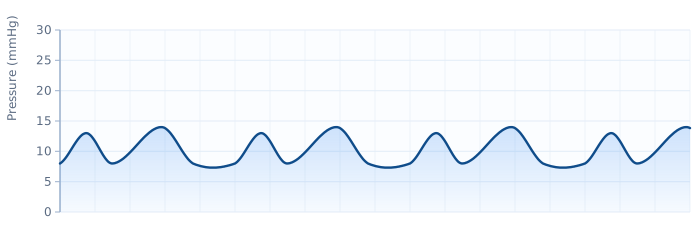
Beyond static values, a handful of derived numbers and their normal ranges recur constantly: cardiac output (roughly 4–8 L/min), cardiac index (about 2.5–4 L/min/m²), stroke volume (60–100 mL/beat), and ejection fraction (normal ≥ 50–55%). Each earns a card, ideally paired with a card for its formula. Reinforce the calculations with the dedicated pages on cardiac output, cardiac index, stroke volume, and systemic vascular resistance so the number and its meaning land together.
High-Yield ECG Facts to Put on Cards
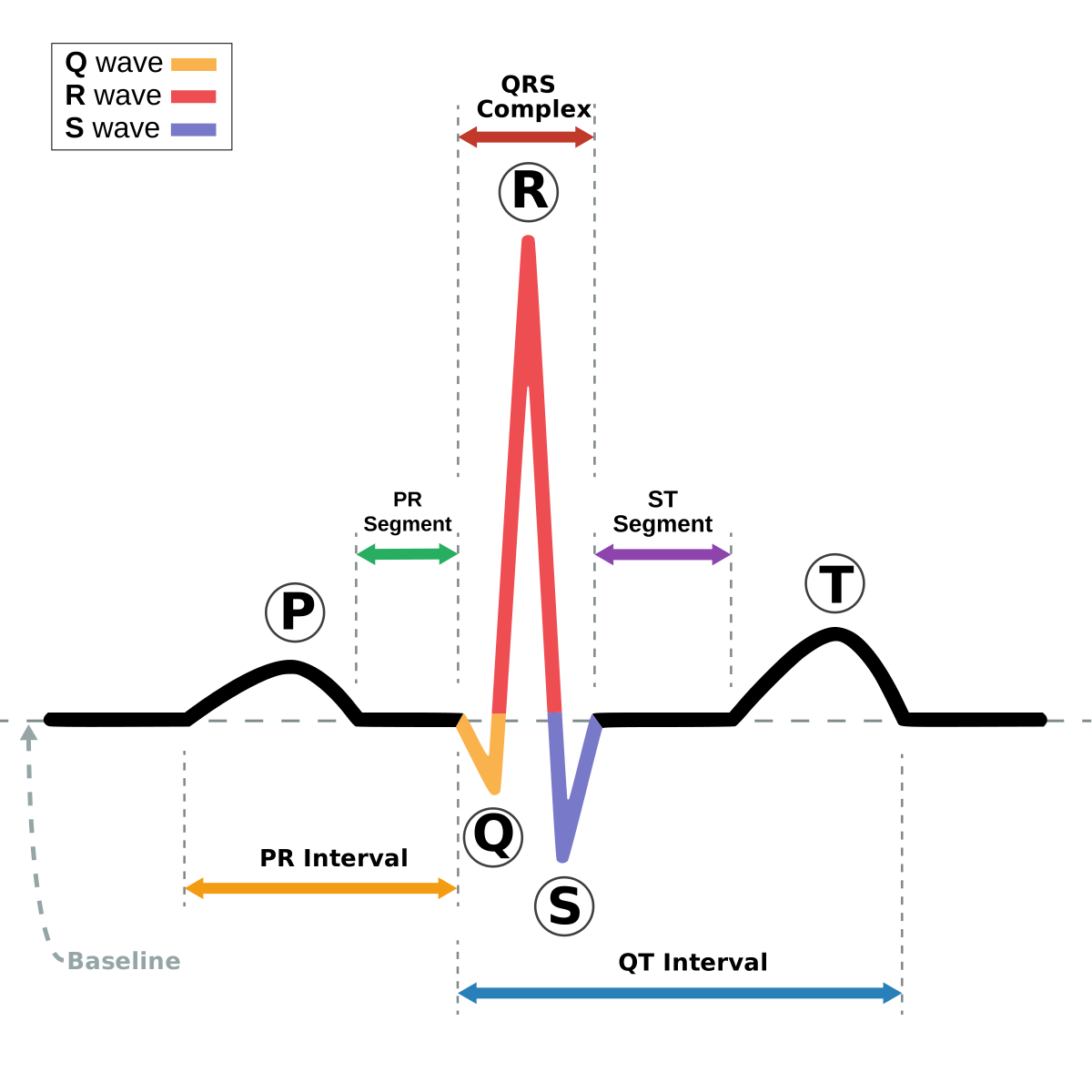
ECG is the other domain where flashcards pay off enormously, because so much of it is pattern-and-number recall. Start with the intervals — their normal limits are pure memorization and appear on the exam again and again.
| Interval / feature | Normal value |
|---|---|
| PR interval | 0.12–0.20 s (3–5 small boxes) |
| QRS duration | < 0.12 s |
| QT interval | < ~0.44 s (rate-dependent; use QTc) |
| Small box | 0.04 s / 1 mm |
| Large box | 0.20 s / 5 mm |
Rhythm recognition is the second half. Build image cards that show a strip and ask you to name it, then flip to the defining criteria. A few that appear constantly: sinus rhythm, atrial fibrillation (irregularly irregular, no P waves), atrial flutter (sawtooth), the AV blocks, ventricular tachycardia (wide and fast), and ventricular fibrillation. The 300 / 1500 rate-estimation rules and the QTc formula deserve their own cards as well. Sharpen all of this against the ECG interpretation pillar, the focused rhythm interpretation walkthrough, and the STEMI recognition guide, then drill them live with a set of practice ECG strips.
High-Yield Pharmacology Facts to Put on Cards
Cath-lab pharmacology is tailor-made for flashcards because each drug is a small bundle of discrete facts — class, mechanism, main use, key caution. The trick is to make a separate card for each of those facets rather than one bloated card per drug. For a given agent you might have: "Mechanism of nitroglycerin?", "Nitroglycerin's main hemodynamic effect?", and "Contraindication to nitroglycerin?"
Group your cards by drug class so the shared logic reinforces itself. A few high-yield anchors that recur on the exam:
- Antiplatelets — aspirin and P2Y12 inhibitors; why dual therapy is given around stenting.
- Anticoagulants — heparin and its monitoring by ACT in the lab; direct thrombin inhibitors as alternatives.
- Vasodilators — nitroglycerin for coronary vasodilation and preload reduction; intracoronary options for spasm.
- Vasopressors and inotropes — the agents that raise pressure or contractility when a patient decompensates.
- Antiarrhythmics — the drugs used for the rhythms you will see on the monitor.
- Contrast media — properties, and the management of contrast reactions.
Because guideline-directed drug therapy genuinely evolves — antiplatelet regimens and anticoagulation strategies around PCI are updated periodically — verify doses and indications against a current source before committing them to a card, and treat any dose you memorize as guideline-dependent rather than fixed. The cath-lab medications overview, the nitroglycerin deep dive, and the heart-failure medications guide are good starting points for accurate card content.
Anatomy and Conduction Cards Worth Memorizing
Structural facts are some of the easiest points on the exam to bank, precisely because they are fixed and memorizable. The conduction pathway, coronary artery supply, and valve locations reward a well-built deck.
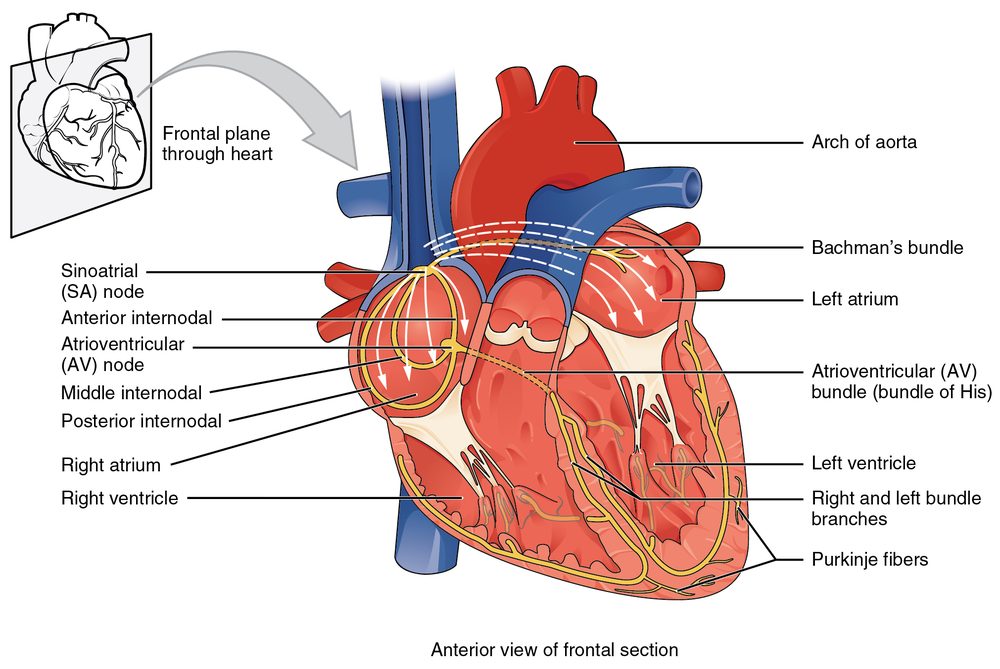
The two most testable anatomy card sets are the conduction order and the intrinsic-rate ladder. Put the sequence — SA node → AV node → bundle of His → bundle branches → Purkinje fibers — on one card, and the rates on another: SA 60–100, AV junction 40–60, ventricle 20–40 bpm. The full logic behind both lives in the cardiac conduction system article.
Coronary anatomy is the other high-yield block. Make cards for what each vessel supplies and for the concept of dominance (which artery gives off the posterior descending). Pair them with the coronary artery anatomy guide and the broader RCIS anatomy guide so the vessel names, territories, and their ECG correlates all connect. When you can look at a coronary tree and name each branch and its territory, a whole category of angiography questions becomes straightforward.
Digital Apps vs. Paper Cards: Which to Use
The best flashcard format is the one you will actually use every day, but the two options have real trade-offs worth weighing.
| Digital (spaced-repetition apps) | Paper cards | |
|---|---|---|
| Scheduling | Automatic spacing; nothing to track | Manual — you must schedule reviews yourself |
| Images | Easy to embed ECGs and waveforms | Harder; must print or draw |
| Portability | Whole deck on your phone | Bulky once the stack grows |
| Making cards | Fast, editable, searchable | Writing by hand aids memory |
| Distraction | Phone notifications lurk nearby | Zero distraction |
For a number- and image-heavy exam like the RCIS, a digital spaced-repetition app is usually the stronger choice: it handles the scheduling that makes spacing work, and it lets you drop in ECG strips and pressure tracings that paper cannot match. That said, the physical act of writing a card by hand encodes the fact as you make it, so some students build cards on paper first and then digitize the ones they want in daily rotation. There is no wrong answer — pick the workflow you will keep.
Whichever you choose, flashcards are a supplement, not a substitute, for applied practice. Interleave your card sessions with full questions from the hemodynamics question bank and the ECG practice bank, and lean on interactive tools like the hemodynamic calculator and the QTc calculator to see how the memorized numbers behave in real calculations.
Fitting Flashcards Into a Real Study Routine
Flashcards fail most often not because the method is weak but because the routine is unsustainable. A little structure keeps the habit alive through the weeks it takes to prepare.
- Start early and add gradually. Introduce a handful of new cards each day rather than building a giant deck in one weekend. A slow drip keeps the daily review load manageable and lets spacing do its work.
- Do your reviews first. Clear the day's scheduled (due) cards before adding new ones. Reviews are where retention happens; new cards are the easy, fun part.
- Use dead time. A five-minute wait is a perfect window for a quick round of cards on your phone. These micro-sessions add up faster than you expect.
- Interleave topics. Mixing hemodynamics, ECG, and pharmacology cards in one session is harder than blocking them — and that extra difficulty improves retention and mirrors the mixed format of the real exam.
- Convert your misses. Every practice question you get wrong is a candidate for a new card. This closes the loop between applied practice and targeted memorization.
- Taper, don't cram. In the final days, do maintenance reviews and light drilling rather than frantic new-card creation. The spacing you did earlier is what pays off now.
If you want a scaffold that tells you what to study in what order, the site's structured study path and topic guides map the whole blueprint into a sequence you can layer cards onto. Anchoring your deck to that plan keeps you from over-carding trivia while neglecting the domains that carry the most exam weight.
Key Takeaways
- RCIS flashcards exploit active recall and spaced repetition — two of the most effective learning techniques ever studied.
- Spaced repetition means reviewing each card at expanding intervals; apps schedule this automatically based on how well you recall each card.
- Grade yourself honestly, always attempt the answer before flipping, and favor short daily sessions over rare marathons.
- Build cards with one fact each, a real question on the front, a short answer, and — where useful — a one-line reason.
- The highest-yield card topics are hemodynamic pressure values, ECG intervals and rhythms, cath-lab drug classes, and the conduction pathway and coronary anatomy.
- Verify doses and evolving guideline-based facts against a current source before committing them to a card.
- Digital spaced-repetition apps suit this number- and image-heavy exam, but paper works if the format keeps you consistent.
- Flashcards supplement — not replace — full practice questions; interleave the two and convert every missed question into a card.
- This is educational content for RCIS preparation and general learning, not medical advice.
Start studying free
Test yourself with free RCIS questions, instant feedback, and explanations.
Practise Now →Frequently asked questions
Are flashcards effective for studying for the RCIS exam?
Yes. The RCIS exam relies heavily on recalling discrete facts — normal pressure values, ECG interval limits, drug mechanisms, the conduction pathway — which is exactly what flashcards train through active recall. They are less useful for reasoning-heavy tasks like interpreting a full hemodynamic tracing, so the best approach pairs flashcards with full practice questions rather than relying on cards alone.
What is spaced repetition and why does it work?
Spaced repetition is reviewing information at increasing intervals — for example after one day, then a few days, then a week — instead of cramming it all at once. It works because each slightly difficult recall, timed just as you are about to forget, strengthens the memory and pushes the next review further out. This produces far better long-term retention than the same number of reviews packed into a single session.
How many RCIS flashcards should I review each day?
There is no fixed number, but a sustainable routine is more important than a big one. Many students add roughly 10–20 new cards a day and then complete all their due reviews, which keeps the daily load manageable. If you use a spaced-repetition app, it schedules the reviews for you, so your job is simply to clear the due cards each day and keep the habit going.
What high-yield facts should be on RCIS flashcards?
Focus on the memorizable scaffolding of each domain: normal hemodynamic pressures (RA, RV, PA, PCWP, LV, aorta) and derived values like cardiac output and index; ECG intervals (PR 0.12–0.20 s, QRS under 0.12 s) and rhythm-recognition patterns; cath-lab drug classes with their mechanisms and cautions; and anatomy such as the conduction pathway order, intrinsic pacemaker rates, and coronary artery supply.
Should I use a flashcard app or paper cards?
For the RCIS exam, a digital spaced-repetition app is usually the stronger choice because it schedules reviews automatically and lets you embed ECG strips and pressure waveforms that paper cannot easily show. Paper cards have their own advantage — writing a card by hand helps encode the fact. The best format is ultimately the one you will use consistently every day.
How do I make a good flashcard?
Put one fact per card, pose a specific question on the front, and keep the answer short enough that you can clearly say whether you knew it. Rephrase facts in your own words as you build the card, add a one-line reason where it aids understanding, and use images for visual material like ECG rhythms and pressure tracings. Avoid cramming multiple facts onto a single card, which makes honest self-grading impossible.
Can flashcards replace practice questions for the RCIS?
No. Flashcards are excellent for memorizing discrete facts, but they do not train the applied reasoning the exam also tests, such as interpreting a full waveform or working through a clinical scenario. Use flashcards for the underlying facts and full practice questions for application, and turn every question you miss into a new card to connect the two.
How far in advance should I start using flashcards?
Start as early as you reasonably can, because spaced repetition needs time between reviews to work. Introducing a few cards a day over several weeks lets each fact be revisited at expanding intervals, which builds durable memory. Starting the week before the exam turns flashcards into ordinary cramming and forfeits most of their advantage.
Are RCIS flashcards medical advice?
No. RCIS flashcards and study resources are educational tools for exam preparation and general learning. Any clinical values, drug doses, or management points are for study purposes, should be checked against current guidelines because practice evolves, and are not a substitute for the judgment of a qualified care team.
Sources & further reading
- Cardiovascular Credentialing International (CCI)
- American College of Cardiology
- American Heart Association
- MedlinePlus (U.S. National Library of Medicine)
External links are provided for reference; always confirm current details with the official source.