Normal ECG Interpretation
Before you can spot a dangerous rhythm or a subtle infarct, you have to know exactly what healthy looks like. This guide builds that reference image of a normal ECG, wave by wave, so every abnormal tracing becomes easy to catch by contrast.
- What 'Normal' Really Means on an ECG
- A Systematic Approach You Can Repeat Every Time
- The Waves, Segments, and Intervals of a Normal Beat
- Normal Values: The Numbers Worth Memorizing
- Normal Sinus Rhythm: The Gold-Standard Reference
- Reading Rate in Clinical Context
- Normal Variants That Look Abnormal (But Are Not)
- How Normal Anchors Every Abnormal Reading
- Common Pitfalls When Calling an ECG Normal
- How Normal ECGs Show Up on the RCIS Exam
- Key Takeaways
What 'Normal' Really Means on an ECG
Normal ECG interpretation starts with a mindset shift: your goal is not to memorize a picture of disease, but to build such a solid mental template of a healthy tracing that anything off-template jumps out. When someone asks what a normal ECG looks like, the honest answer is a short checklist — a regular rhythm from the sinus node, an upright P wave before every narrow QRS, intervals within accepted ranges, and no ST-segment shift or T-wave inversion where you would not expect one.
The word 'normal' also carries more flexibility than beginners expect. A perfectly healthy 22-year-old athlete and a fit 70-year-old will produce ECGs that differ in rate, axis, and voltage, yet both are normal. That is why interpretation always blends measured normal values with clinical context: age, sex, body habitus, and what the patient is doing when the tracing is taken. This article walks through that template systematically, then covers the many normal variants that trip people up. If you are still shaky on the basics of waves and leads, start with our broader ECG interpretation primer, then come back here for the normal-reference deep dive.
This is educational content written for RCIS exam preparation. It is not medical advice; clinical decisions belong to the treating team following current guidelines.
A Systematic Approach You Can Repeat Every Time
Consistency beats cleverness. Reading every tracing in the same order means you never skip the finding that matters. A widely taught sequence runs like this:
- Rate — is the ventricular rate 60–100 beats per minute?
- Rhythm — is it regular, and does it originate in the sinus node?
- Axis — is the mean QRS axis in the normal range?
- Intervals — are the PR, QRS, and QT (corrected) within normal values?
- P waves — is there one upright P before each QRS in lead II?
- QRS morphology — normal voltage, no pathologic Q waves, normal R-wave progression across the chest leads?
- ST segments and T waves — is the baseline flat, with no elevation, depression, or unexpected T-wave inversion?
Run those seven checks on every strip and you will read a normal ECG in well under a minute. The discipline also prevents the classic trap of anchoring on the first interesting squiggle and missing a second problem elsewhere. For rhythm-specific reasoning that builds on this foundation, our dedicated ECG rhythm interpretation walkthrough applies the same logic across the full family of arrhythmias.
The Waves, Segments, and Intervals of a Normal Beat
Every normal cardiac cycle produces the same signature of deflections, each mapping to a physiological event. Understanding the mechanism makes the values stick far better than rote numbers.
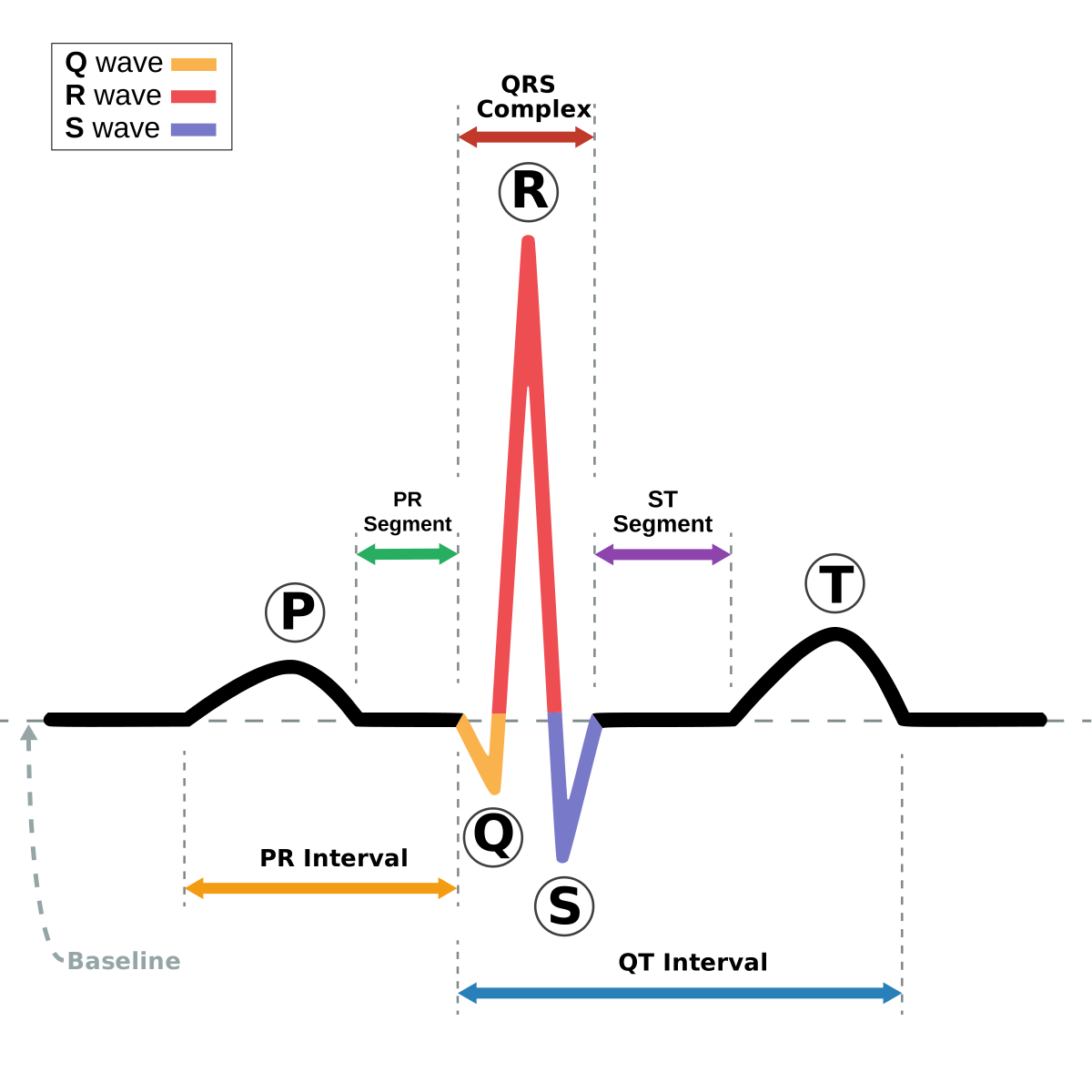
- P wave — atrial depolarization. Upright in lead II, small and smooth, under about 0.12 s wide and 2.5 mm tall.
- PR interval — start of the P wave to start of the QRS; the time the impulse takes to cross the atria and pause at the AV node. Normal is 0.12–0.20 s.
- QRS complex — ventricular depolarization. Narrow (under 0.12 s) because the His-Purkinje system spreads the impulse fast.
- ST segment — the flat stretch from the end of the QRS (J point) to the start of the T wave; it should sit level with the baseline.
- T wave — ventricular repolarization. Normally upright in most leads and asymmetric, with a gentle upslope and steeper downslope.
- QT interval — start of QRS to end of T; the total time of ventricular depolarization and recovery. Because it shortens as heart rate rises, we correct it (QTc).
The impulse that drives all of this originates in the sinoatrial node and travels a fixed path — a journey worth reviewing on our cardiac conduction system page, since the anatomy explains why each wave has its shape and timing.
Normal Values: The Numbers Worth Memorizing
These are the reference ranges most sources and exams use. Small variations exist between references and populations, so treat borderline numbers as a prompt to look at the whole tracing and the patient, not as a hard verdict.
| Measurement | Normal range | Quick note |
|---|---|---|
| Heart rate | 60–100 bpm | <60 = bradycardia; >100 = tachycardia |
| P wave | <0.12 s wide, <2.5 mm tall | Upright in II, smooth and rounded |
| PR interval | 0.12–0.20 s | 3–5 small boxes |
| QRS duration | <0.12 s | Under 3 small boxes = narrow |
| QT interval (QTc) | ≤0.44 s (men), ≤0.46 s (women) | Rate-corrected; longer values raise arrhythmia risk |
| QRS axis | -30° to +90° | Roughly leftward-and-down |
A handy conversion: on standard paper each small box is 0.04 s (40 ms) and each large box is 0.20 s. So a normal PR interval spans three to five small boxes, and a normal QRS fits inside three. For the QT, calculating a corrected value by hand is error-prone at unusual rates, which is why bedside teams lean on tools like our QTc calculator; the clinical significance of a long QT is covered in depth on the QT interval page.
Normal Sinus Rhythm: The Gold-Standard Reference
Normal sinus rhythm (NSR) is the tracing you compare every other rhythm against. Its four defining features are simple: the rate is 60–100 bpm, the rhythm is regular, each beat begins with an upright P wave in lead II, and that P is followed by a narrow QRS after a constant PR interval. If all four hold, the sinus node is doing its job as the heart's natural pacemaker.
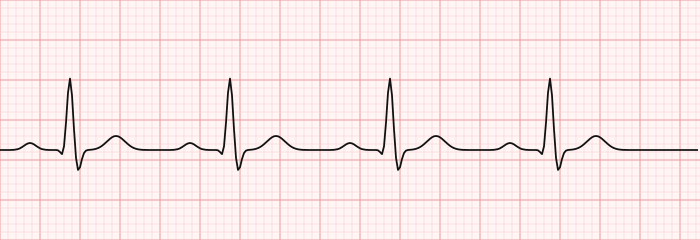
Counting the rate quickly is worth practicing. The two fastest methods: divide 300 by the number of large boxes between two R waves, or count the QRS complexes in a 6-second strip and multiply by ten. Both land you close enough to classify the rhythm.
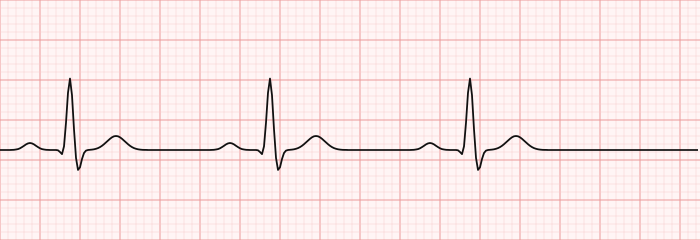
Two close relatives keep the sinus pattern but shift only the rate. Sinus bradycardia is NSR under 60 bpm — often perfectly normal in athletes and during sleep. Sinus tachycardia is NSR over 100 bpm — usually a response to fever, pain, exertion, or anxiety rather than a primary electrical fault. In both, the defining feature survives: one upright P before every narrow QRS.
Reading Rate in Clinical Context
A number on the monitor means little without context, and this is where ECG reading connects to the bigger cardiovascular picture. Heart rate is one of the two levers — the other being stroke volume — that set how much blood the heart moves each minute.
That relationship, cardiac output = heart rate × stroke volume, explains why the body defends output by changing rate. A patient who is bleeding or septic will run a sinus tachycardia to compensate for a falling stroke volume, keeping cardiac output up until compensation fails. Conversely, an extreme bradycardia or a very fast arrhythmia can drop output by shortening filling time. Understanding this keeps you from reading a rate in isolation — a 'normal' rate of 70 in a crashing patient may actually be inappropriately slow.
For technologists moving into the cath lab, this is exactly where the ECG meets pressure and flow. The way rhythm shapes filling and output is the throughline of our hemodynamics guide, and it explains why an abnormal rate on the monitor often shows up as a distorted pressure waveform seconds later.
Normal Variants That Look Abnormal (But Are Not)
Some of the most common interpretation errors come from calling a healthy variant a disease. Recognizing these normal variants is a hallmark of a confident reader, and current guidance — including athlete-screening criteria such as the international consensus on ECG interpretation in athletes — draws an explicit line between benign findings and ones that warrant workup.
- Sinus arrhythmia. A gentle, cyclical speeding and slowing of the sinus rate with breathing (faster on inspiration). It is a sign of healthy vagal tone, especially in the young, and is benign.
- Early repolarization. A slurred or notched J point with mild, concave ST elevation, common in young and athletic people. It can mimic injury, but the pattern and clinical context usually distinguish it. When in doubt, comparison with a prior tracing helps.
- Athlete's heart adaptations. Resting sinus bradycardia, first-degree AV block, and high QRS voltages are common in well-trained endurance athletes and reflect physiologic adaptation rather than disease.
- Isolated T-wave findings. A persistent juvenile T-wave pattern (inverted T waves in the right precordial leads) can be a normal variant in younger patients.
- Respiratory and positional voltage shifts. Body habitus, lead placement, and breathing can change QRS amplitude without any pathology.
The evidence base here is genuinely evolving — thresholds for what counts as a benign athletic adaptation versus an early warning sign have been refined repeatedly, and borderline tracings sometimes need echocardiography or rhythm monitoring to sort out. The safest posture is humility: when a 'variant' does not fit cleanly, compare with old ECGs and involve a cardiologist rather than forcing a label.
How Normal Anchors Every Abnormal Reading
The payoff of mastering the normal template is speed and safety when things are not normal. Because you know exactly where the baseline sits, ST-segment elevation from an acute coronary occlusion leaps off the page — the topic of our STEMI ECG interpretation guide. Because you know a normal QRS is narrow, a wide complex immediately flags either a ventricular origin or abnormal conduction.
Consider a few high-yield contrasts against normal:
- Rhythm. Lose the upright-P-before-every-QRS pattern and a wandering baseline appears — that is atrial fibrillation, the most common sustained arrhythmia.
- Width. A normal narrow QRS becoming wide and fast should be treated as ventricular tachycardia until proven otherwise.
- Conduction. A PR interval that stretches beyond 0.20 s, or P waves that stop conducting, points toward heart block.
- ST/T. New ST depression or T inversions raise concern for ischemia and the spectrum of coronary artery disease.
Every one of those is defined by how it departs from the normal reference you have now built. That is why seasoned readers spend so much energy on 'normal' — it is the yardstick that makes everything else measurable. To connect the electrical picture to the vessels and chambers behind it, our cardiac anatomy guide ties waveform to structure.
Common Pitfalls When Calling an ECG Normal
Labeling a tracing 'normal' is a real clinical decision, not a default, and a few recurring traps catch even experienced readers.
- Lead misplacement. Reversed limb leads can invert the P and QRS in ways that mimic disease. If lead I looks upside-down and the axis seems bizarre, suspect a swapped electrode before diagnosing pathology.
- Artifact masquerading as arrhythmia. Tremor, shivering, or a loose lead can throw a chaotic baseline. The tell is that you can usually march normal QRS complexes through the noise while the patient sits calmly.
- Ignoring the prior ECG. A finding that would worry you in isolation is often reassuring when an identical pattern appears on a tracing from two years ago. Comparison is one of the most powerful tools you have.
- Anchoring on rate alone. A rate of 75 does not make a tracing normal if the QT is dangerously long or the ST segments are shifted. Complete all seven steps.
- Over-calling variants. Reflexively labeling early repolarization or athletic bradycardia as disease creates unnecessary alarm and testing.
None of this replaces judgment or guidelines, and no single strip should override the clinical picture. When a tracing sits on the border between normal and abnormal, the right move is often more information — a repeat ECG, a prior for comparison, or an echocardiogram to look at structure directly.
How Normal ECGs Show Up on the RCIS Exam
On the credentialing exam, 'normal' questions are quietly high-yield. You will be asked to confirm normal values, identify normal sinus rhythm among distractors, or recognize a benign variant that a weaker candidate would flag as disease. The disciplined seven-step read is exactly what these items reward.
Carry these anchors into the test:
- NSR = 60–100 bpm, regular, upright P before every narrow QRS at a constant PR.
- Intervals from memory: PR 0.12–0.20 s, QRS <0.12 s, QTc roughly ≤0.44–0.46 s.
- Small box 0.04 s, large box 0.20 s — the basis of every measurement.
- Sinus arrhythmia and athletic bradycardia are normal variants, not disease.
- Always compare to normal before naming an abnormality — width, rhythm, intervals, ST/T.
The fastest way to make these reflexive is repetition against real tracings. Work through the focused RCIS ECG practice questions, then the ECG strip identification set, which places normal and abnormal strips side by side so the contrast trains your eye. For the full waveform-to-rhythm progression, the ECG guide ties fundamentals to recognition.
Key Takeaways
- A normal ECG is a checklist, not a picture: sinus rhythm, upright P before every narrow QRS, intervals in range, flat ST segments, and no unexpected T inversions.
- Read in the same order every time — rate, rhythm, axis, intervals, P waves, QRS morphology, ST/T — to avoid missing a second finding.
- Know the normal values cold: rate 60–100 bpm, PR 0.12–0.20 s, QRS <0.12 s, QTc roughly ≤0.44 s (men) and ≤0.46 s (women).
- Normal sinus rhythm is the reference against which every arrhythmia is judged; small box = 0.04 s, large box = 0.20 s.
- Many variants are benign — sinus arrhythmia, early repolarization, and athlete's-heart adaptations — and calling them disease is a common error.
- Read rate in clinical context; a 'normal' number can still be inappropriate for what the patient's circulation needs.
- Guidance is evolving, especially for athlete screening; when a variant does not fit cleanly, compare with a prior ECG and involve a cardiologist.
- This is educational content for RCIS preparation, not medical advice; diagnosis and management follow current guidelines and the treating team.
Frequently asked questions
What does a normal ECG look like?
A normal ECG shows a regular rhythm from the sinus node at 60 to 100 beats per minute, with one upright P wave before every narrow QRS complex in lead II, a constant PR interval, and a flat ST segment leading into an upright T wave. All intervals fall within accepted ranges, and there is no unexpected ST elevation, ST depression, or T-wave inversion.
What are the normal values for ECG intervals?
The commonly used ranges are: PR interval 0.12 to 0.20 seconds, QRS duration under 0.12 seconds, and a corrected QT (QTc) up to about 0.44 seconds in men and 0.46 seconds in women. The heart rate is normal between 60 and 100 beats per minute, and the QRS axis normally lies between roughly -30 and +90 degrees.
How do you know if an ECG is normal sinus rhythm?
Check four things: the rate is 60 to 100 beats per minute, the rhythm is regular, there is an upright P wave before every QRS in lead II, and the PR interval is constant and normal. If all four are present, the sinus node is pacing the heart normally and the tracing qualifies as normal sinus rhythm.
What is a normal heart rate on an ECG?
A normal resting ventricular rate is 60 to 100 beats per minute. Below 60 is termed bradycardia and above 100 is tachycardia, though neither is automatically abnormal — trained athletes are often normally bradycardic at rest, and a healthy person exercising or anxious can be normally tachycardic. Rate must always be judged against clinical context.
Can a normal ECG have some unusual findings?
Yes. Several patterns are normal variants rather than disease, including respiratory sinus arrhythmia, early repolarization, high QRS voltages and resting bradycardia in athletes, and a persistent juvenile T-wave pattern in some younger people. These are more likely benign when the patient is young, asymptomatic, and the pattern is stable and symmetric.
How do you calculate heart rate from an ECG strip?
Two quick methods work well. Divide 300 by the number of large boxes between two consecutive R waves for a regular rhythm, or count the number of QRS complexes in a 6-second strip and multiply by ten, which also works for irregular rhythms. Each large box represents 0.20 seconds and each small box 0.04 seconds.
What is the difference between a normal and abnormal QRS?
A normal QRS is narrow, under 0.12 seconds, because the impulse spreads quickly through the His-Purkinje system. A wide QRS of 0.12 seconds or more means the beat either arose in the ventricle or was conducted abnormally, such as through a bundle branch block. A wide, fast, regular rhythm should be treated as ventricular tachycardia until proven otherwise.
Why does the QT interval need to be corrected?
The raw QT interval shortens as the heart rate rises and lengthens as it slows, so a single threshold cannot apply across all rates. Correcting it for heart rate produces the QTc, which allows a fair comparison. A prolonged QTc raises the risk of dangerous arrhythmias such as torsades de pointes, which is why it is monitored closely.
Is sinus arrhythmia a normal finding on an ECG?
Yes. Respiratory sinus arrhythmia is a gentle, cyclical variation in the sinus rate tied to breathing — the rate speeds up slightly on inspiration and slows on expiration. It reflects healthy autonomic tone and is especially common in children and young adults. It is benign and does not require treatment.
Sources & further reading
- Cardiovascular Credentialing International (CCI)
- American College of Cardiology
- American Heart Association
- MedlinePlus (U.S. National Library of Medicine)
External links are provided for reference; always confirm current details with the official source.