Shock Index: Formula, Normal Range & What It Tells You
The shock index is one bedside number — heart rate divided by systolic blood pressure — that flags a patient sliding toward circulatory collapse before either vital sign looks alarming on its own. This guide covers the formula, the normal range, the modified version, and how clinicians use it in trauma and sepsis.
What is the shock index?
The shock index (SI) is the ratio of a patient's heart rate to their systolic blood pressure. That is the whole definition — two vital signs you already have, combined into a single dimensionless number that says more about circulatory stress than either one alone.
The appeal is that it catches trouble early. A patient bleeding internally or slipping into sepsis will often keep a "normal-looking" blood pressure for a surprisingly long time because the body compensates by speeding up the heart and clamping down blood vessels. Read in isolation, a systolic pressure of 105 mmHg looks fine and a heart rate of 105 bpm looks unremarkable. Put them together as a shock index of 1.0, though, and the picture changes: this is a patient whose compensatory reserve is running out.
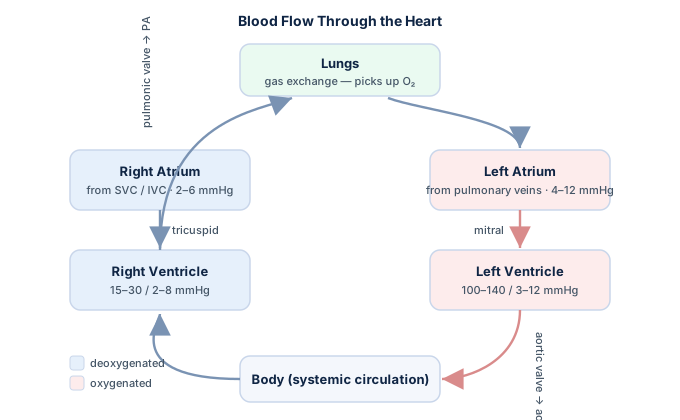
First described by Allgöwer and Burri in 1967, the shock index has enjoyed a strong revival in modern emergency and critical care because it is fast, free, and requires no lab draw or calculation tool. It shows up in trauma triage, sepsis screening, obstetric hemorrhage protocols, and increasingly on the RCIS exam as an example of how simple hemodynamic reasoning predicts outcomes. If you want the broader framework, our hemodynamics study guide connects the shock index to the pressures and flows behind it.
This article is educational and not medical advice. Thresholds vary by population and institution; always follow current guidelines and local protocols.
Shock index formula
The formula could not be simpler:
Shock Index = Heart Rate ÷ Systolic Blood Pressure
SI = HR (beats/min) ÷ SBP (mmHg)
Both inputs come straight off the monitor, and the result has no units — it is a pure ratio. A worked example makes it concrete:
- A patient with a heart rate of 80 bpm and a systolic pressure of 120 mmHg has a shock index of 80 ÷ 120 = 0.67 — squarely normal.
- A trauma patient with a heart rate of 120 bpm and a systolic pressure of 90 mmHg has a shock index of 120 ÷ 90 = 1.33 — a red flag, even though the blood pressure alone might not trigger a massive-transfusion call.
Notice the direction of change. Anything that raises the numerator (tachycardia) or lowers the denominator (hypotension) pushes the index up, and both of those happen together as shock develops. That is precisely why the ratio outperforms either vital sign checked separately.
Because a healthy person's heart rate is well below their systolic pressure, the normal shock index is always a fraction below 1. When the ratio climbs toward and past 1.0, the heart rate is catching up with — or overtaking — the blood pressure, which almost never happens in a stable circulation.
What is a normal shock index?
A normal shock index in a healthy adult is approximately 0.5 to 0.7. Most references treat anything from about 0.5 to 0.7 as reassuring, values of 0.7 to 0.9 as a caution zone worth a second look, and readings of 0.9 or above as concerning for hemodynamic instability. As with most bedside cutoffs, treat these as guideposts rather than absolute lines.
| Shock index | Interpretation |
|---|---|
| 0.5 – 0.7 | Normal — stable circulation |
| 0.7 – 0.9 | Caution — early compensation; reassess and monitor |
| 0.9 – 1.0 | Concerning — significant physiologic stress |
| > 1.0 | High risk — impaired perfusion, greater need for transfusion or ICU care |
| > 1.3 – 1.4 | Severe — strongly associated with mortality and massive transfusion |
The threshold that gets memorized most is 0.9. Across trauma, sepsis, and obstetric-hemorrhage studies, a shock index at or above 0.9 repeatedly tracks with worse outcomes — more transfusions, more ICU admissions, and higher mortality — even when the individual vital signs still look acceptable. A value crossing 1.0 is a louder alarm still, and readings above roughly 1.3 to 1.4 are ominous.
Two caveats keep you honest. First, the "normal" band shifts with age and physiology — see the section on limitations below. Second, a single reading is a snapshot; a shock index that is rising over serial checks is often more informative than any one value, because it shows compensation failing in real time.
Modified shock index (MSI)
The modified shock index (MSI) replaces systolic blood pressure with mean arterial pressure (MAP) in the denominator. The reasoning is that MAP better reflects true tissue perfusion pressure than systolic pressure does, so the modified version may capture circulatory stress that the standard index misses.
Modified Shock Index = Heart Rate ÷ Mean Arterial Pressure
MSI = HR ÷ MAP
Because MAP is lower than systolic pressure, the modified shock index produces larger numbers than the standard index for the same patient. A commonly cited normal range is roughly 0.7 to 1.3, with values above about 1.3 flagging elevated risk and values below 0.7 suggesting a high-resistance, potentially low-output state. Some emergency-medicine literature reports that MSI predicts mortality at least as well as, and sometimes better than, the traditional index.
| Variant | Formula | Typical normal range |
|---|---|---|
| Shock index (SI) | HR ÷ SBP | 0.5 – 0.7 |
| Modified shock index (MSI) | HR ÷ MAP | 0.7 – 1.3 |
| Age shock index (ASI) | Age × SI | varies; used in trauma |
| Pediatric SIPA | Age-adjusted SI cutoffs | age-specific |
You will also meet the age shock index (age multiplied by SI), which sharpens prediction in older trauma patients, and the shock index pediatric age-adjusted (SIPA), which uses different cutoffs for different age bands because children's baseline heart rates and pressures differ so much from adults'. The proliferation of variants tells you something important: no single ratio is perfect, and the evidence base is still evolving.
Shock index in trauma
Trauma is where the shock index earns its keep. Blood loss after injury is deceptive: young, fit patients compensate so effectively that systolic pressure can stay near normal until they have lost a large fraction of their blood volume, and then it crashes. The shock index catches the compensation phase, because the rising heart rate shows up in the ratio long before the pressure falls.
In practice, an elevated shock index on arrival — commonly a value of 0.9 or higher, and especially above 1.0 — is used to help predict the need for massive transfusion, the likelihood of significant hemorrhage, and the risk of early death. Many trauma systems fold it into triage and activation decisions precisely because it needs no equipment beyond a monitor and can be recalculated in seconds as the resuscitation unfolds.
The underlying physiology ties back to circulatory mechanics you will study elsewhere on this site. As blood volume falls, stroke volume drops; the body defends blood pressure by raising heart rate and increasing systemic vascular resistance through vasoconstriction. The shock index is essentially a bedside readout of how hard that compensation is working. Once it can no longer keep up, both the index and the patient decompensate together — the tipping point into overt shock.
A trending shock index is the most useful kind. A value that climbs from 0.8 to 1.1 over serial checks during a trauma resuscitation is a signal that the patient is losing ground and that current interventions are not keeping pace — a prompt to escalate blood products and reassess the source of bleeding.
Shock index in sepsis
Sepsis produces a different mechanism but a similar bedside signature. Instead of losing blood volume, the septic patient loses vascular tone: widespread vasodilation and capillary leak drop the effective circulating volume and lower resistance. The heart responds by beating faster to maintain output, and once again the shock index rises before the blood pressure formally crosses into hypotension.
That early-warning quality has made the shock index a popular sepsis-screening adjunct. A value of 0.9 or higher has been associated with higher lactate, greater need for critical care, and increased mortality in patients with suspected infection, and some studies suggest it identifies deteriorating patients earlier than heart rate or systolic pressure alone. Because it needs no lab result, it can flag a patient at the very first set of vitals, before cultures or a lactate return.
The septic picture also illustrates why the index must be read in context. Early "warm" septic shock is a high-output, low-resistance state — see our discussion of systemic vascular resistance — so the fast heart rate driving the shock index up is a compensatory response to profound vasodilation, not a failing pump. The index tells you the patient is in trouble; it does not by itself tell you the cause. Pairing it with lactate, mental status, urine output, and the overall clinical trajectory is what turns a number into a decision.
Screening thresholds in sepsis are an area of active research; use the shock index as one input alongside validated sepsis criteria and clinical judgment, not as a standalone diagnosis.
Limitations and pitfalls
The shock index is a screening shortcut, not a diagnosis, and it fails in predictable ways. Knowing where it breaks is what separates careful use from blind trust.
- Medications distort it. Beta-blockers blunt the tachycardic response, so a patient can be in real trouble with a deceptively "normal" shock index because their heart rate cannot rise. Conversely, stimulants, pain, and anxiety raise heart rate without any circulatory compromise, inflating the index for benign reasons.
- Arrhythmias muddy it. In atrial fibrillation or other irregular rhythms, the "heart rate" is a moving target, and a rapid ventricular response can spike the index independent of volume status. Understanding the underlying rhythm — a skill our ECG rhythm interpretation guide builds — helps you interpret the number correctly.
- Age and pregnancy shift the baseline. Older adults often run higher "normal" indices, and the physiologic changes of pregnancy alter both heart rate and pressure, so obstetric hemorrhage protocols sometimes use adjusted thresholds.
- It says nothing about cause. A high shock index in hemorrhage, sepsis, cardiac tamponade, and pulmonary embolism looks identical, yet each demands very different treatment. The index flags risk; it does not localize the problem.
The practical rule is simple: let the shock index raise your suspicion and trigger a closer look, but never let a reassuring value override a worrying clinical gestalt. It is a tripwire, not a verdict.
Shock index on the RCIS exam and in the cath lab
For cardiovascular technologists and RCIS candidates, the shock index is a favorite because it rewards clear thinking rather than memorized trivia. Expect questions that give you a heart rate and systolic pressure and ask for the ratio, or that hand you a value and ask you to classify the patient's risk. You should also be ready to distinguish the standard index from the modified version and to explain why the ratio beats either vital sign alone.
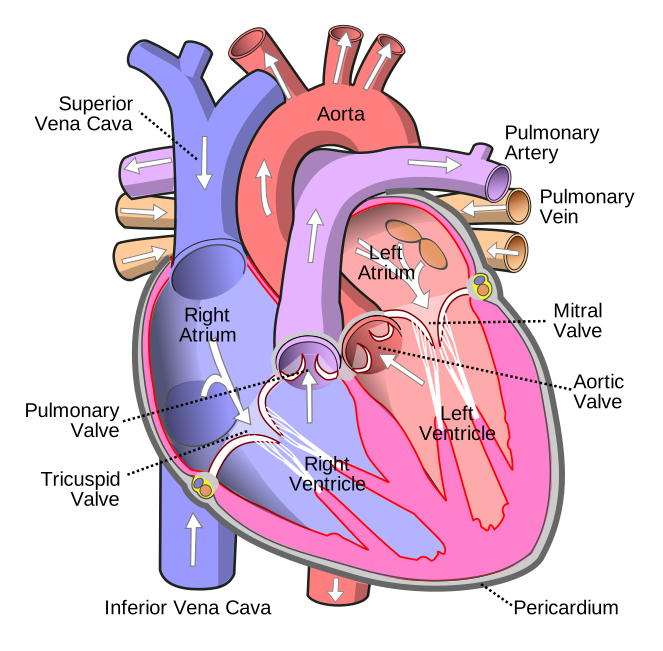
In the cath lab, the shock index provides a quick pre-procedure gauge of a patient's stability — a high value in someone arriving for primary PCI after a large myocardial infarction hints at evolving cardiogenic shock and the possible need for mechanical support such as an intra-aortic balloon pump. It complements, rather than replaces, the invasive numbers you generate during a right-heart study, like cardiac index and filling pressures. Solidify the surrounding physiology with our cardiac anatomy guide, then test yourself with the hemodynamics practice questions.
Key takeaways
- Shock index = heart rate ÷ systolic blood pressure, a unitless ratio calculated from two routine vital signs.
- A normal shock index is about 0.5 to 0.7; a value of 0.9 or higher signals concern, and above 1.0 marks meaningful hemodynamic instability.
- The modified shock index (MSI) swaps systolic pressure for mean arterial pressure (HR ÷ MAP), with a normal range near 0.7 to 1.3.
- In trauma, a rising index detects blood loss during the compensation phase, before systolic pressure falls, and helps predict massive transfusion.
- In sepsis, it serves as an early-warning screen for deterioration, but must be read alongside lactate and validated sepsis criteria.
- Limitations matter: beta-blockers, arrhythmias, age, pregnancy, and stimulants all distort the index, and it never identifies the cause of shock.
- This content is educational, not medical advice, and thresholds are still evolving — always defer to current guidelines and local protocols.
Calculate shock index
Enter heart rate and systolic blood pressure to get the shock index with interpretation.
Open the Shock Index Calculator →Frequently asked questions
What is a normal shock index?
In a healthy adult, a normal shock index is roughly 0.5 to 0.7. Values from 0.7 to 0.9 warrant caution, and readings of 0.9 or higher are associated with hemodynamic instability and worse outcomes. Interpret any single value in the full clinical context and watch the trend over serial checks.
What is the shock index formula?
The shock index equals heart rate divided by systolic blood pressure: SI = HR (beats/min) ÷ SBP (mmHg). Both numbers come straight from the monitor, and the result is unitless. For example, a heart rate of 100 with a systolic of 90 gives a shock index of about 1.1.
What does a high shock index mean?
A high shock index — generally 0.9 or above, and especially over 1.0 — means the heart rate is rising relative to the blood pressure, a sign that the circulation is under stress and compensation may be failing. It is linked to greater need for transfusion, ICU care, and higher mortality in trauma and sepsis.
What is the difference between shock index and modified shock index?
The standard shock index uses systolic blood pressure in the denominator (HR ÷ SBP), while the modified shock index uses mean arterial pressure (HR ÷ MAP). Because MAP is lower than systolic pressure, the modified index yields larger numbers, with a normal range near 0.7 to 1.3, and it may better reflect true perfusion pressure.
Why is the shock index useful in trauma?
Young, healthy trauma patients keep a near-normal blood pressure until they have lost a large volume of blood, then crash. The shock index rises earlier because it captures the compensatory tachycardia, so it helps predict significant hemorrhage and the need for massive transfusion before systolic pressure falls.
Can the shock index be used in sepsis?
Yes. In sepsis, vasodilation and capillary leak drive a compensatory tachycardia that raises the shock index before overt hypotension appears, making it a useful early-warning screen. A value of 0.9 or higher has been linked to higher lactate and mortality, but it should be combined with validated sepsis criteria rather than used alone.
What is a dangerously high shock index?
A shock index above 1.0 indicates meaningful hemodynamic instability, and values above roughly 1.3 to 1.4 are strongly associated with mortality and the need for massive transfusion. Any value that is rising over serial measurements is concerning regardless of the exact number, because it shows compensation failing in real time.
What can make the shock index inaccurate?
Beta-blockers blunt the heart-rate rise and can mask a truly sick patient, while pain, anxiety, and stimulants raise heart rate without circulatory compromise. Atrial fibrillation and other arrhythmias make the heart rate unreliable, and age and pregnancy shift the normal baseline. The index also never identifies the underlying cause of shock.
Is the shock index the same as blood pressure?
No. Blood pressure is a single measured value, whereas the shock index is a ratio that combines heart rate and systolic pressure into one number. The ratio often reveals early circulatory stress that a normal-looking blood pressure alone would hide, which is why clinicians use it as a screening tool.
Sources & further reading
- Cardiovascular Credentialing International (CCI)
- American College of Cardiology
- American Heart Association
- MedlinePlus (U.S. National Library of Medicine)
External links are provided for reference; always confirm current details with the official source.